 layrd.liveLayer by Layer
- 1. Conduction & Steady State
- 2. Thermal Conductivity
- 3. Rods in Series
- 4. Parallel & Networks
- 5. Radial Conduction & Ice
- 6. Heating Through a Rod
- 7. Convection
- 8. Radiation & Kirchhoff
- 9. Stefan's Law
- 10. Solar Constant
- 11. Newton's Cooling
- 12. Method of Cooling
- 13. Wien's Law
- 14. Planck & Kirchhoff
Radial Conduction and the Growing Ice Layer
When the area changes along the heat path, slice the material into thin layers and add their resistances: . That gives the spherical and cylindrical shells and the frustum, and the same thinking shows why ice on a pond thickens ever more slowly.
Builds on: Part 3 · Thermal Resistance and Rods in Series.
 Video coming soon
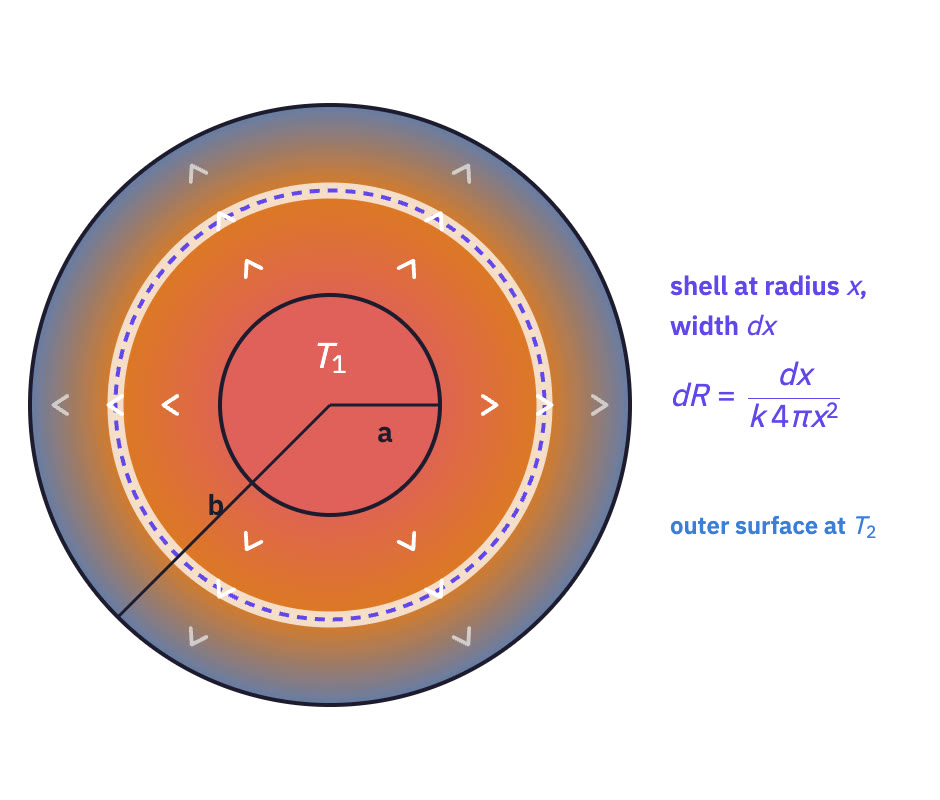
A thin shell at radius has ; the shells are in series.
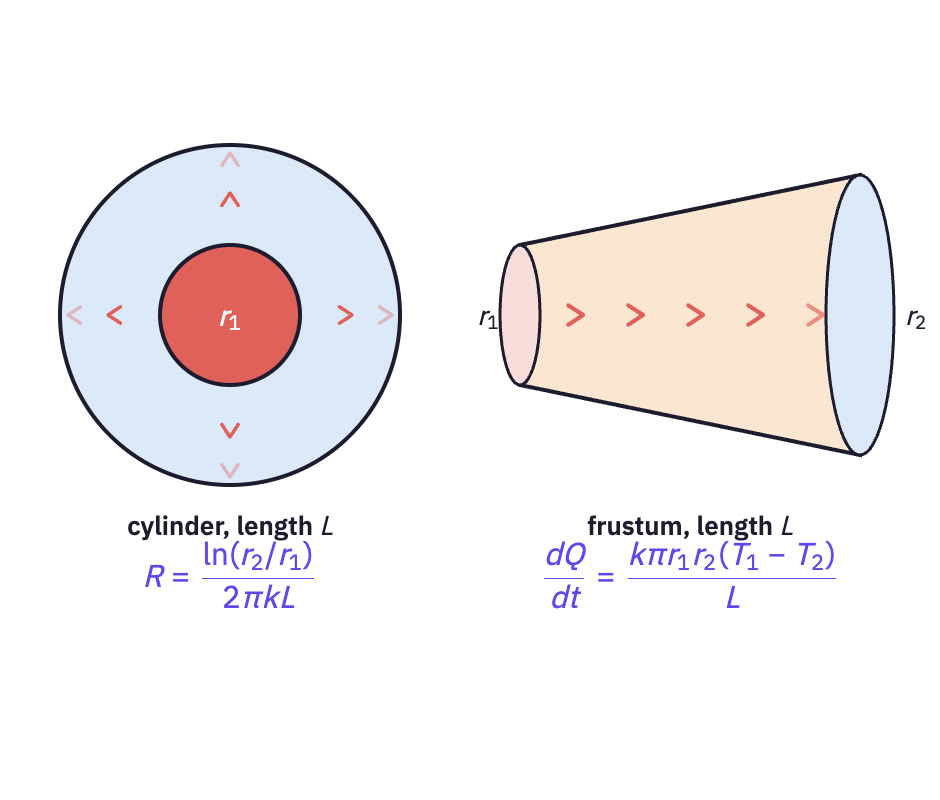
Cylinder and frustum
Cylinder: . Frustum of a cone: .
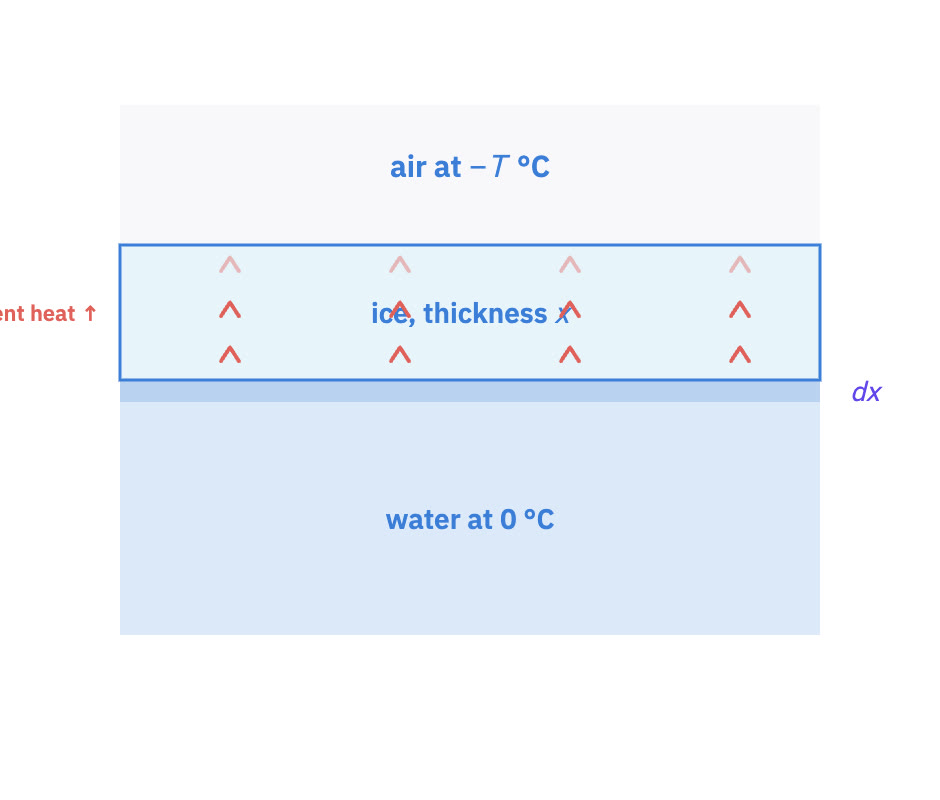
Latent heat from the freezing water is conducted up through the ice already formed, so a thicker layer grows more slowly.
Key formulas
One for every idea
1. The space between two thin concentric metallic shells of radii and is filled with a medium of conductivity . The inner shell is at , the outer at . Find the rate of heat flow outward.
- Elemental shell: .
- .
.
2. A layer of ice of thickness floats on a pond with the air at °C. Show that it takes to grow to .
- Heat through the layer in : .
- It freezes , releasing : .
- Integrate from to .
; from zero, .
Your turn
Ice on a pond grows from zero thickness to 1 cm in 4 hours (air temperature constant). The time for it to grow further from 1 cm to 2 cm is:
Show the answer and the traps
t ∝ x₂² − x₁²: 4 × (4 − 1) = 12 hours, option c.
4 hours assumes each centimetre takes the same time.
8 hours treats the time as proportional to the thickness.
And 16 hours is the total time from 0 to 2 cm, not the extra time.
Common mistakes
Try these
1. A spherical shell has inner radius 5 cm and outer radius 10 cm ( = 0.5 W m⁻¹ K⁻¹). Inside is at 100 °C, outside at 20 °C. Find the heat current.
W.
2. Ice grows from 2 cm to 4 cm in time . How long does it take to grow from 4 cm to 6 cm?
, so .
3. (Book, PE 4.1 viii) Find the heat current through a frustum of a cone of length , end radii and , ends at and (), conductivity .
.