 layrd.liveLayer by Layer
- 1. Conduction & Steady State
- 2. Thermal Conductivity
- 3. Rods in Series
- 4. Parallel & Networks
- 5. Radial Conduction & Ice
- 6. Heating Through a Rod
- 7. Convection
- 8. Radiation & Kirchhoff
- 9. Stefan's Law
- 10. Solar Constant
- 11. Newton's Cooling
- 12. Method of Cooling
- 13. Wien's Law
- 14. Planck & Kirchhoff
Bodies Heated or Cooled Through a Rod
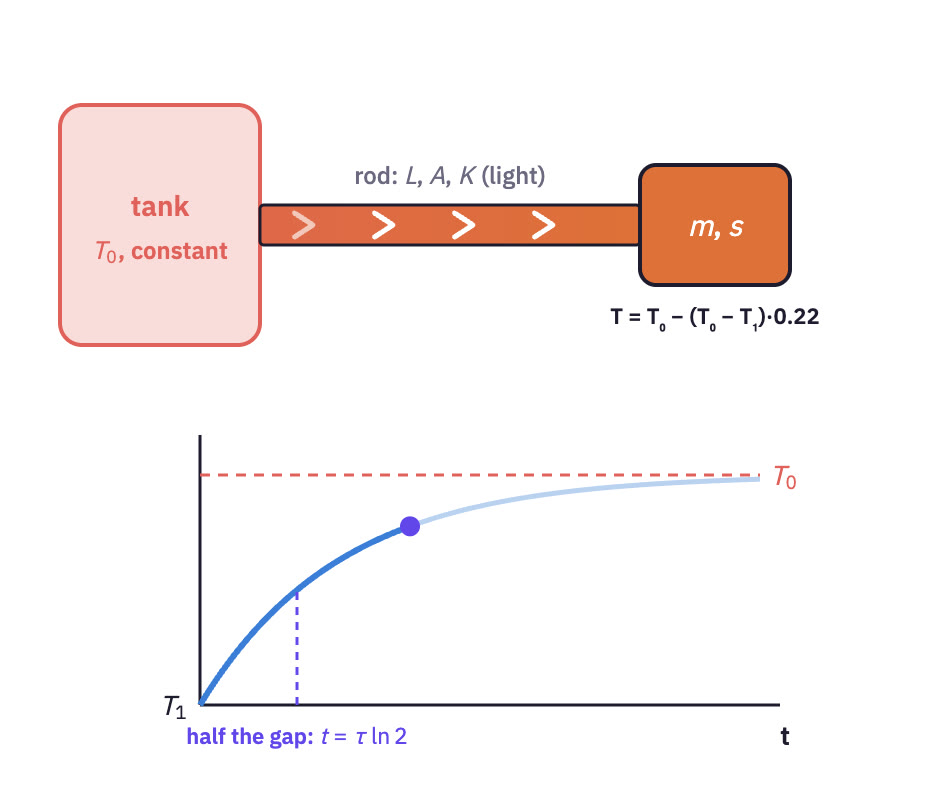
When one end of a rod is a small body, its temperature changes as heat flows. A rod with negligible heat capacity is in steady state at every instant, and the body approaches its final temperature exponentially, with a time constant equal to heat capacity × thermal resistance.
Builds on: Part 3 · Thermal Resistance and Rods in Series.
 Video coming soon
The light rod carries at each instant; the body warms as . Half the gap closes in , with .
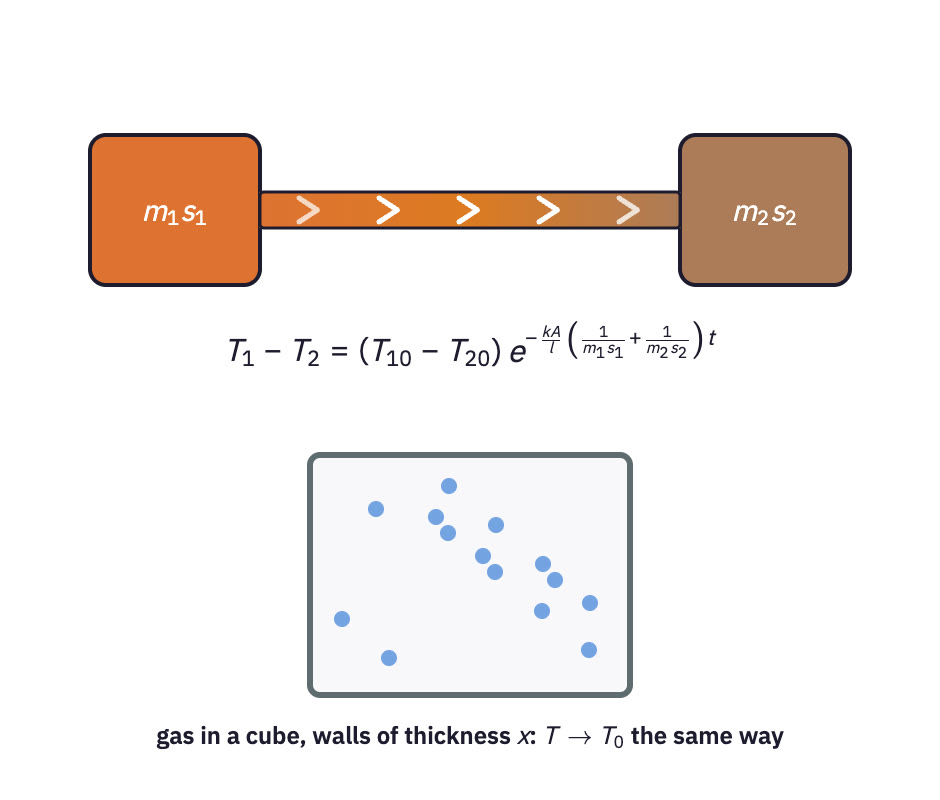
Two bodies, and a gas in a box
Two bodies joined by a rod: their temperature difference decays exponentially. A gas cooling through the walls of a cube follows the same law with .
Key formulas
One for every idea
1. A water tank at constant is joined by a metal rod (length , area , conductivity , negligible heat capacity) to a small body of mass , specific heat , at . Find the body's temperature as a function of time.
- The rod is always in steady state: .
- .
- .
.
Your turn
A small body is heated by a tank at constant temperature through a rod of negligible heat capacity. If the rod is replaced by one of the same material and area but twice the length, the time for the body to cover half its initial temperature gap to the tank:
Show the answer and the traps
The exponent is KAt/(msL): doubling L doubles every time. It doubles, option c.
Halving would need a shorter, better rod. A longer rod resists more.
Staying the same would mean the rod doesn't matter, but it sets the time constant.
And 4 times would need L squared; the time constant is simply proportional to L.
Common mistakes
Try these
1. A body at 20 °C is joined by a light rod to a tank at 80 °C; the time constant is 5 min. Find its temperature after 5 min.
°C.
2. Two blocks, each of heat capacity , are joined by a rod of thermal resistance . Find the time constant of their temperature difference.
, so .
3. (Book, PE 4.1 iv) A closed cylinder 10 cm high with base area 10 cm² holds water at 50 °C; its ends are metal discs 1 mm thick ( = 200 W m⁻¹ °C⁻¹), the walls insulating, the surroundings 20 °C. How long for the water to cool by 1 °C?
Two discs, total area m²: W; water 0.1 kg × 4200 = 420 J/°C, so s.