 layrd.liveLayer by Layer
- 1. Conduction & Steady State
- 2. Thermal Conductivity
- 3. Rods in Series
- 4. Parallel & Networks
- 5. Radial Conduction & Ice
- 6. Heating Through a Rod
- 7. Convection
- 8. Radiation & Kirchhoff
- 9. Stefan's Law
- 10. Solar Constant
- 11. Newton's Cooling
- 12. Method of Cooling
- 13. Wien's Law
- 14. Planck & Kirchhoff
Newton's Law of Cooling
For a body only a little warmer than its surroundings, Stefan's law simplifies: , so the rate of cooling is proportional to the temperature difference. That is Newton's law of cooling, with an exact exponential form and a handy average form.
Builds on: Part 9 · Stefan–Boltzmann Law and Net Radiation.
 Video coming soon
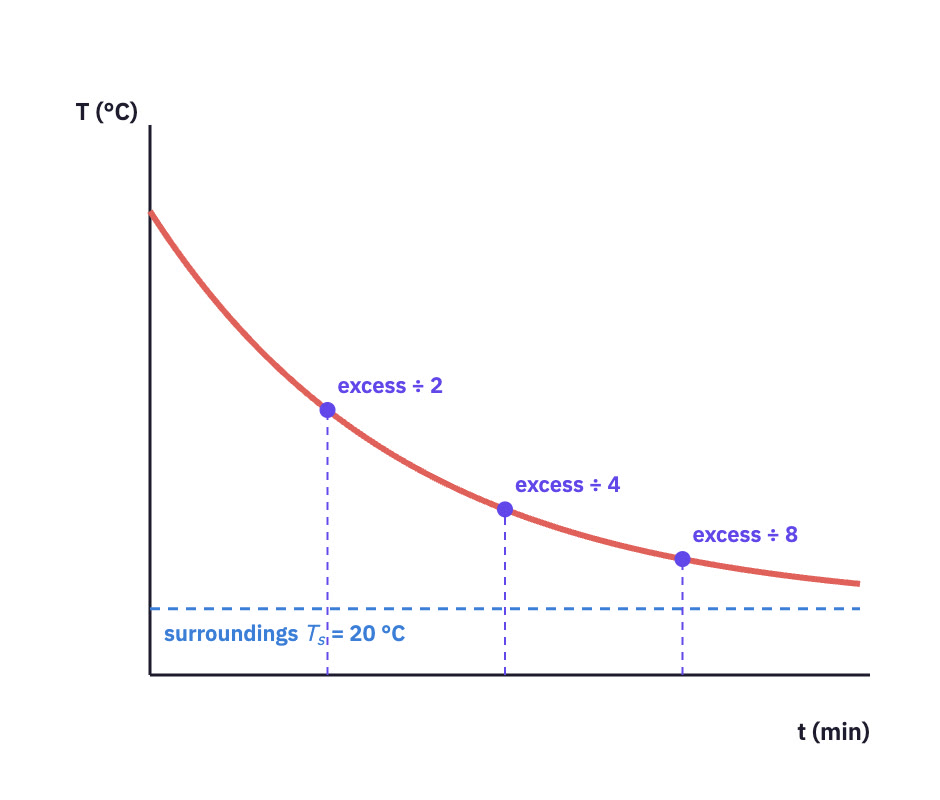
Integrated: . The excess temperature halves in equal time intervals.
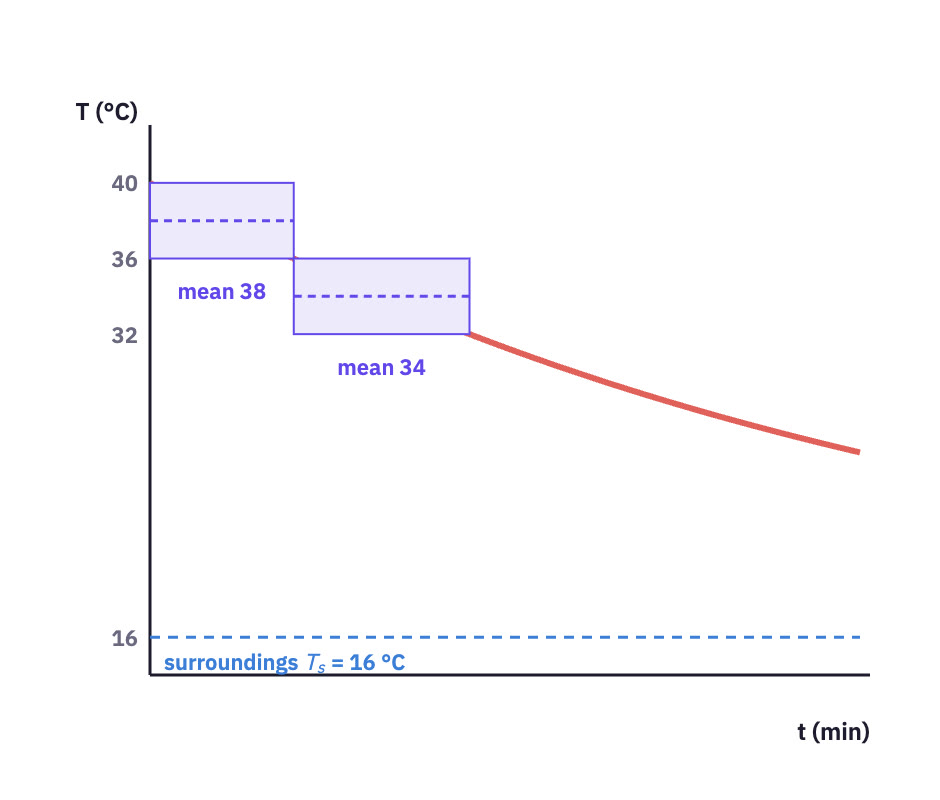
Use the mean temperature
Over a small drop, . The same drop takes longer at a lower temperature.
Key formulas
One for every idea
1. The excess temperature of a hot body above its surroundings is halved in 10 minutes. In what time will it be 1/10 of its initial value? Assume Newton's law of cooling.
- ; halving in 10 min gives per min.
- .
min.
2. In surroundings at 16 °C a body cools from 40 °C to 36 °C in 5 minutes. Find the time it takes to cool from 36 °C to 32 °C.
- per min.
- .
min. (The book rounds to 0.036 and prints 6.17 min; its Practice Exercise 4.3 (i), the same problem, gives 6.11 min.)
3. Water at 50 °C cools to 45 °C in 5 minutes and to 40 °C in the next 8 minutes. Find the surrounding temperature.
- and .
- Divide: .
°C.
Your turn
A body in a room at 20 °C cools from 60 °C to 50 °C in 10 minutes. Assuming Newton's law of cooling, the time it takes to cool from 50 °C to 40 °C is:
Show the answer and the traps
10/10 = k(55 − 20), so k = 1/35. Then 10/t = (45 − 20)/35, and t = 14 minutes: option b.
10 minutes assumes equal drops take equal times.
13.3 minutes uses the starting temperatures instead of the means.
And 7.1 minutes turns the ratio upside down.
Common mistakes
Try these
1. In a room at 20 °C a body cools from 70 °C to 60 °C in 6 minutes. Find the cooling constant (average form).
per min.
2. The excess temperature of a body falls from 40 °C to 20 °C in 8 minutes. How long does it take to fall from 20 °C to 10 °C?
Excess halves in equal times: 8 minutes.
3. Why does Newton's law of cooling fail for a red-hot iron bar in a room?
Its temperature difference is not small; use Stefan's law.
4. (Book, PE 4.3 i) A body cools from 40 °C to 36 °C in 5 minutes in surroundings at 16 °C. When will it reach 32 °C?
About 6.11 min later (average form).
5. (Book, PE 4.3 ii) A body cools from 80 °C to 64 °C in 5 minutes and to 52 °C in the next 5 minutes. Find its temperature after another 5 minutes and the surrounding temperature.
Equal intervals multiply the excess by the same factor: °C; factor 0.75, so °C.
6. (Book, PE 4.3 iii) The excess temperature of a body is halved in 10 minutes. When will it be 1/10 of its initial value?
min.