 layrd.liveLayer by Layer
- 1. Conduction & Steady State
- 2. Thermal Conductivity
- 3. Rods in Series
- 4. Parallel & Networks
- 5. Radial Conduction & Ice
- 6. Heating Through a Rod
- 7. Convection
- 8. Radiation & Kirchhoff
- 9. Stefan's Law
- 10. Solar Constant
- 11. Newton's Cooling
- 12. Method of Cooling
- 13. Wien's Law
- 14. Planck & Kirchhoff
Black-Body Spectrum and Wien's Law
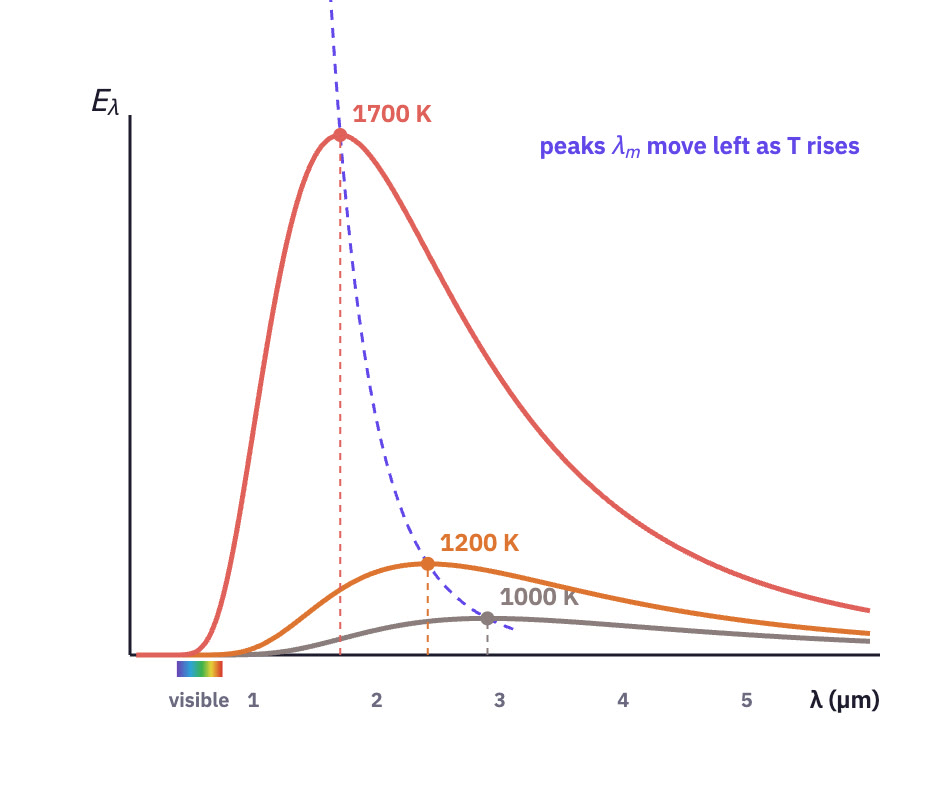
A hot body emits over a whole spectrum of wavelengths. The area under its curve is , the peak moves to shorter wavelength as (Wien's displacement law), and the peak height grows as .
Builds on: Part 9 · Stefan–Boltzmann Law and Net Radiation.
 Video coming soon
Curves at 1000, 1200 and 1700 K from Planck's law: hotter curves are higher at every wavelength and peak at shorter . m K (standard value 2.898 × 10⁻³).
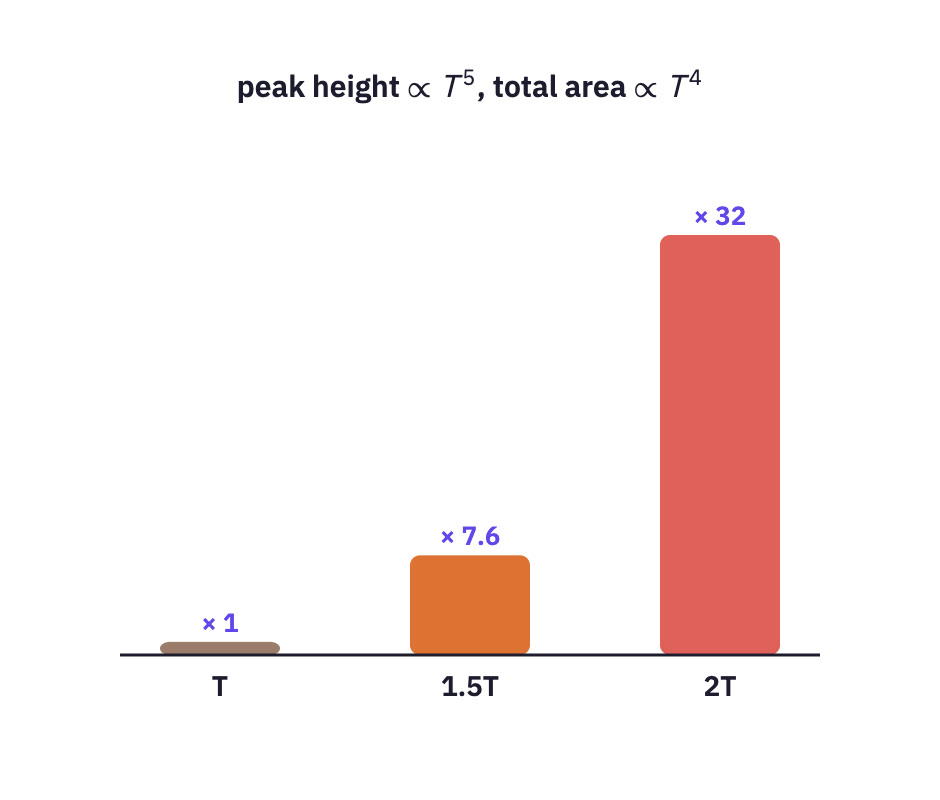
Peak ∝
The maximum spectral emittance grows as , while the total power grows as .
Key formulas
One for every idea
1. Two black bodies are at and . How do their total emitted powers per unit area compare?
- Total power = area under the curve = .
; the hotter curve peaks at a shorter wavelength.
2. A black body at 1500 K emits maximum energy at 20 000 Å. The Sun emits maximum energy at 5500 Å. Find the Sun's temperature.
- : .
K.
3. A 100 W bulb filament of area 0.25 cm² behaves as a perfect black body. Find the wavelength of its peak emission ( = 2.89 × 10⁻³ m K).
- W/m².
- K.
Å, in the infrared.
4. A body emits maximum energy at 4253 Å at one temperature and at 2342 Å at another. Find the ratio of the maximum spectral emittances.
- .
.
Your turn
The Sun (surface ≈ 5800 K) has its peak emission near 500 nm. A star has its peak emission at 290 nm. Treating both as black bodies, the star's surface temperature is about:
Show the answer and the traps
λm T is constant: T = 5800 × 500/290 = 10 000 K, option b.
3364 K multiplies by the wrong ratio: λm goes as 1/T.
17 241 K squares the ratio.
And 5800 K ignores the shift: a different peak means a different temperature.
Common mistakes
Try these
1. A star's spectrum peaks at 350 nm. Estimate its surface temperature ( = 2.89 × 10⁻³ m K).
K.
2. The absolute temperature of a black body doubles. What happens to its peak wavelength and its peak spectral emittance?
halves; the peak height rises 32 times.
3. (Book, PE 4.4 i) The Sun's spectrum peaks at 4753 Å at 6050 K. Find the temperature of a star whose spectrum peaks at 9506 Å.
K.
4. (Book, PE 4.4 iii) A furnace is at 2000 K. At what wavelength does it emit most intensely?
Å.
5. (Book, PE 4.4 v) A black body's radiant emittance is 250 kW/m². Find its peak wavelength ( = 2.9 × 10⁻³ m K, = 5.67 × 10⁻⁸).
K, Å (the book prints 19 944.7 Å).