 layrd.liveLayer by Layer
- 1. Inductive Effect
- 2. Carboxylic Acid Strength
- 3. Alcohols, Hydrocarbons, Amines
- 4. Electromeric & Mesomeric
- 5. Hyperconjugation
- 6. Fission & Free Radicals
- 7. Carbocations
- 8. Carbanions
- 9. Carbenes
- 10. Nitrenes & Benzyne
- 11. Electrophiles & Nucleophiles
- 12. Reaction Types
- 13. Free Radical Substitution
- 14. SN2 Reaction
- 15. SN1 Reaction
- 16. SN1 vs SN2
- 17. Electrophilic Substitution
- 18. Markovnikov's Rule
- 19. Br₂ Addition & Dienes
- 20. Peroxide Effect
- 21. Nucleophilic Addition
- 22. E1, E1cB & Saytzeff
- 23. E2 Elimination
Inductive Effect: −I and +I Groups
A polar σ bond doesn't keep its polarity to itself: the δ+ carbon pulls on its neighbour, which pulls on the next, with the charge shrinking at every step. This permanent, short-range relay is the inductive effect, and comparing groups with hydrogen gives the −I and +I series used throughout the chapter.
 Video coming soon
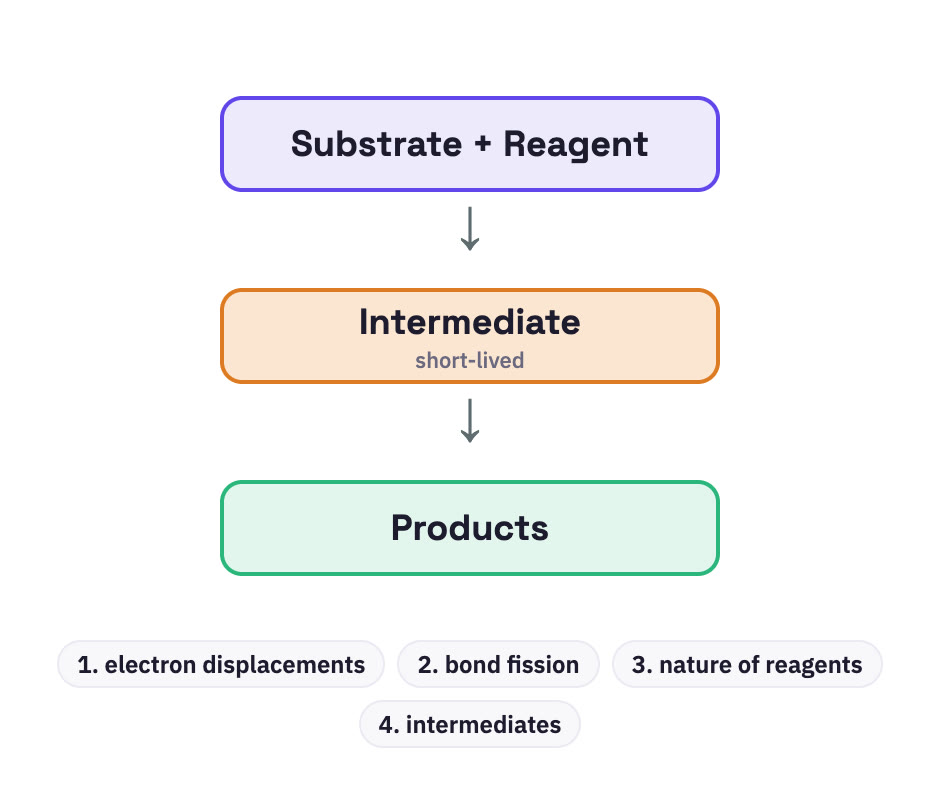
Substrate + reagent → intermediate → products
The reagent attacks the substrate. Most reactions pass through short-lived intermediates, and the step-by-step path is the mechanism. Positive reagents attack electron-rich sites, negative reagents electron-poor ones.
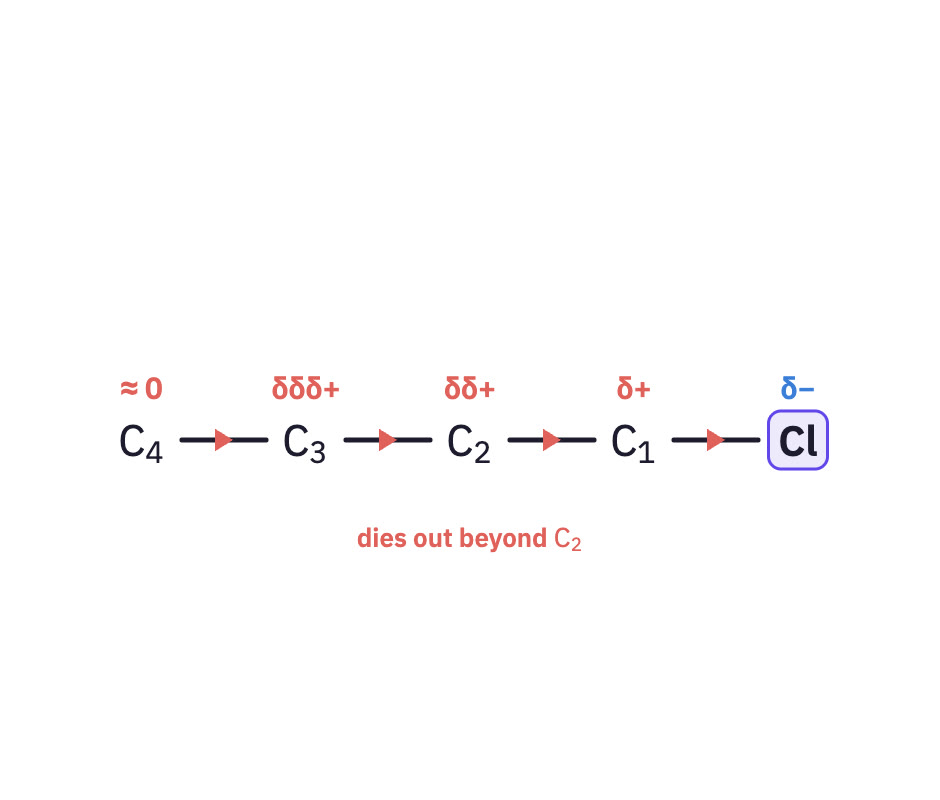
δ+ relayed along the chain
Chlorine pulls the C–Cl σ pair: C₁ becomes δ+, C₂ a smaller δδ+, C₃ smaller still. Beyond the second carbon the effect is negligible. The arrowhead in the middle of each bond shows the direction of the pull.
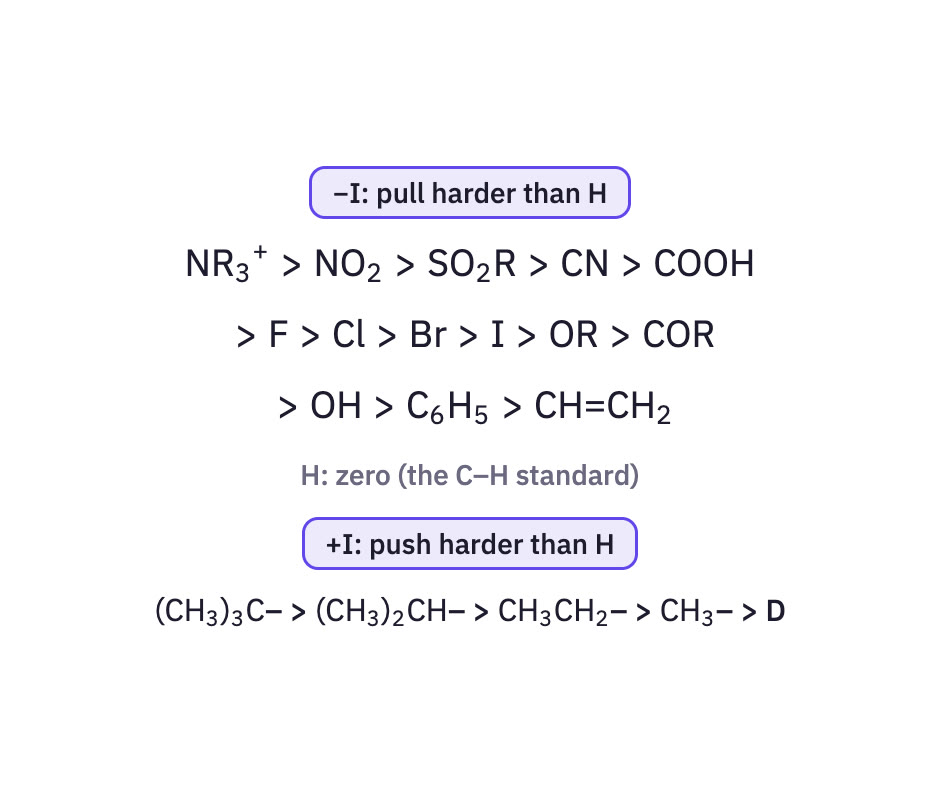
−I and +I groups
The C–H bond is the standard. Groups that pull harder than H are −I (electron-withdrawing); groups that push harder are +I (electron-releasing). Phenyl and vinyl are weakly −I because an sp² carbon is more electronegative.
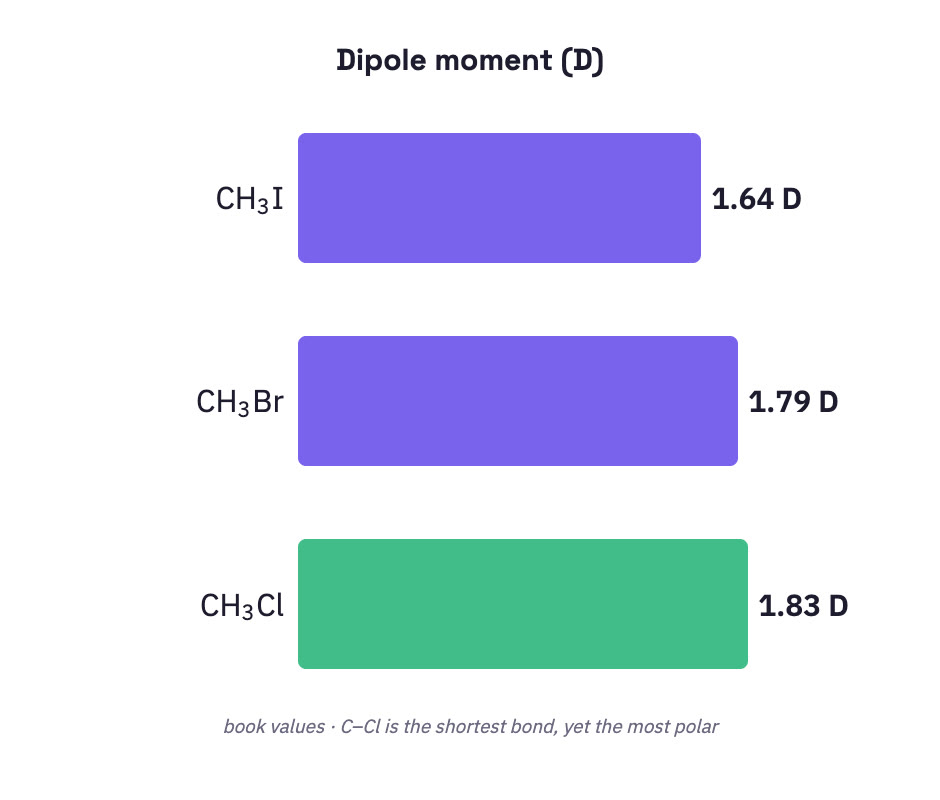
Dipole moments of methyl halides
CH₃I 1.64 D < CH₃Br 1.79 D < CH₃Cl 1.83 D (book values). C–Cl is the shortest of the three bonds, yet the most polar: the charge separation decides.
Key formulas
One for every idea
1. In , name the substrate and the reagent, and the site of attack.
- is the species attacked: the substrate.
- does the attacking: the reagent.
- A negative reagent attacks an electron-poor site: the carbon bonded to Cl.
Substrate , reagent , attacking the δ+ carbon.
2. In 1-bromopropane, which carbon carries the largest partial positive charge, and roughly how much does C₃ feel the bromine?
- C₁ is bonded to Br, which pulls the σ pair: C₁ gets δ+.
- C₂ receives a smaller δδ+ by relay through the C₁–C₂ bond.
- The effect is negligible beyond the second carbon.
C₁ carries the largest δ+; C₃ feels almost nothing.
3. Arrange –CN, –F, –OH and –C₆H₅ in decreasing order of −I effect.
- Read the −I series: NR₃⁺ > NO₂ > SO₂R > CN > COOH > F > Cl > Br > I > OR > COR > OH > C₆H₅ > CH=CH₂ > H.
–CN > –F > –OH > –C₆H₅.
4. Which releases electrons more strongly by the inductive effect: an isopropyl group or an ethyl group? Why?
- +I grows with the number of methyl groups on the attached carbon.
- (CH₃)₂CH– has two; CH₃CH₂– has one.
Isopropyl is the stronger +I group.
5. Explain why chloromethane reacts with a negatively charged reagent while methane does not.
- In CH₃Cl the C–Cl bond is polarised: C δ+, Cl δ−.
- The δ+ carbon is a low-electron-density site that attracts the negative reagent.
- Methane's C–H bonds are almost non-polar, so it has no such site.
Only CH₃Cl has an electron-poor (δ+) carbon for the reagent to attack.
Your turn
Which group has the strongest −I effect?
Show the answer and the traps
–NO₂, option b. It is near the very top of the −I series, just below –NR₃⁺.
–F is the strongest halogen, but it comes after NO₂, CN and COOH.
–CN is strong, but it sits below –NO₂.
And –COOH sits below –CN.
Common mistakes
Try these
1. Which group has zero inductive effect by definition? (a) –CH₃ (b) –H (c) –Cl (d) –C₆H₅
(b) –H: the C–H bond is the standard against which −I and +I are measured.
2. Arrange in decreasing −I effect: –Cl, –NO₂, –COOH, –I.
–NO₂ > –COOH > –Cl > –I.
3. Arrange in decreasing +I effect: –CH₃, –C(CH₃)₃, –CH(CH₃)₂, –H.
–C(CH₃)₃ > –CH(CH₃)₂ > –CH₃ > –H (more methyls on the attached carbon, stronger +I).
4. Why is the effect of a chlorine atom on a carbon chain negligible beyond the second carbon?
Each carbon passes on only part of the pull it feels, so the charges shrink quickly: δ+ > δδ+ > δδδ+.
5. CH₃Cl has a larger dipole moment than CH₃I although the C–I bond is longer. Explain.
Cl is much more electronegative than I, so the charge separation in C–Cl is far greater; that outweighs the shorter bond (1.83 D vs 1.64 D).