 layrd.liveLayer by Layer
- 1. Inductive Effect
- 2. Carboxylic Acid Strength
- 3. Alcohols, Hydrocarbons, Amines
- 4. Electromeric & Mesomeric
- 5. Hyperconjugation
- 6. Fission & Free Radicals
- 7. Carbocations
- 8. Carbanions
- 9. Carbenes
- 10. Nitrenes & Benzyne
- 11. Electrophiles & Nucleophiles
- 12. Reaction Types
- 13. Free Radical Substitution
- 14. SN2 Reaction
- 15. SN1 Reaction
- 16. SN1 vs SN2
- 17. Electrophilic Substitution
- 18. Markovnikov's Rule
- 19. Br₂ Addition & Dienes
- 20. Peroxide Effect
- 21. Nucleophilic Addition
- 22. E1, E1cB & Saytzeff
- 23. E2 Elimination
SN2 Reaction: Mechanism, Walden Inversion and Rates
In an SN2 reaction the nucleophile attacks carbon from the side opposite the leaving group, in a single step through a five-coordinate transition state, and the configuration inverts like an umbrella in the wind (Walden inversion). Because both reactants are in that one step, Rate = k[RX][Nu⁻], and the rate depends on how crowded the carbon is, how strong the nucleophile is, how good the leaving group is, and whether the solvent cages the nucleophile.
Builds on: Part 11 · Electrophiles, Nucleophiles and Ambident Reagents, Part 13 · Free Radical Substitution: Chlorination of Methane and NBS.
 Video coming soon
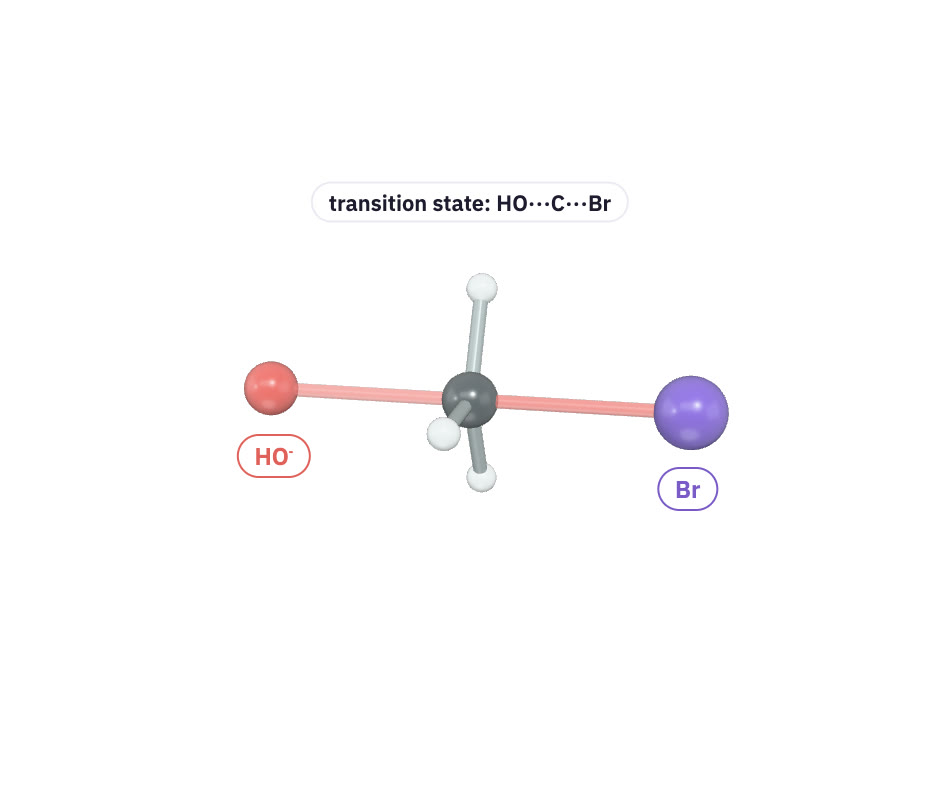
Backside attack
approaches from the back; in the transition state carbon is partly bonded to both, and the three other groups lie in a plane before flipping.
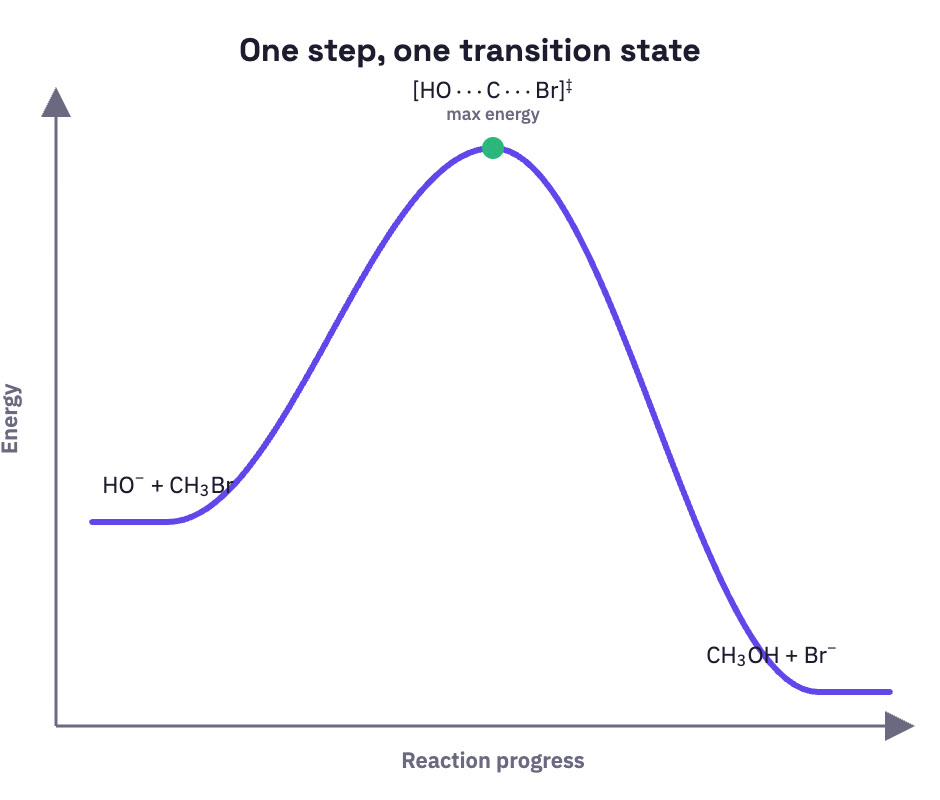
One transition state
Rate : bimolecular, second order. The transition state has the maximum energy and minimum stability; there is no intermediate.
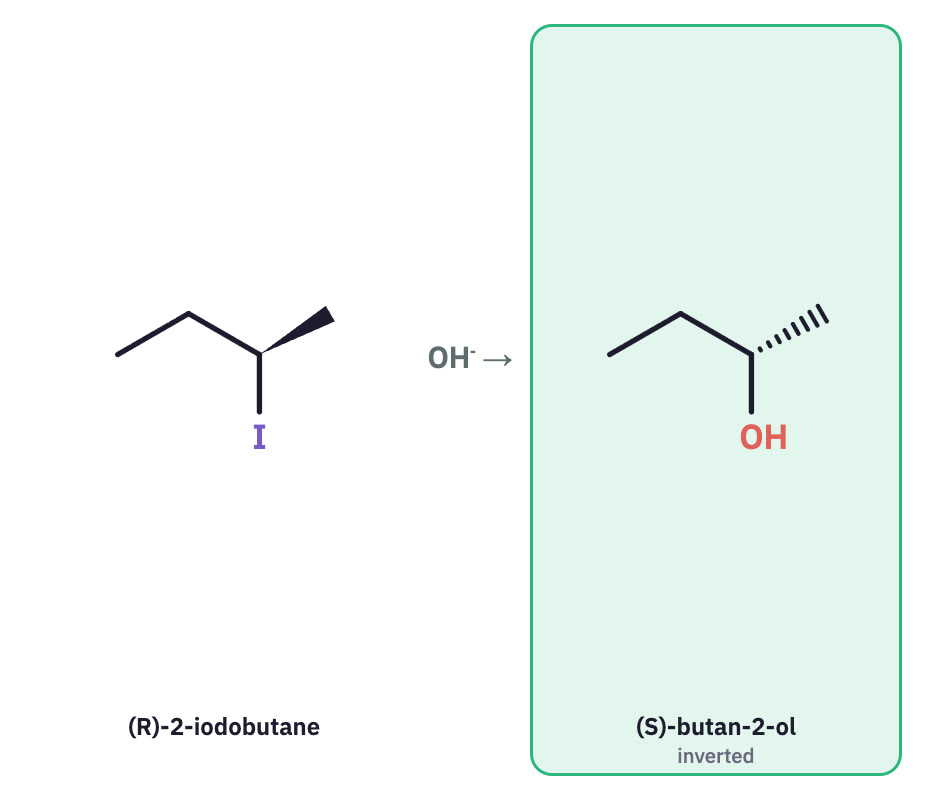
(R)-2-Iodobutane → (S)-butan-2-ol
Backside attack inverts the centre; OH takes the top CIP priority that I had, so the label flips from R to S. (−)-2-Bromooctane gives (+)-octan-2-ol in the same way.
Room at the back of carbon
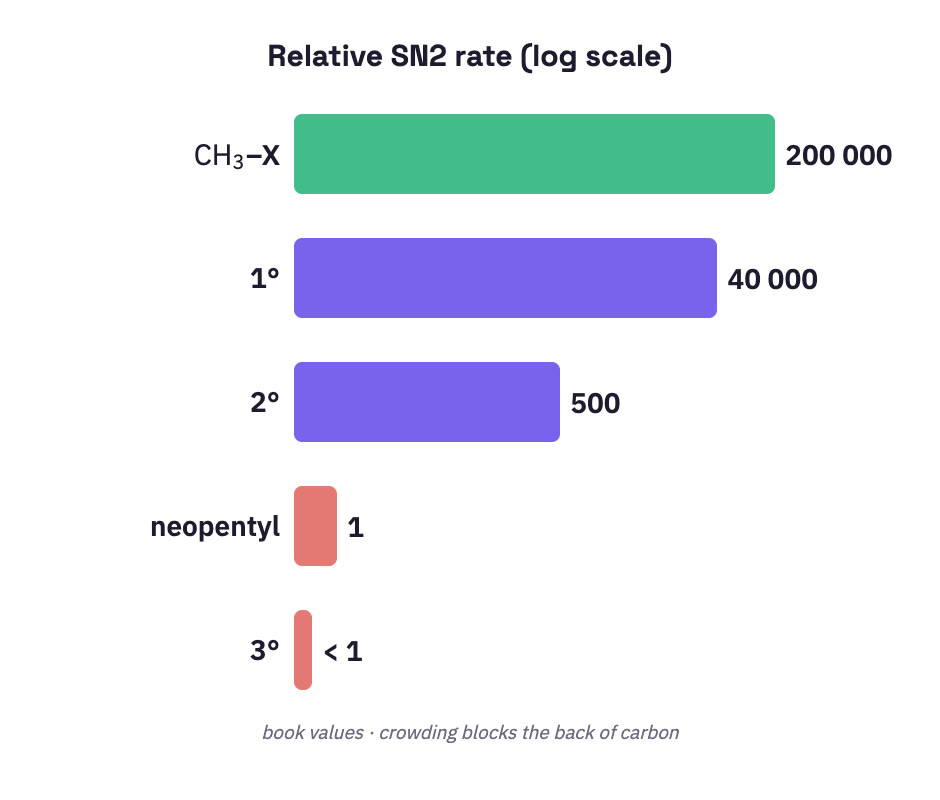
Relative rates (book): 200 000, 1° 40 000, 2° 500, neopentyl 1, 3° < 1. Bulk on the β-carbon (neopentyl) slows SN2 as much as a 3° centre.
Activated carbons
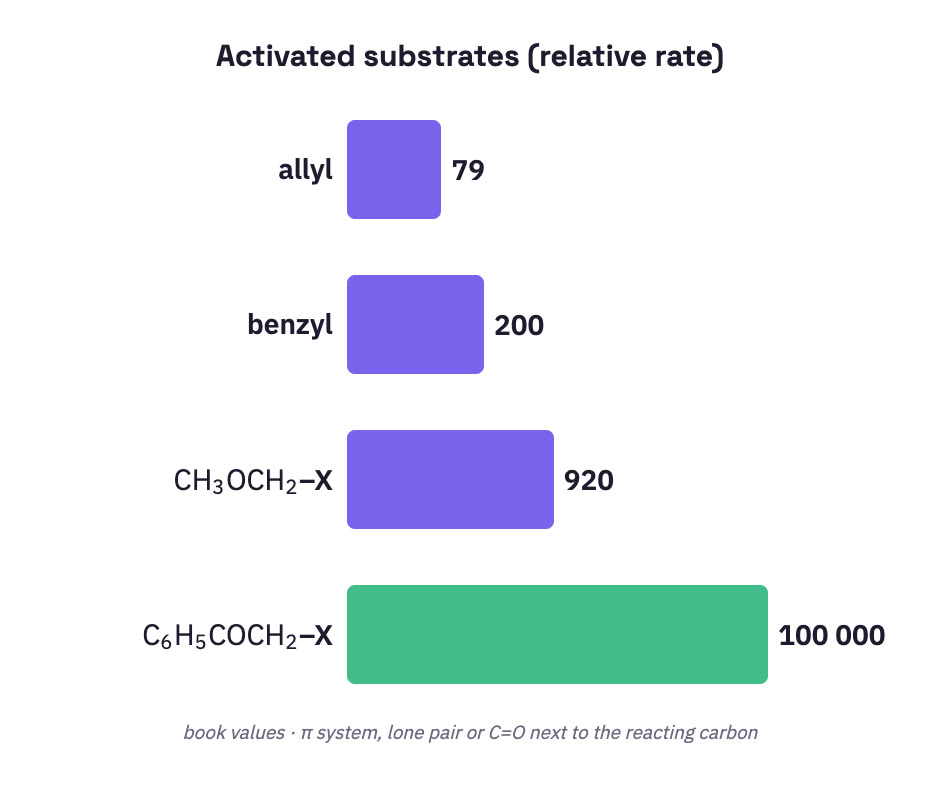
Allyl 79, benzyl 200, 920, 100 000: a π system, an α-heteroatom lone pair or an α-C=O stabilises the transition state.
Relative rates with CH₃Br
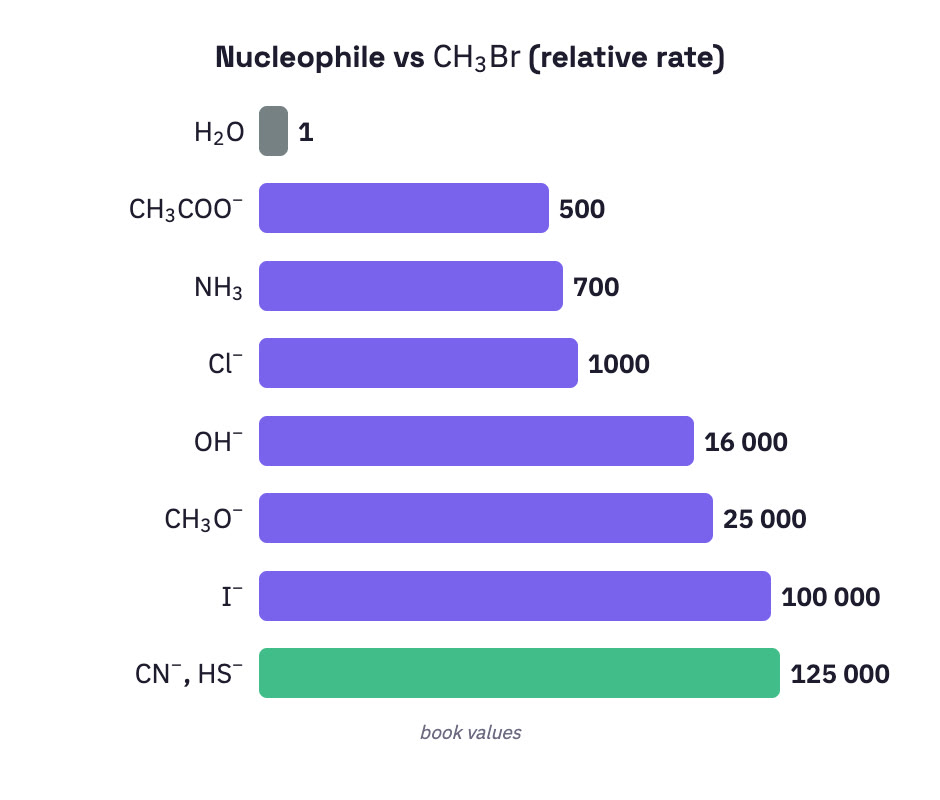
1, 500, 700, 1000, 16 000, 25 000, 100 000, and 125 000.
Weak bases leave best
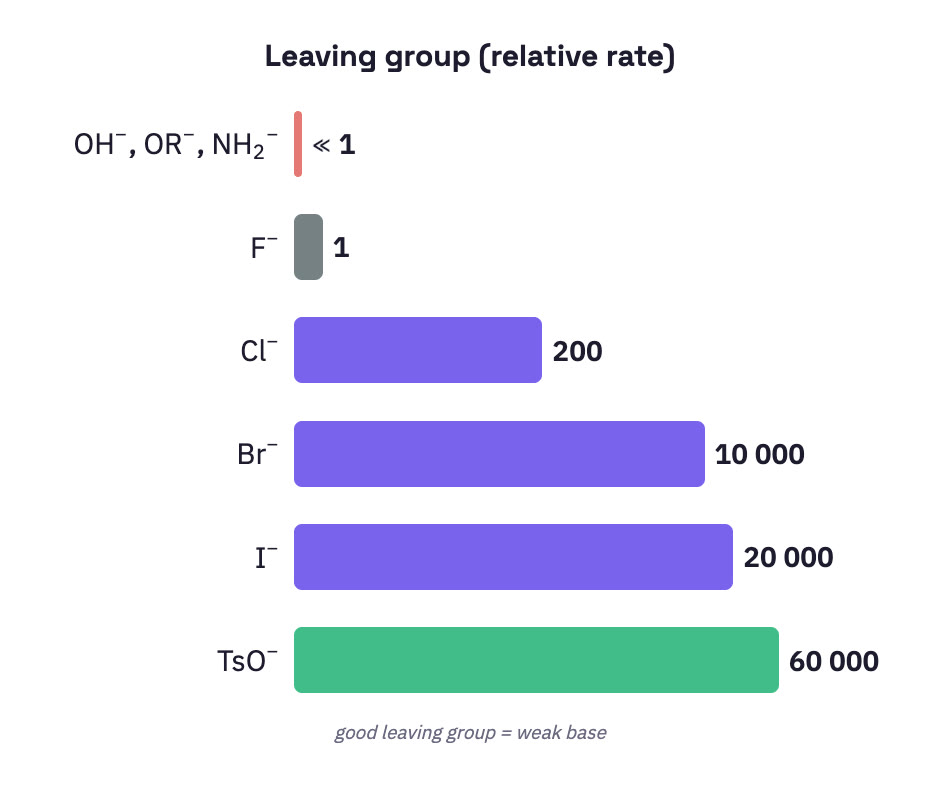
1, 200, 10 000, 20 000, 60 000; , , ≪ 1, so RF, ROH, ROR and do not undergo SN2.
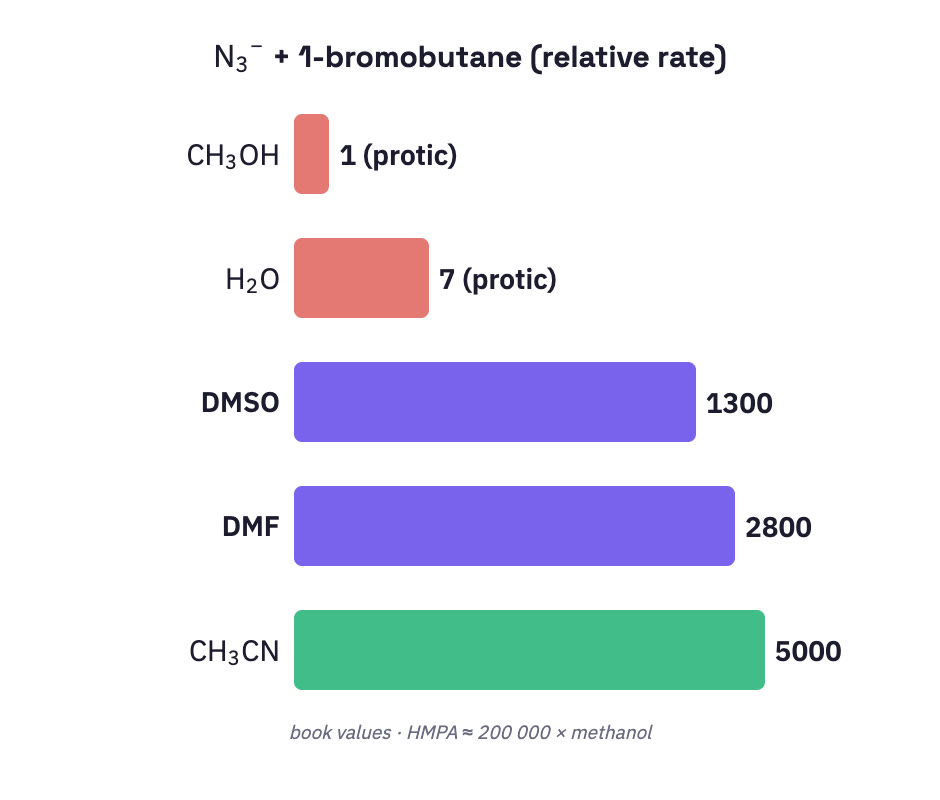
Polar aprotic solvents
+ 1-bromobutane: 1, 7, DMSO 1300, DMF 2800, 5000; HMPA ≈ 200 000 × methanol. Protic solvents cage the nucleophile by hydrogen bonding; polar aprotic solvents leave it bare. Neopentyl bromide reacts by SN2 with ethoxide but by SN1 in ethanol.
Key formulas
One for every idea
1. (R)-2-Iodobutane reacts with NaOH under conditions. Give the configuration of the butan-2-ol formed, and say what happens to the rate when is doubled.
- Backside attack inverts the centre; OH takes the priority rank I had, so the label flips.
- Rate .
(S)-Butan-2-ol; the rate doubles.
2. Using the relative rates 1° = 40 000 and 2° = 500, how many times faster does a primary bromide react by than a secondary one? Explain the difference.
- 40 000 / 500 = 80.
- The extra alkyl group on the secondary carbon blocks the backside approach and crowds the five-coordinate transition state.
80 times faster.
3. Which conditions give the fastest reaction of 1-chloropropane: (a) NaI in acetone, (b) NaF in water, (c) alone? Give reasons.
- is a strong nucleophile and acetone (polar aprotic) leaves it unsolvated.
- is heavily hydrogen-bonded in water; neutral water is the weakest nucleophile.
(a) NaI in acetone.
Your turn
In which solvent is the SN2 reaction of azide ion with 1-bromobutane fastest?
Show the answer and the traps
CH₃CN, option d: relative rate 5000.
Methanol, rate 1: protic, it cages N₃⁻.
Water, rate 7: also protic.
DMSO, 1300: polar aprotic, but slower than acetonitrile here.
Common mistakes
Try these
1. Which alkyl bromide reacts fastest with NaCN in DMSO? (a) (b) (c) (d)
(c) : least hindered (neopentyl is very slow).
2. Why does not react with by SN2, while + HBr gives ?
is a very poor leaving group; in HBr the O is protonated and leaves as , a good leaving group.
3. How does the rate of an SN2 reaction change if both [RX] and [Nu⁻] are doubled?
It becomes four times as fast (Rate = k[RX][Nu⁻]).
4. Arrange in decreasing SN2 reactivity: 2-bromopropane, bromomethane, 1-bromopropane, 2-bromo-2-methylpropane.
Bromomethane > 1-bromopropane > 2-bromopropane > 2-bromo-2-methylpropane.
5. Why is (phenacyl bromide) far more reactive towards SN2 than ?
The adjacent C=O stabilises the transition state (relative rate about 100 000).
6. Which reacts faster with in DMF: or ? And in methanol?
In DMF (aprotic) can be faster (stronger base, unsolvated); in methanol is faster ( is caged).