 layrd.liveLayer by Layer
- 1. Inductive Effect
- 2. Carboxylic Acid Strength
- 3. Alcohols, Hydrocarbons, Amines
- 4. Electromeric & Mesomeric
- 5. Hyperconjugation
- 6. Fission & Free Radicals
- 7. Carbocations
- 8. Carbanions
- 9. Carbenes
- 10. Nitrenes & Benzyne
- 11. Electrophiles & Nucleophiles
- 12. Reaction Types
- 13. Free Radical Substitution
- 14. SN2 Reaction
- 15. SN1 Reaction
- 16. SN1 vs SN2
- 17. Electrophilic Substitution
- 18. Markovnikov's Rule
- 19. Br₂ Addition & Dienes
- 20. Peroxide Effect
- 21. Nucleophilic Addition
- 22. E1, E1cB & Saytzeff
- 23. E2 Elimination
Electrophilic Addition: Markovnikov's Rule and Rearrangements
Electrophiles add to C=C in two steps: the electrophile bonds first and leaves a carbocation (slow), then the nucleophile captures it (fast). Because H⁺ adds so as to give the more stable carbocation, the negative part of an unsymmetrical reagent ends up on the carbon with fewer hydrogens: Markovnikov's rule. Before capture, the carbocation may rearrange by a 1,2-hydride, methyl or phenyl shift.
Builds on: Part 7 · Carbocations: Structure and Stability, Part 11 · Electrophiles, Nucleophiles and Ambident Reagents.
 Video coming soon
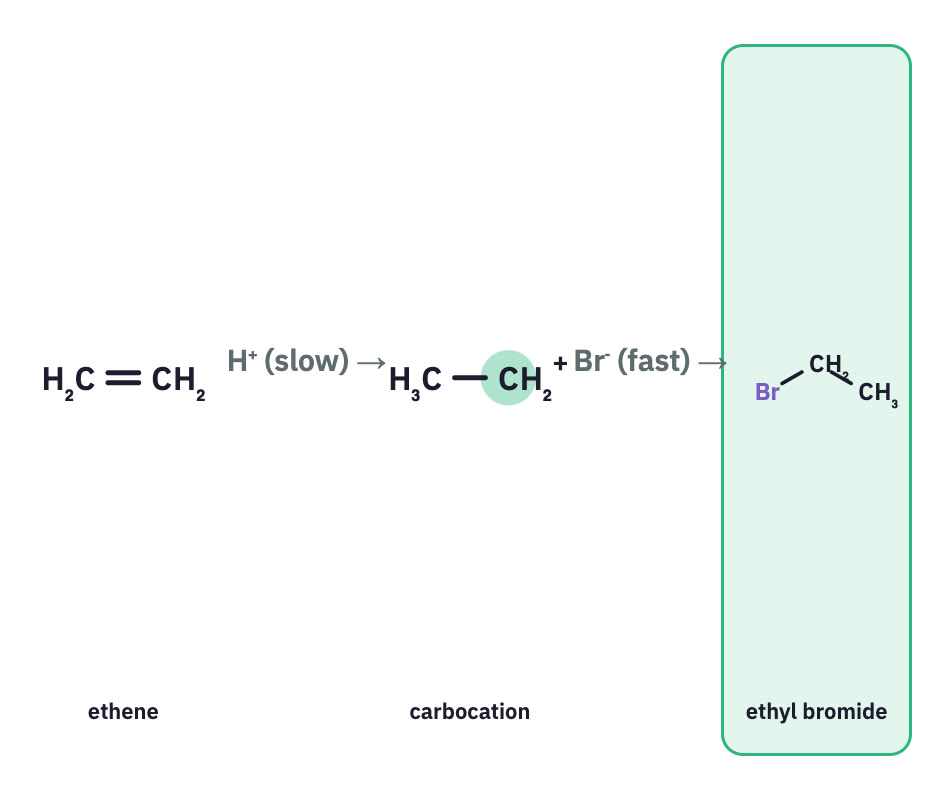
HBr on ethene
Step 1 (slow): . Step 2 (fast): . Reactivity: HI > HBr > HCl; . C=C and C≡C are attacked by electrophiles; C=O and C≡N by nucleophiles.
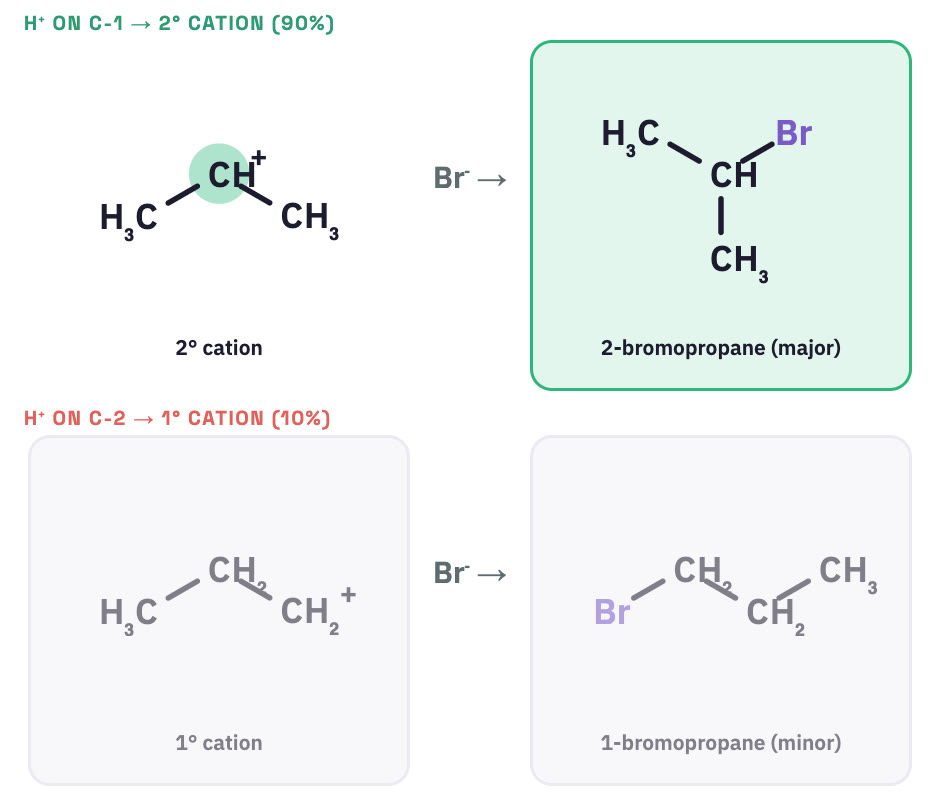
Why 2-bromopropane wins
H⁺ on C-1 gives a 2° cation; on C-2 it would give a 1° cation. Propene + HBr: isopropyl bromide 90 %, n-propyl bromide 10 %. When both carbons carry one H (pent-2-ene), both cations are 2° and a mixture forms.
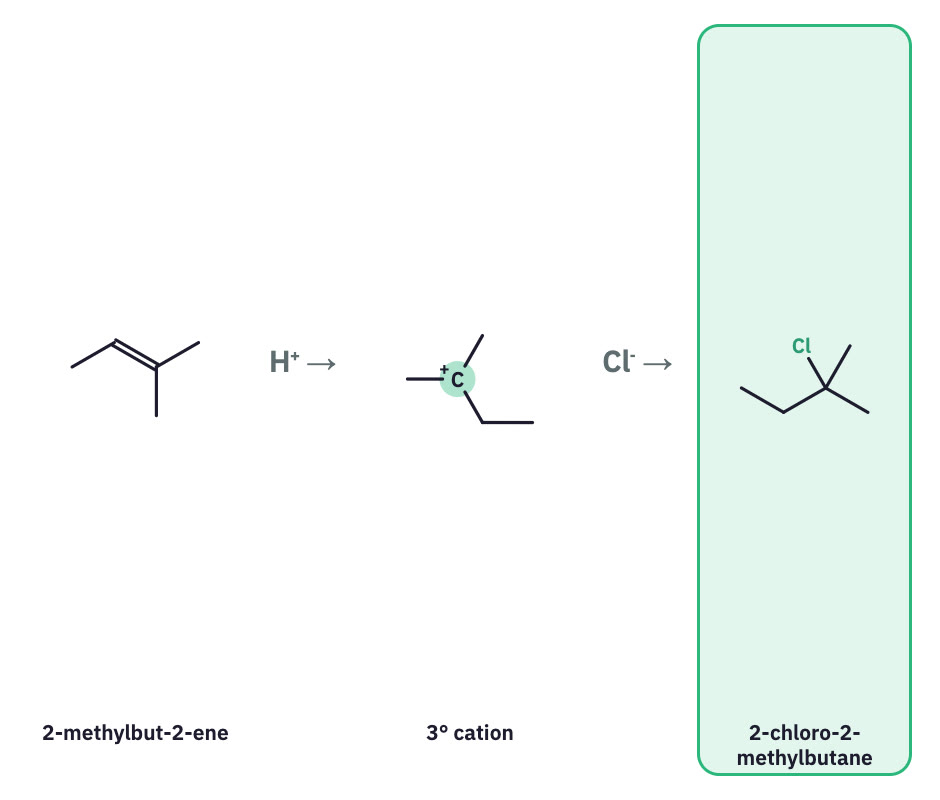
2-Methylbut-2-ene + HCl
H⁺ on C-3 gives the 3° cation ; chloride captures it: 2-chloro-2-methylbutane.
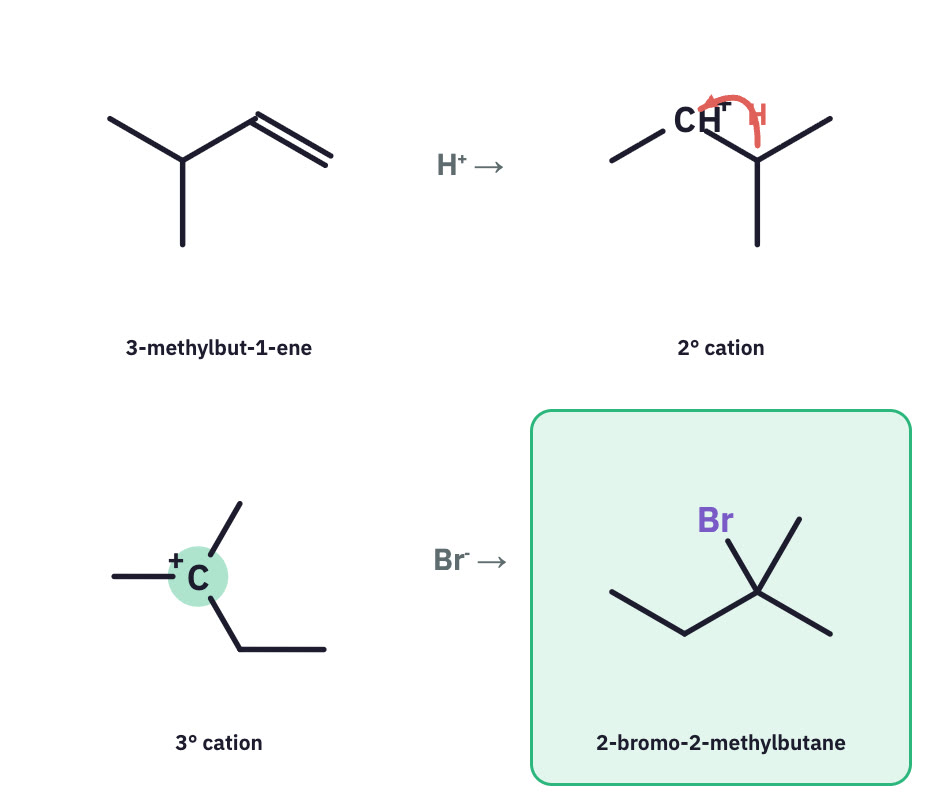
A 1,2-hydride shift
3-Methylbut-1-ene + HBr: the 2° cation takes a hydride from C-3 and becomes 3°, giving mainly 2-bromo-2-methylbutane (with some 2-bromo-3-methylbutane).
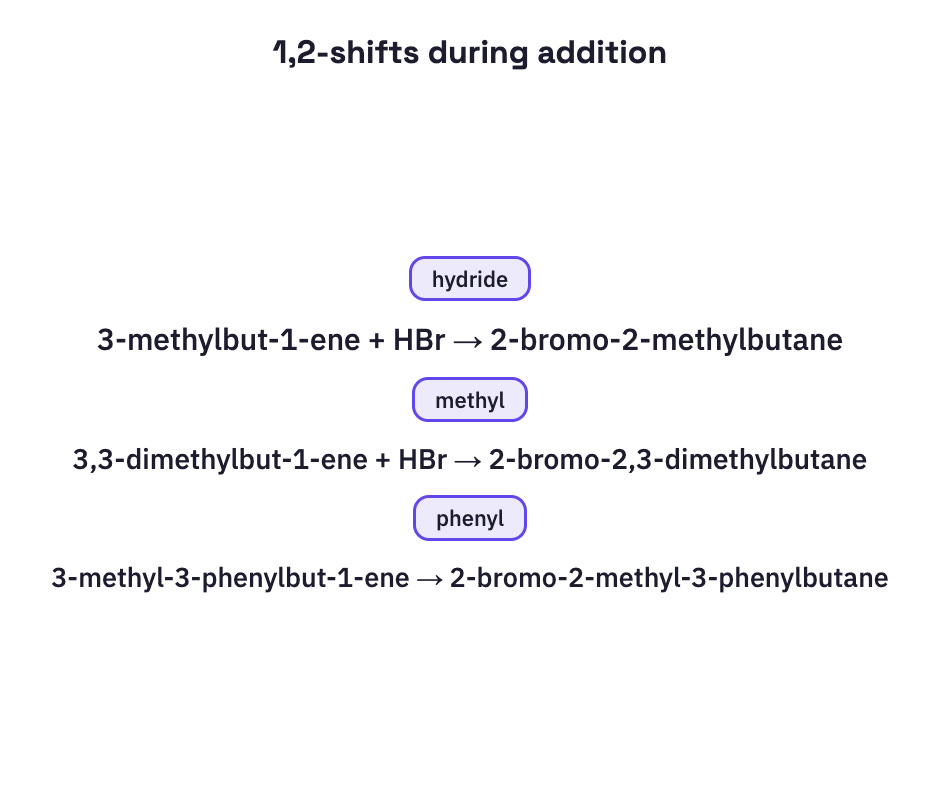
H, CH₃ and Ph shifts
Hydride: 3-methylbut-1-ene → 2-bromo-2-methylbutane. Methyl: 3,3-dimethylbut-1-ene → 2-bromo-2,3-dimethylbutane. Phenyl: 3-methyl-3-phenylbut-1-ene → 2-bromo-2-methyl-3-phenylbutane. The group moves with its bonding pair to the neighbouring C⁺.
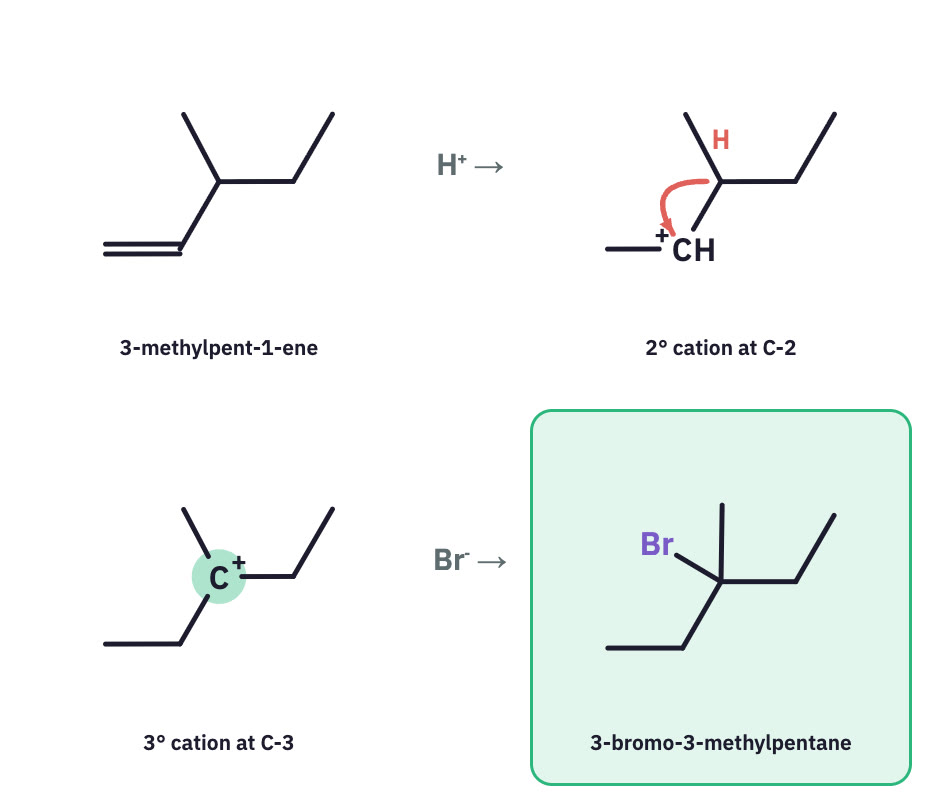
3-Methylpent-1-ene + HBr
H⁺ on C-1 gives the 2° cation at C-2; a hydride shift from C-3 gives the 3° cation ; bromide adds: 3-bromo-3-methylpentane.
One for every idea
1. Write the mechanism for the addition of HI to ethene. Which step is rate-determining?
- .
- Slow: .
- Fast: .
Forming the carbocation is rate-determining.
2. Predict the major product of 2-methylbut-2-ene + HCl and explain using carbocation stability.
- H⁺ adds to C-3, giving the 3° cation rather than a 2° one.
- captures it.
2-Chloro-2-methylbutane.
3. Predict the major product when 3-methylpent-1-ene reacts with HBr.
- H⁺ adds to C-1: 2° cation at C-2.
- 1,2-Hydride shift from C-3: 3° cation .
- Br⁻ adds there.
3-Bromo-3-methylpentane.
Your turn
3,3-Dimethylbut-1-ene reacts with HBr. The major product is:
Show the answer and the traps
2-Bromo-2,3-dimethylbutane, option b: a methyl shift turns the 2° cation into a 3° one.
2-Bromo-3,3-dimethylbutane is the unrearranged product, only minor.
1-Bromo-3,3-dimethylbutane is anti-Markovnikov: it needs peroxide and a radical path.
And 1-bromo-2,3-dimethylbutane puts Br on a primary carbon, which no cation here offers.
Common mistakes
Try these
1. Predict the major product of propene + HI.
2-Iodopropane (via the 2° cation).
2. What is the major product of 2-methylpropene with HBr (no peroxide)?
2-Bromo-2-methylpropane (3° cation).
3. 3-Methylbut-1-ene reacts with HCl. Give the major product.
2-Chloro-2-methylbutane (after a hydride shift).
4. Why does pent-2-ene give a mixture with HBr?
H⁺ on either carbon gives a 2° cation, so both 2- and 3-bromopentane form.