 layrd.liveLayer by Layer
- 1. Inductive Effect
- 2. Carboxylic Acid Strength
- 3. Alcohols, Hydrocarbons, Amines
- 4. Electromeric & Mesomeric
- 5. Hyperconjugation
- 6. Fission & Free Radicals
- 7. Carbocations
- 8. Carbanions
- 9. Carbenes
- 10. Nitrenes & Benzyne
- 11. Electrophiles & Nucleophiles
- 12. Reaction Types
- 13. Free Radical Substitution
- 14. SN2 Reaction
- 15. SN1 Reaction
- 16. SN1 vs SN2
- 17. Electrophilic Substitution
- 18. Markovnikov's Rule
- 19. Br₂ Addition & Dienes
- 20. Peroxide Effect
- 21. Nucleophilic Addition
- 22. E1, E1cB & Saytzeff
- 23. E2 Elimination
Types of Organic Reactions
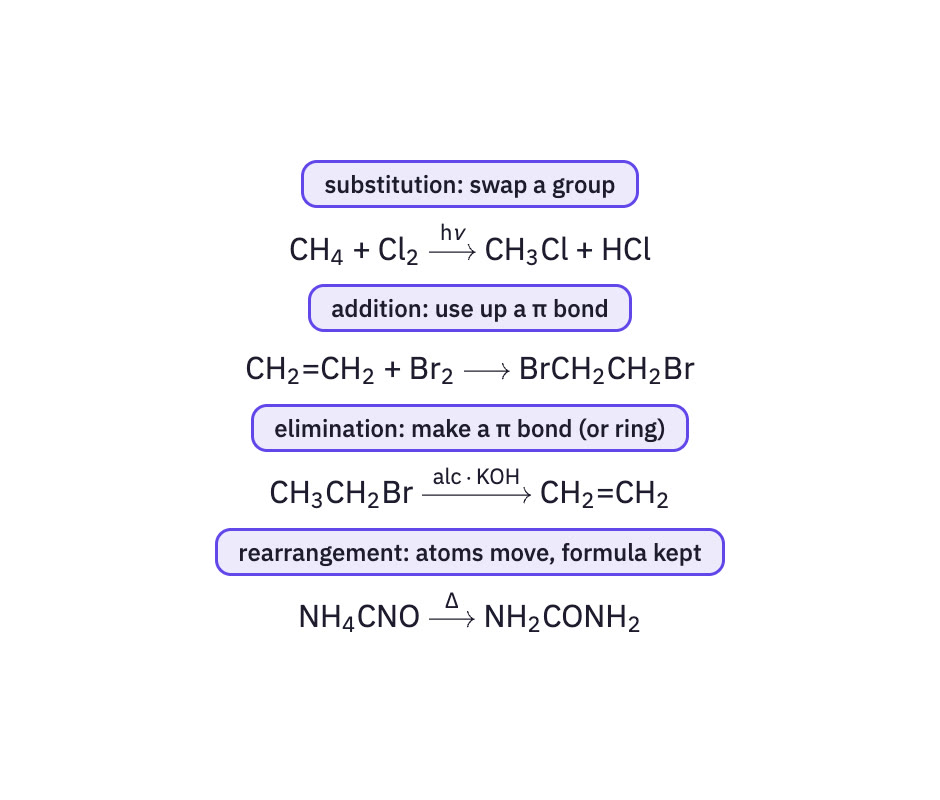
Whatever the mechanism, almost every organic reaction is one of four types. Substitution swaps one group for another; addition uses up a π bond; elimination creates one (from β, α or γ carbons); rearrangement moves atoms within the molecule without adding or removing any.
Builds on: Part 11 · Electrophiles, Nucleophiles and Ambident Reagents.
 Video coming soon
Four reaction types
Substitution (), addition (), elimination (), rearrangement ().
Substitution
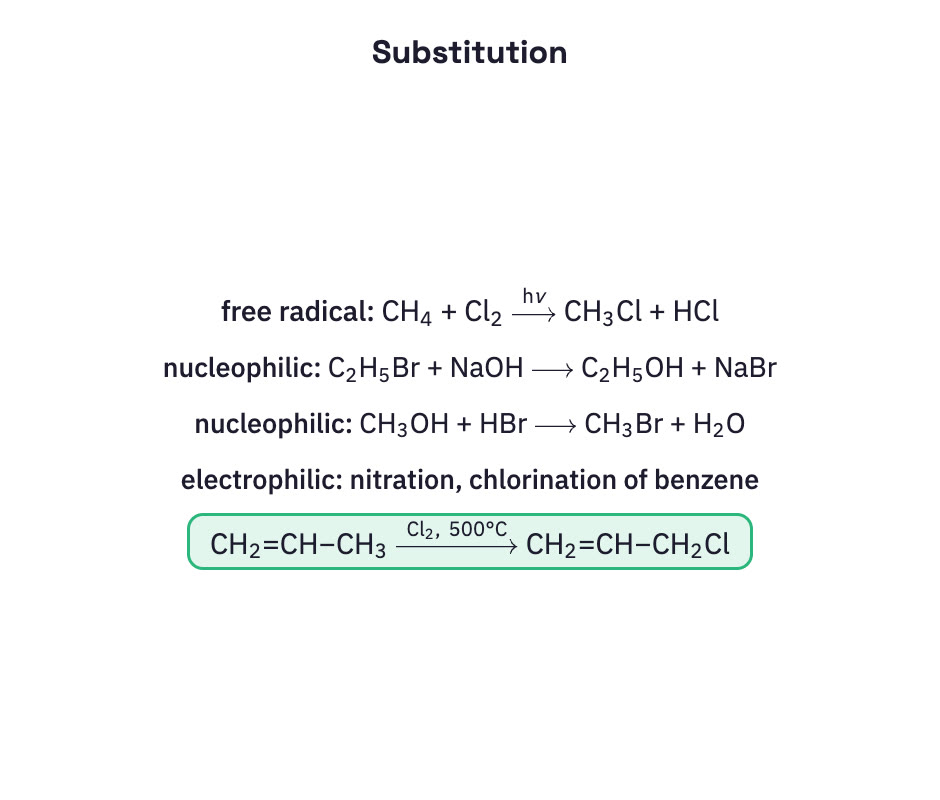
Free radical (methane + chlorine in UV), nucleophilic (, ), electrophilic (nitration and chlorination of benzene). Propene + at 500 °C substitutes to give allyl chloride.
Addition: sp → sp² → sp³
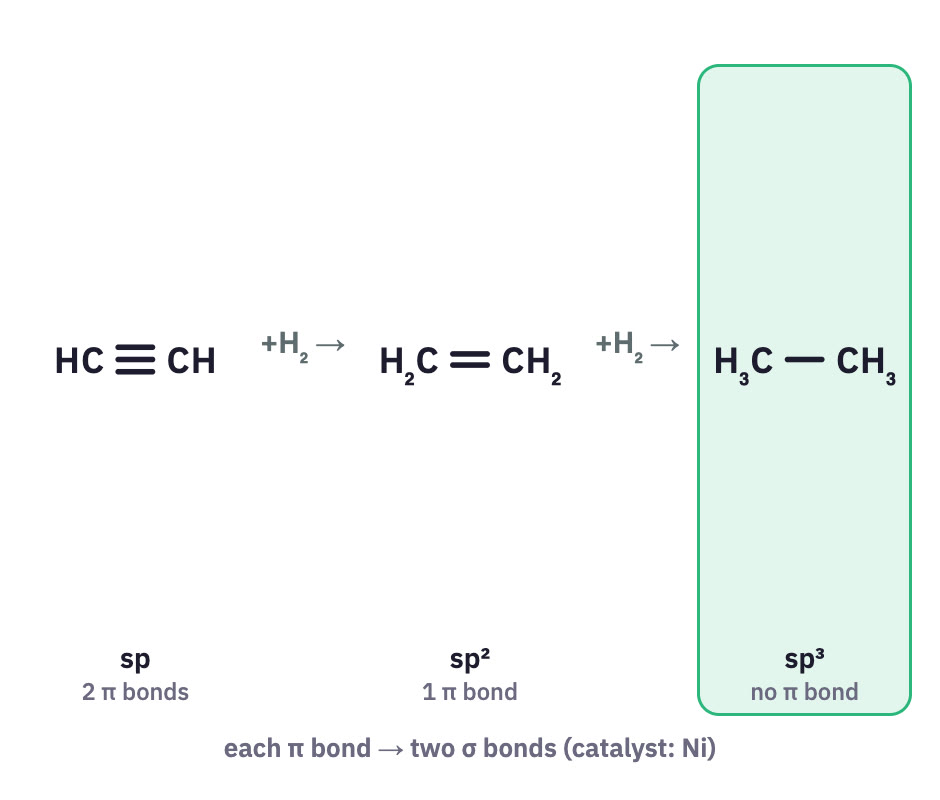
Each π bond becomes two σ bonds: . Additions can be electrophilic (), nucleophilic (HCN on ) or radical; HBr adds to ethyne twice (vinyl bromide, then 1,1-dibromoethane).
β-, α- and γ-elimination
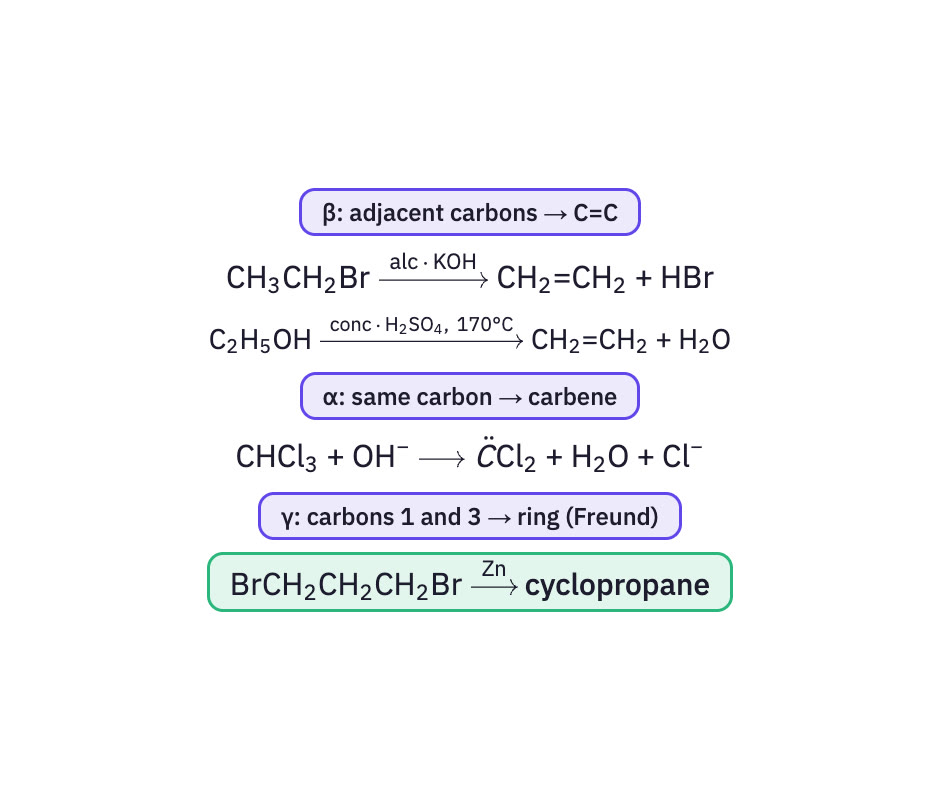
β (adjacent carbons): dehydrohalogenation (alc. KOH), dehydration (conc. , 170 °C), dehalogenation (Zn), dehydrogenation (Cu, 300 °C). α (same carbon): . γ (C-1 and C-3): + Zn → cyclopropane (Freund reaction).
Freund reaction
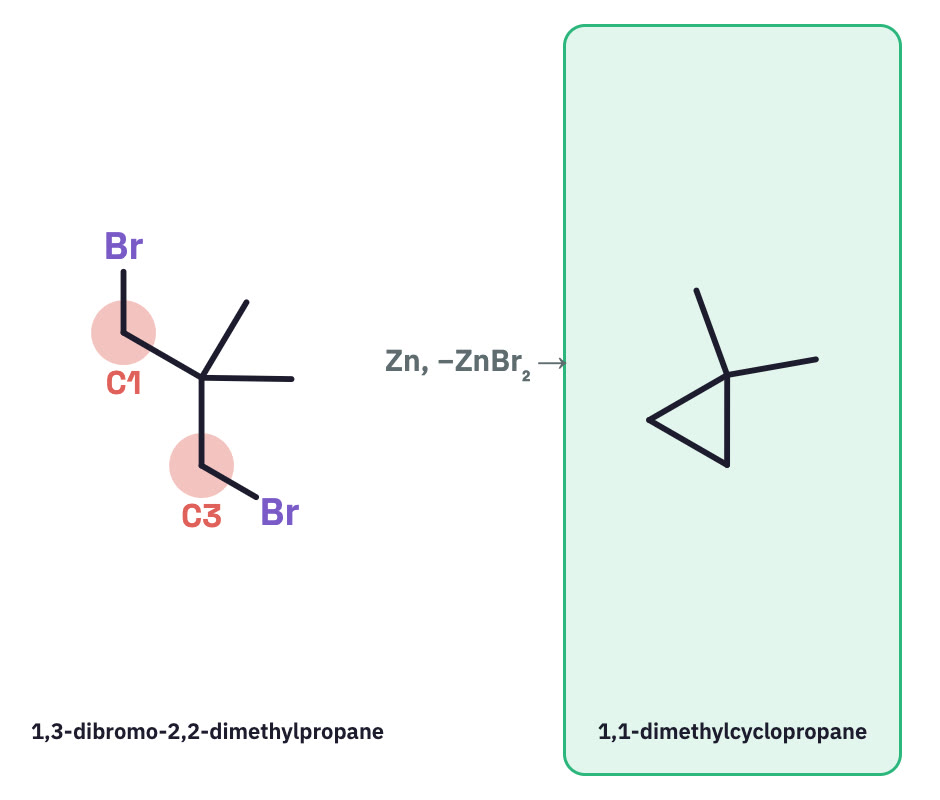
1,3-Dibromo-2,2-dimethylpropane + Zn → 1,1-dimethylcyclopropane: both Br atoms leave from C-1 and C-3 and the ring closes.
Rearrangement
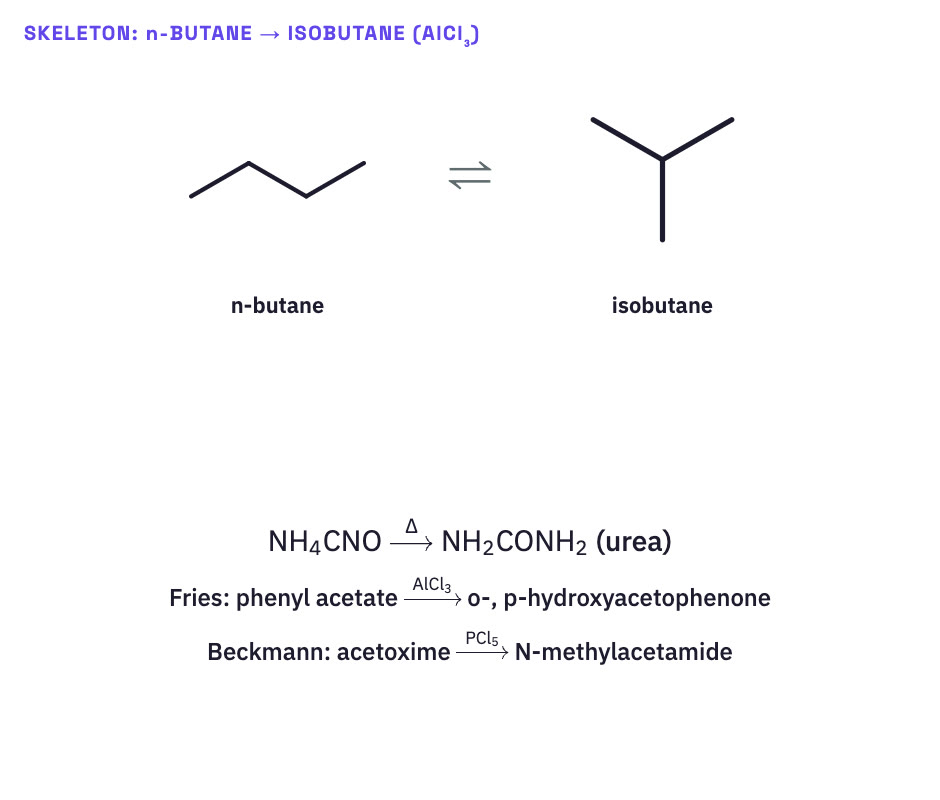
n-Butane ⇌ isobutane (); but-1-ene → but-2-ene + 2-methylpropene; n-propyl bromide → isopropyl bromide (); → urea; Fries (phenyl acetate → o-/p-hydroxyacetophenone); Beckmann (acetoxime → N-methylacetamide).
One for every idea
1. Classify: (a) ; (b) ; (c) .
- (a) Br replaces H on the ring.
- (b) The π bond is used up.
- (c) CN replaces Cl.
(a) electrophilic substitution; (b) electrophilic addition; (c) nucleophilic substitution.
2. 1,3-Dibromo-2,2-dimethylpropane is heated with zinc dust. Name the product and the type of elimination.
- Zn removes Br from C-1 and C-3; a C1–C3 bond closes the ring.
1,1-Dimethylcyclopropane, by γ-elimination (Freund reaction).
3. Heating ammonium cyanate gives urea. Why is this a rearrangement and not an addition or elimination?
- and have the same formula, .
Atoms are only reorganised; nothing is added or removed.
Your turn
Conversion of 1,3-dibromopropane into cyclopropane with zinc is an example of:
Show the answer and the traps
γ-elimination, option c: the groups leave carbons 1 and 3, and the ring closes.
α-elimination would remove both groups from one carbon.
β-elimination, from adjacent carbons, would give an alkene.
And atoms are lost, so it isn't a rearrangement.
Common mistakes
Try these
1. Conversion of into : by a base is an example of: (a) β-elimination (b) α-elimination (c) γ-elimination (d) substitution
(b) α-elimination.
2. Classify: .
Nucleophilic addition.
3. What is the hybridisation change at carbon when ethyne is reduced to ethane?
sp → sp² → sp³.
4. Ethanol heated with conc. at 170 °C gives ethene. Which type of reaction is this?
β-elimination (dehydration).