 layrd.liveLayer by Layer
- 1. Inductive Effect
- 2. Carboxylic Acid Strength
- 3. Alcohols, Hydrocarbons, Amines
- 4. Electromeric & Mesomeric
- 5. Hyperconjugation
- 6. Fission & Free Radicals
- 7. Carbocations
- 8. Carbanions
- 9. Carbenes
- 10. Nitrenes & Benzyne
- 11. Electrophiles & Nucleophiles
- 12. Reaction Types
- 13. Free Radical Substitution
- 14. SN2 Reaction
- 15. SN1 Reaction
- 16. SN1 vs SN2
- 17. Electrophilic Substitution
- 18. Markovnikov's Rule
- 19. Br₂ Addition & Dienes
- 20. Peroxide Effect
- 21. Nucleophilic Addition
- 22. E1, E1cB & Saytzeff
- 23. E2 Elimination
Anti-Addition of Bromine and 1,4-Addition to Dienes
Bromine does not add through an open carbocation. Its Br⁺ end bridges both carbons as a cyclic bromonium ion, so Br⁻ must come in from the opposite face: anti-addition, which fixes the stereochemistry of the product. A conjugated diene adds differently again: the electrophile on C-1 gives an allylic cation whose positive charge is shared by C-2 and C-4, so both 1,2- and 1,4-products form.
Builds on: Part 18 · Electrophilic Addition: Markovnikov's Rule and Rearrangements.
 Video coming soon
The bromonium ion
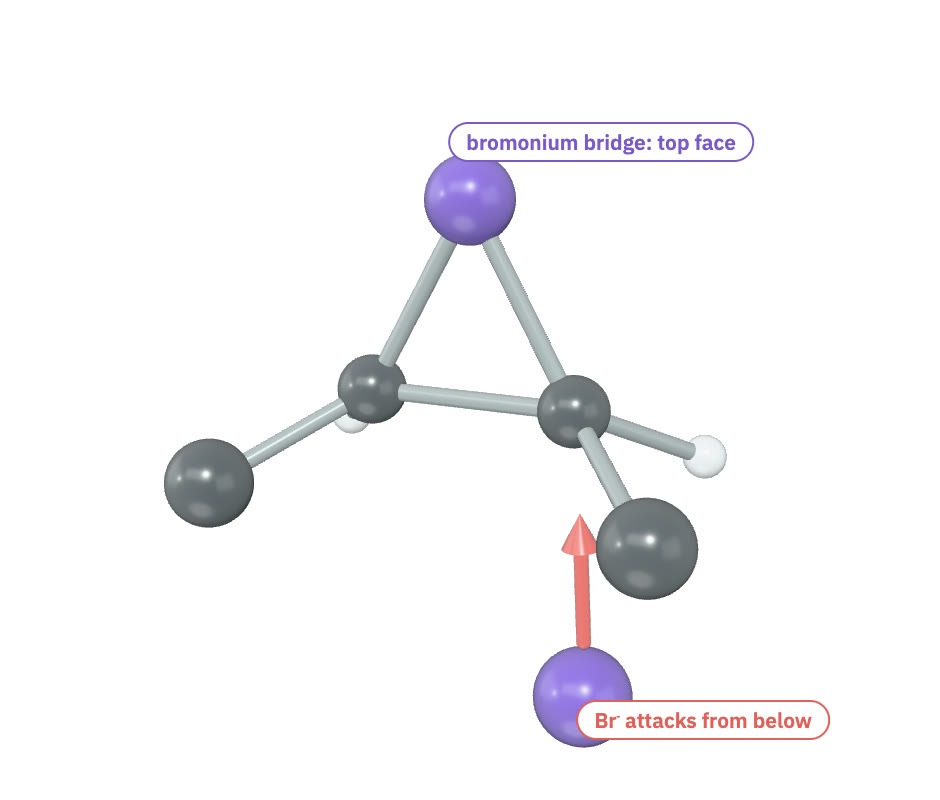
The π electrons attack ; the end bonds to both carbons at once, forming a three-membered cyclic bromonium ion. The bridge blocks the top face, so opens the ring from below: the two Br atoms end up on opposite faces (anti-addition).
cis → racemic, trans → meso
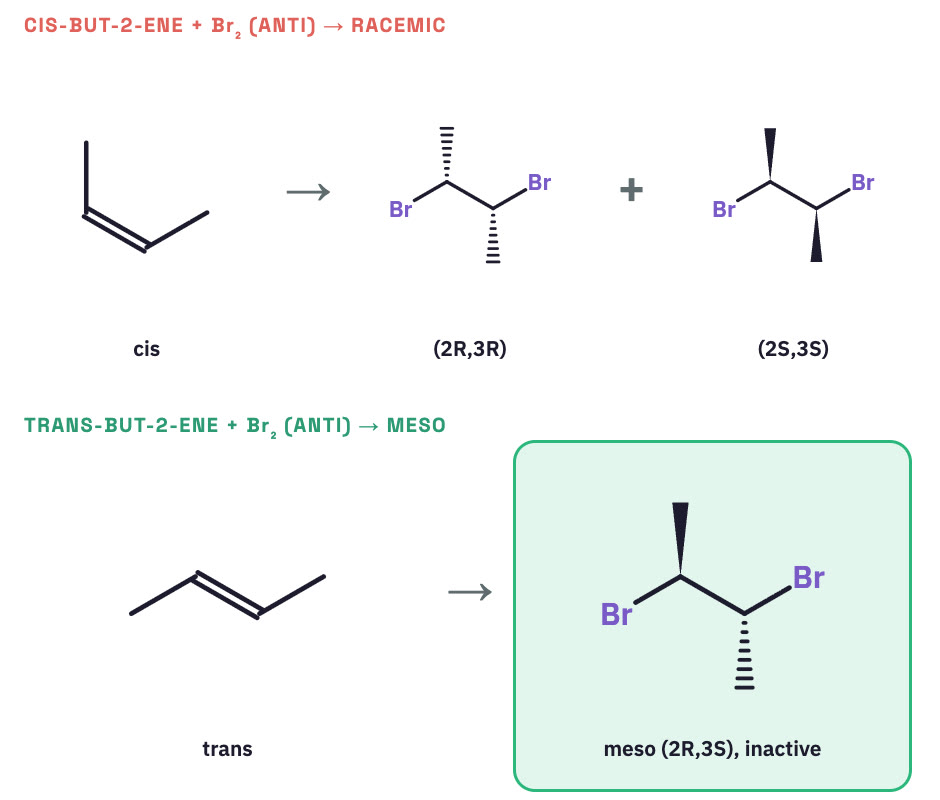
cis-But-2-ene + in gives racemic (dl) 2,3-dibromobutane: equal amounts of (2R,3R) and (2S,3S). trans-But-2-ene gives meso-2,3-dibromobutane, (2R,3S), which is optically inactive. The addition is stereoselective: mainly anti.
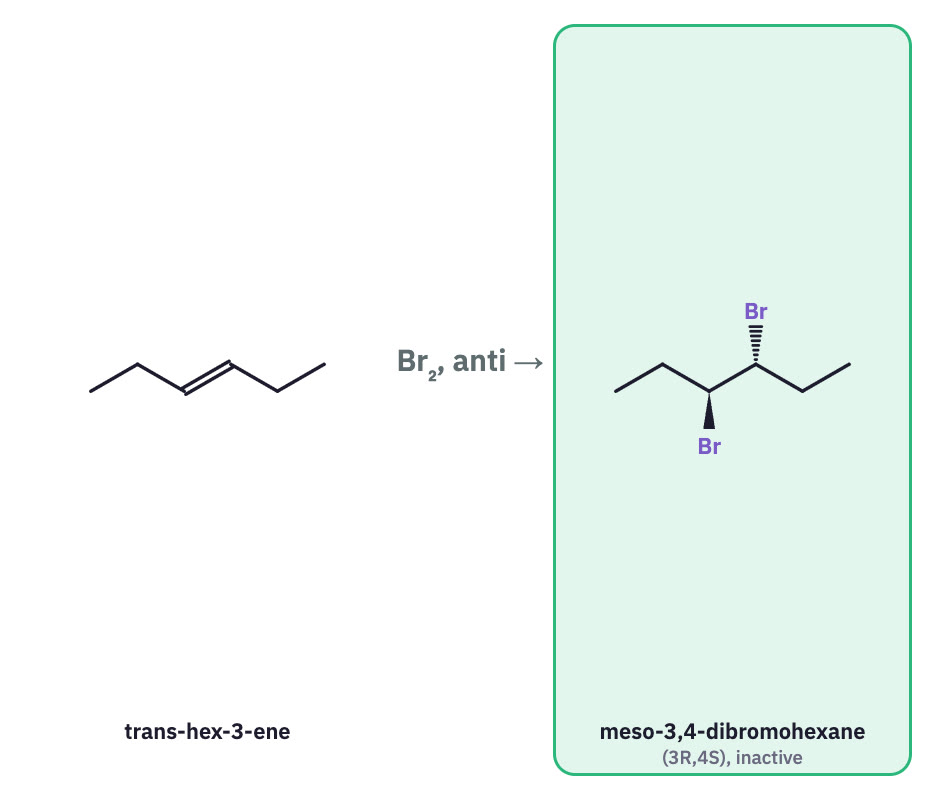
trans-Hex-3-ene + Br₂
Anti-addition to a trans alkene with identical ends gives (3R,4S)-3,4-dibromohexane, the meso form. It has an internal plane of symmetry, so it is optically inactive.
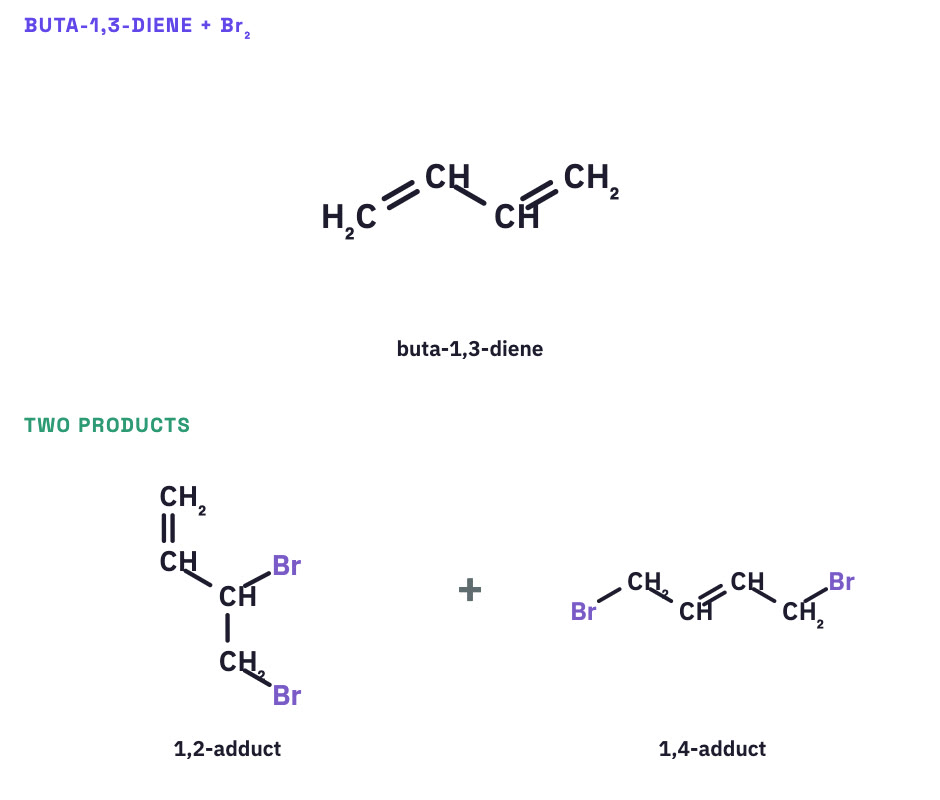
Two products from one diene
Buta-1,3-diene + gives 3,4-dibromobut-1-ene (1,2-addition) and 1,4-dibromobut-2-ene (1,4-addition). With HBr the pair is 3-bromobut-1-ene and 1-bromobut-2-ene.
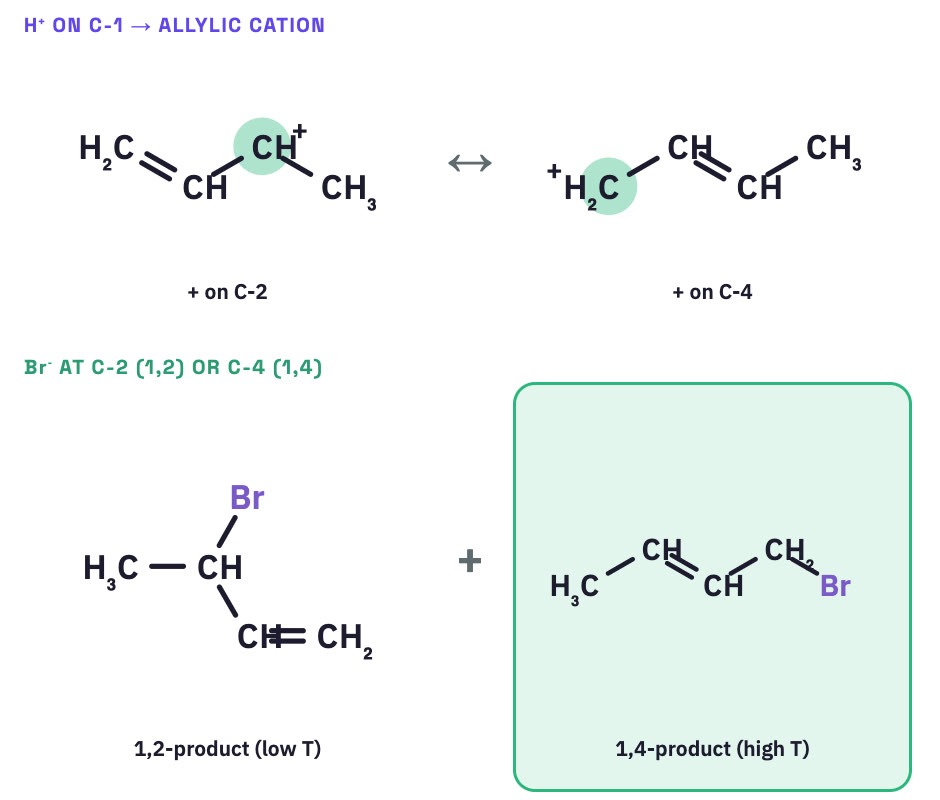
The allylic cation
H⁺ adds to C-1, giving . The nucleophile adds at C-2 (1,2-product) or C-4 (1,4-product). Low temperature and non-ionising solvents (hexane) favour 1,2; high temperature and ionising solvents (acetic acid) favour 1,4.
One for every idea
1. trans-Hex-3-ene is treated with Br₂ in CCl₄. Is the product optically active? Name its stereochemical form.
- Br₂ adds anti through a bromonium ion.
- Anti-addition to a trans alkene with identical ends gives (3R,4S)-3,4-dibromohexane.
- It has an internal plane of symmetry.
meso-3,4-Dibromohexane: optically inactive.
2. Give the two products when buta-1,3-diene reacts with one mole of HCl, and say which is favoured at high temperature.
- H⁺ adds to C-1: .
- Cl⁻ adds at C-2: 3-chlorobut-1-ene (1,2); at C-4: 1-chlorobut-2-ene (1,4).
At high temperature, 1-chlorobut-2-ene (the 1,4-product) predominates.
Your turn
Buta-1,3-diene reacts with 1 mol HBr at 40 °C. The main product is:
Show the answer and the traps
1-Bromobut-2-ene, option b: the 1,4-product wins at higher temperature.
3-Bromobut-1-ene, the 1,2-product, is favoured at low temperature.
1,4-Dibromobut-2-ene needs two Br atoms, from Br₂.
And 2-bromobut-1-ene would need H⁺ on C-2, giving a 1° cation with no resonance.
Common mistakes
Try these
1. Addition of Br₂ to cis-but-2-ene gives: (a) meso-2,3-dibromobutane (b) racemic 2,3-dibromobutane (c) 1,2-dibromobutane (d) only (2R,3R)-2,3-dibromobutane
(b) Racemic: anti-addition to the cis alkene gives (2R,3R) and (2S,3S) in equal amounts.
2. Which product is optically inactive: Br₂ + cis-but-2-ene, or Br₂ + trans-but-2-ene?
trans-But-2-ene: it gives meso-2,3-dibromobutane.
3. Name the intermediate that makes bromine addition anti.
The cyclic bromonium ion: it blocks one face, so Br⁻ attacks from the other.
4. Buta-1,3-diene + 1 mol HBr in acetic acid at 40 °C: which product predominates, and why?
1-Bromobut-2-ene (1,4): high temperature and an ionising solvent favour 1,4-addition.