 layrd.liveLayer by Layer
- 1. Inductive Effect
- 2. Carboxylic Acid Strength
- 3. Alcohols, Hydrocarbons, Amines
- 4. Electromeric & Mesomeric
- 5. Hyperconjugation
- 6. Fission & Free Radicals
- 7. Carbocations
- 8. Carbanions
- 9. Carbenes
- 10. Nitrenes & Benzyne
- 11. Electrophiles & Nucleophiles
- 12. Reaction Types
- 13. Free Radical Substitution
- 14. SN2 Reaction
- 15. SN1 Reaction
- 16. SN1 vs SN2
- 17. Electrophilic Substitution
- 18. Markovnikov's Rule
- 19. Br₂ Addition & Dienes
- 20. Peroxide Effect
- 21. Nucleophilic Addition
- 22. E1, E1cB & Saytzeff
- 23. E2 Elimination
Carbocations: Structure and Stability
A carbocation is a carbon with a positive charge and only six electrons: sp², trigonal planar, with an empty p orbital waiting for a nucleophile. Anything that spreads the charge stabilises it: alkyl groups (+I and hyperconjugation), an adjacent lone pair that completes every octet, and resonance in allyl and benzyl cations.
Builds on: Part 6 · Bond Fission and Free Radicals.
 Video coming soon
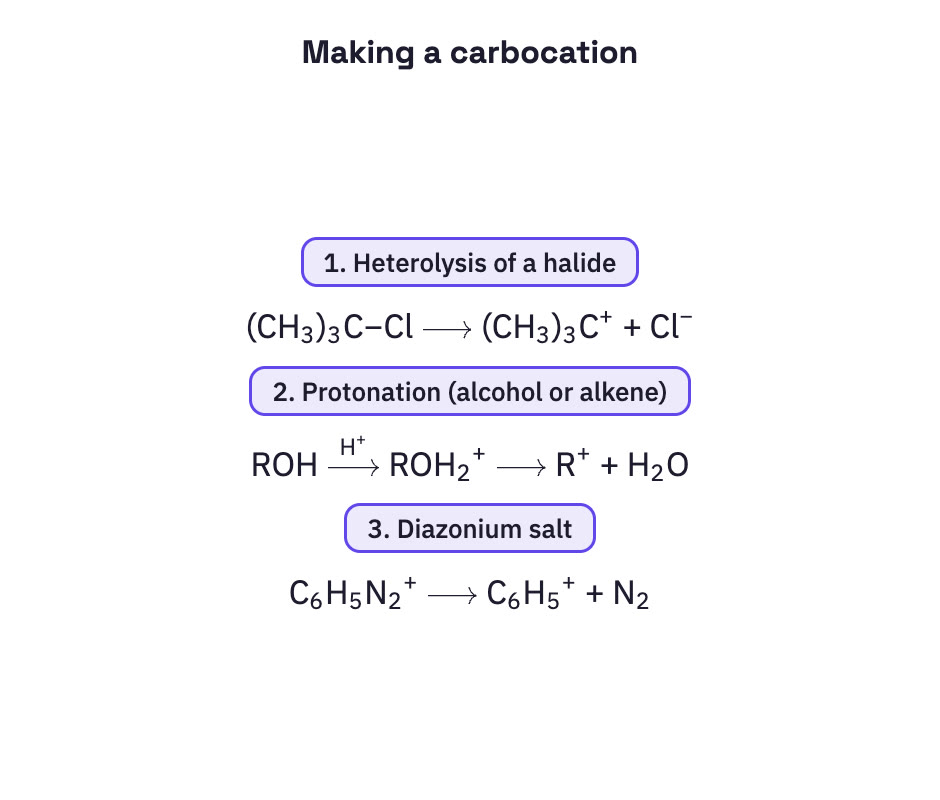
Making a carbocation
Heterolysis of a halide (), protonation of an alcohol or alkene (), or loss of from a diazonium ion ().
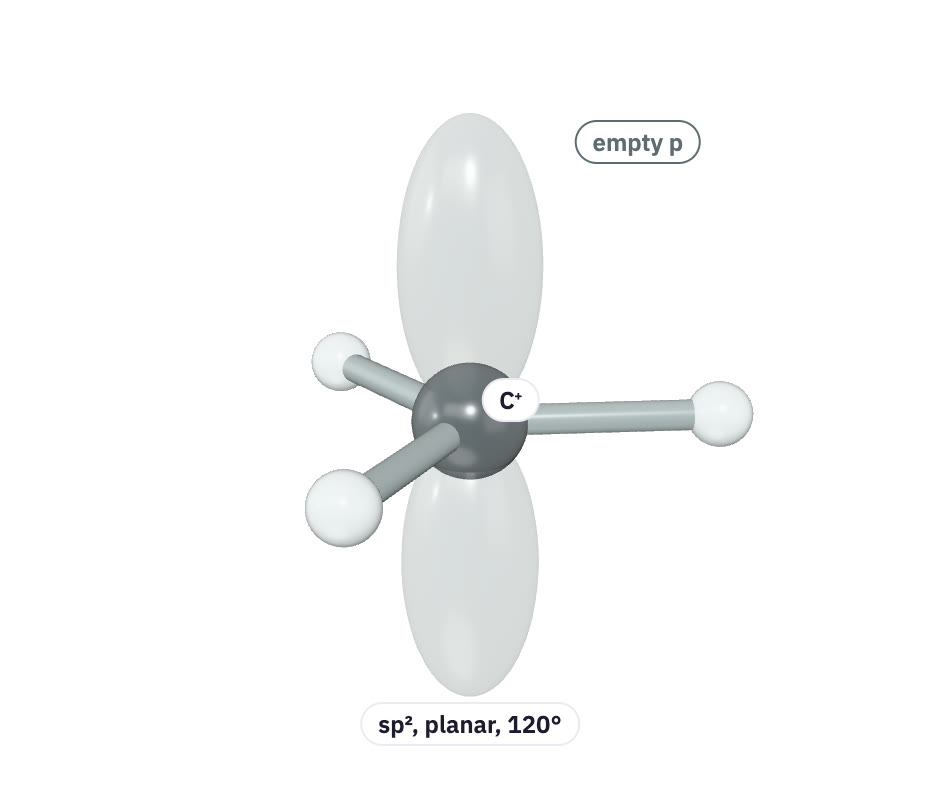
sp², planar, empty p
The cationic carbon has six electrons in three bonds 120° apart; the empty p orbital stands at right angles to the plane and is where nucleophiles attack.
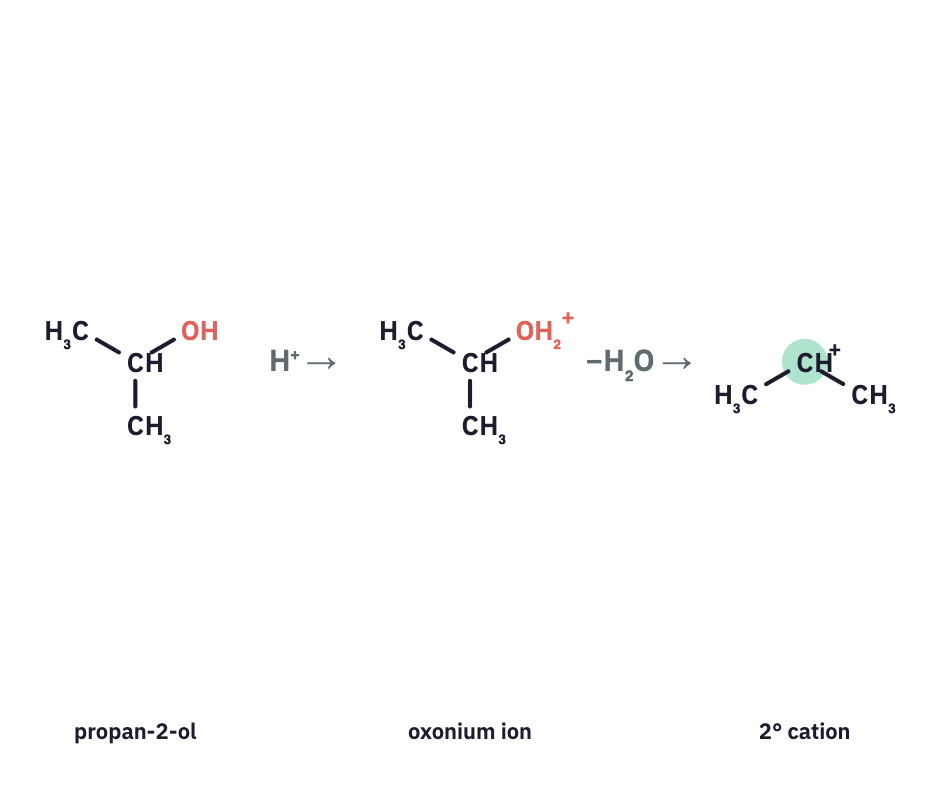
Propan-2-ol in acid
.
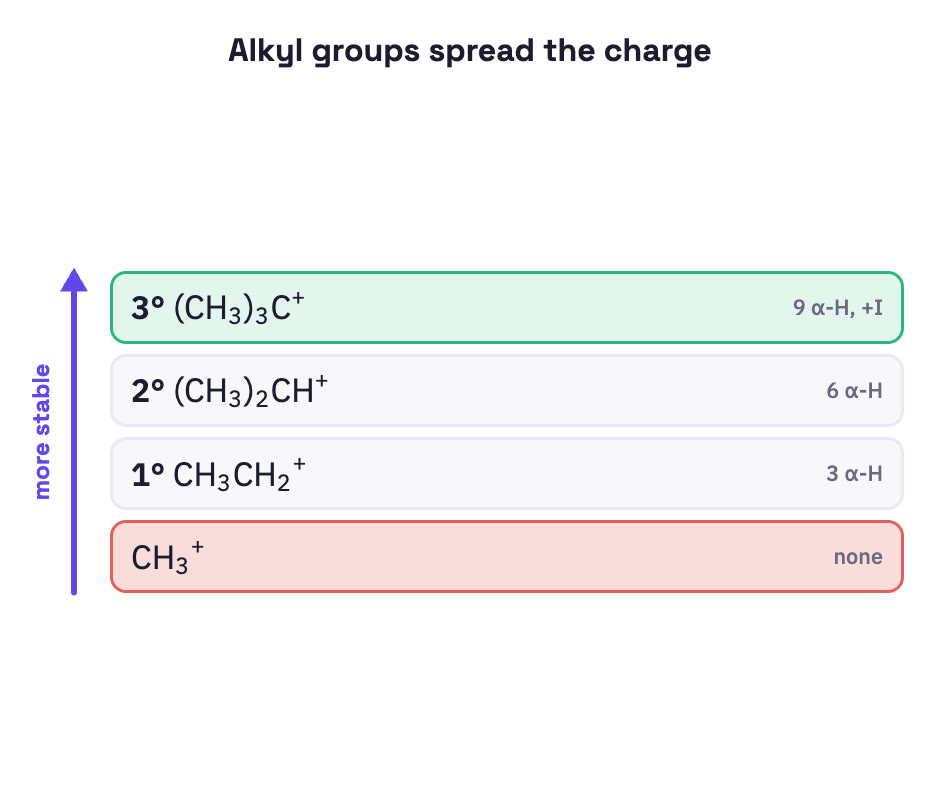
3° > 2° > 1° > CH₃⁺
Alkyl groups spread the positive charge by +I and hyperconjugation (9, 6, 3, 0 α-H). Among primary cations a longer chain helps slightly.
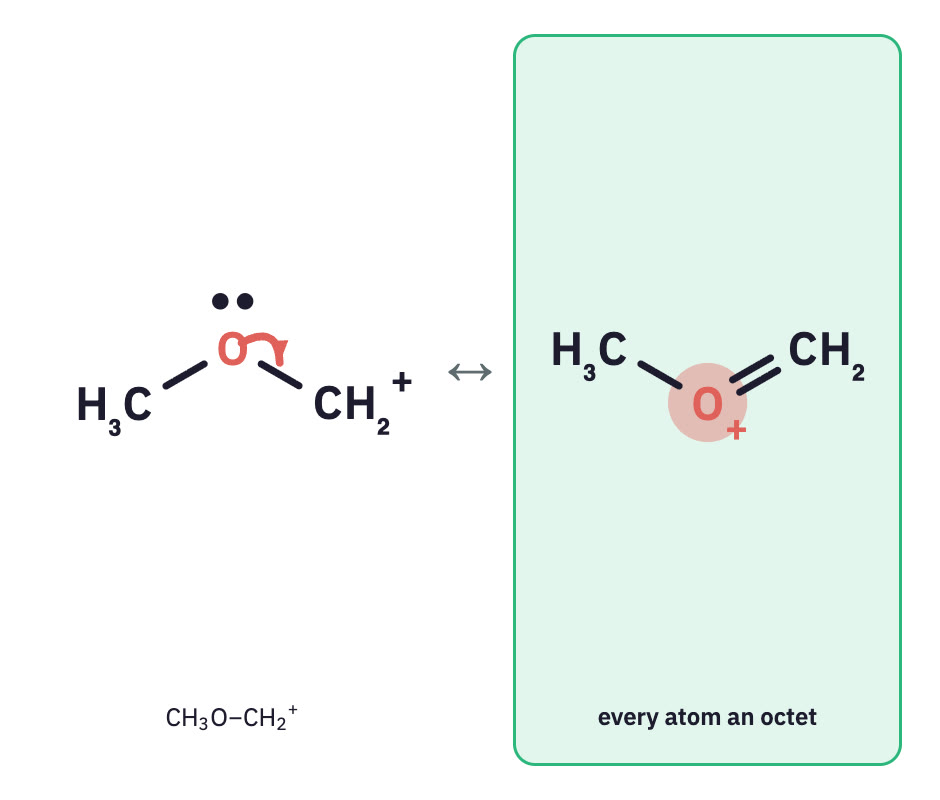
An adjacent oxygen (or nitrogen) shares its lone pair so every atom has an octet; such cations are more stable than even 3° alkyl cations. −I groups (NO₂, CN, Br) destabilise.
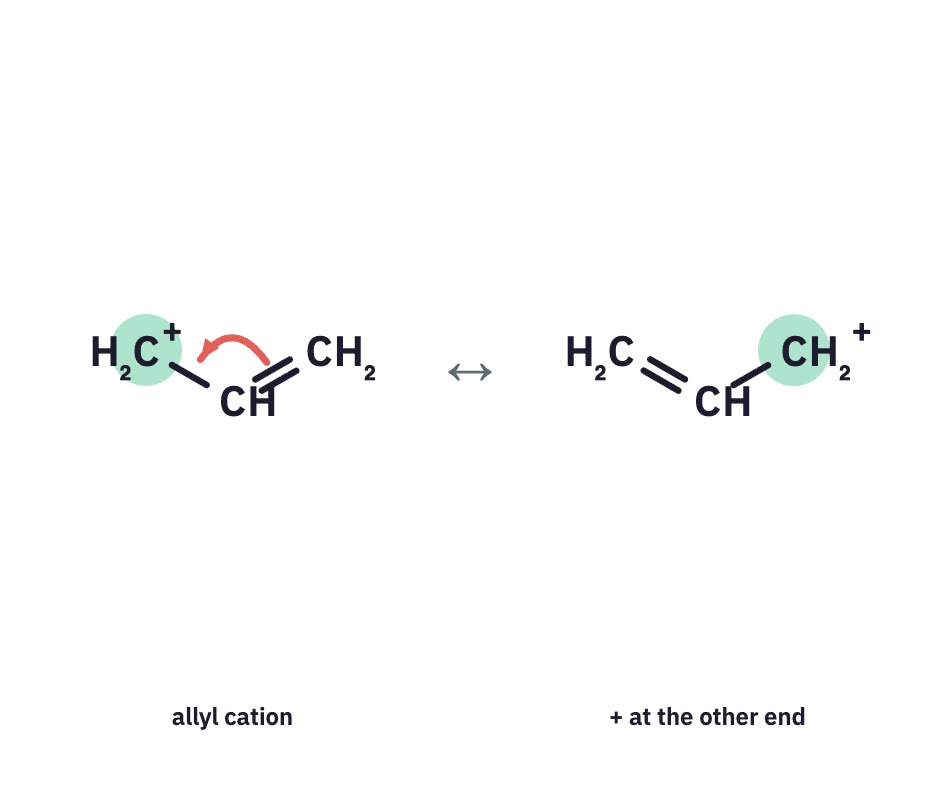
The allyl cation
Two resonance forms put the positive charge on either end carbon.
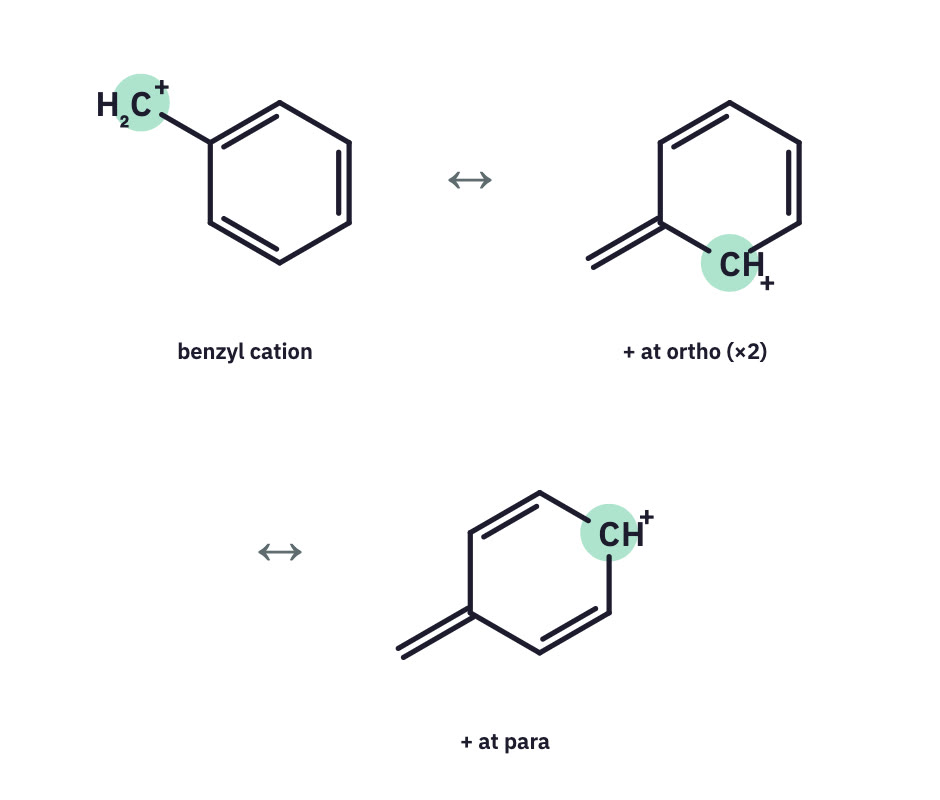
The benzyl cation
Four forms spread the charge to the two ortho carbons and the para carbon. Allyl and benzyl cations are almost equally stable.
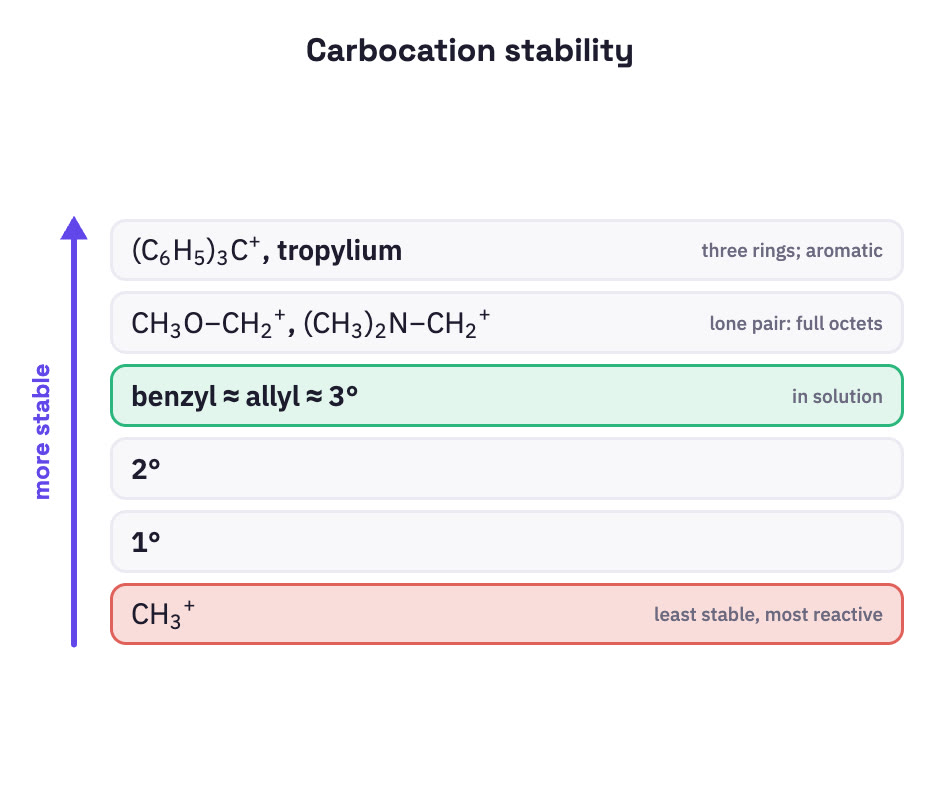
Carbocation stability
, tropylium > > benzyl ≈ allyl ≈ 3° > 2° > 1° > . Cyclopropylmethyl cations beat benzyl. The book's lists disagree on benzyl, allyl and 3°; in solution they are about equal, so read the options.
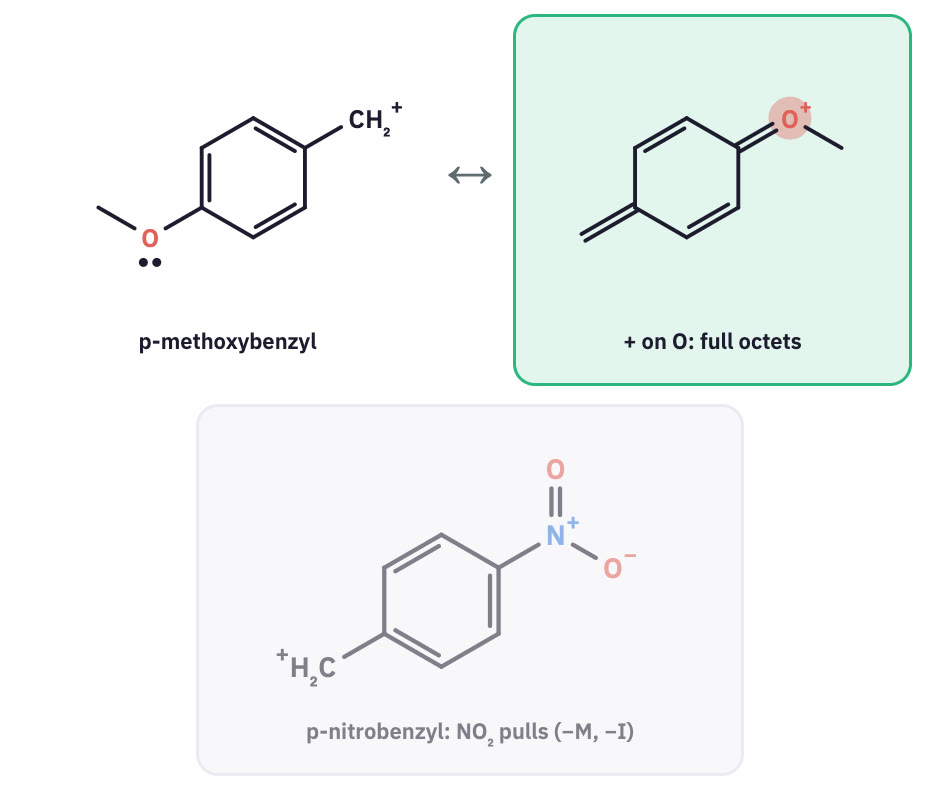
p-Methoxy vs p-nitro
The para-OCH₃ lone pair reaches the (a form with + on O and full octets); para-NO₂ withdraws and adds positive charge to the ring.
One for every idea
1. Show how propan-2-ol gives a carbocation in acid, and state the hybridisation and shape of the cation.
- .
- Water leaves: .
The cationic carbon is sp², trigonal planar, with a vacant p orbital.
2. Arrange in decreasing stability: , , , .
- : the O lone pair gives with full octets.
- Then α-H: 6, 3, 0.
.
3. Which is more stable, the p-methoxybenzyl cation or the p-nitrobenzyl cation? Why?
- donates its lone pair (+M) into the ring and onto the .
- withdraws (−M, −I) and puts more positive charge on the ring.
p-Methoxybenzyl.
Your turn
Which carbocation is the most reactive?
Show the answer and the traps
CH₃⁺, option d: the least stable cation is the most reactive.
(CH₃)₃C⁺ is the most stable, so the least reactive.
(CH₃)₂CH⁺ is held back by 6 α-H.
And CH₃CH₂⁺ by 3.
Common mistakes
Try these
1. Which carbocation is the most stable? (a) (b) (c) (d)
(d): the charge spreads over three rings.
2. Arrange in decreasing stability: , , , .
.
3. Why is more stable than ?
N's lone pair forms , in which every atom has an octet.
4. What is the hybridisation of the cationic carbon in the benzyl cation, and how many resonance forms does it have?
sp²; four forms (charge on CH₂, two ortho carbons and the para carbon).
5. Give the carbocation formed when benzenediazonium chloride loses .
The phenyl cation, .