 layrd.liveLayer by Layer
- 1. Inductive Effect
- 2. Carboxylic Acid Strength
- 3. Alcohols, Hydrocarbons, Amines
- 4. Electromeric & Mesomeric
- 5. Hyperconjugation
- 6. Fission & Free Radicals
- 7. Carbocations
- 8. Carbanions
- 9. Carbenes
- 10. Nitrenes & Benzyne
- 11. Electrophiles & Nucleophiles
- 12. Reaction Types
- 13. Free Radical Substitution
- 14. SN2 Reaction
- 15. SN1 Reaction
- 16. SN1 vs SN2
- 17. Electrophilic Substitution
- 18. Markovnikov's Rule
- 19. Br₂ Addition & Dienes
- 20. Peroxide Effect
- 21. Nucleophilic Addition
- 22. E1, E1cB & Saytzeff
- 23. E2 Elimination
SN1 Reaction: Carbocations, Racemisation and Rearrangement
In an SN1 reaction the substrate ionises first, slowly, to a planar carbocation, and the nucleophile joins in a fast second step. So the rate depends only on the substrate (Rate = k[RX]), a chiral substrate is largely racemised (with a little extra inversion), and the carbocation can rearrange by a 1,2-hydride or methyl shift before it is captured.
Builds on: Part 7 · Carbocations: Structure and Stability, Part 14 · SN2 Reaction: Mechanism, Walden Inversion and Rates.
 Video coming soon
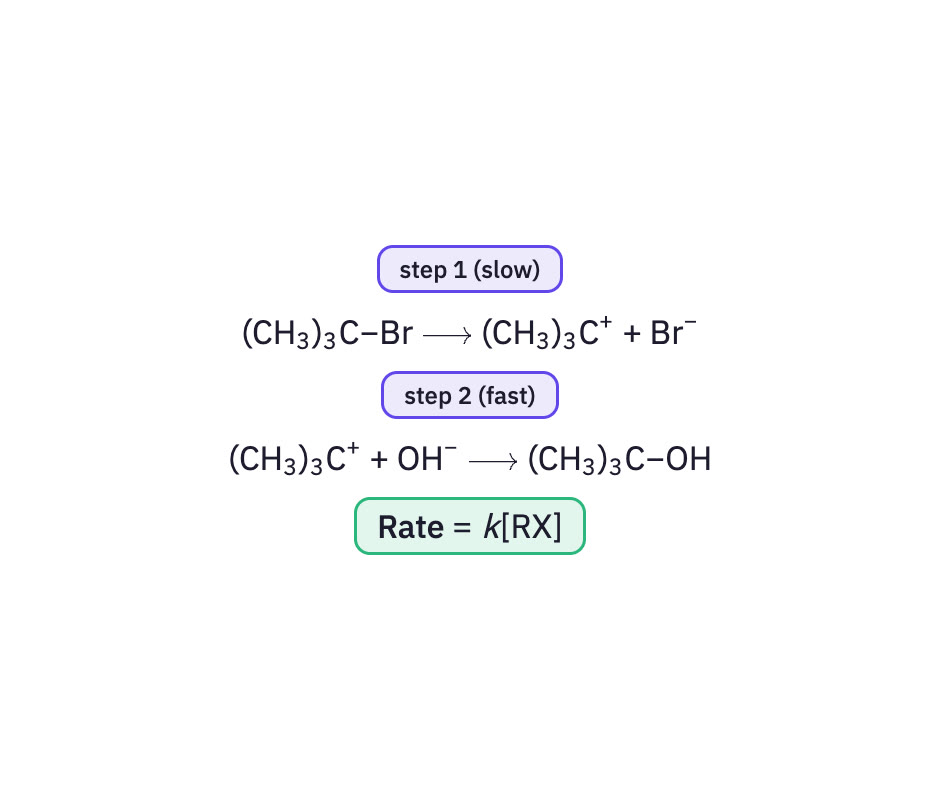
Two steps
Step 1 (slow): . Step 2 (fast): . Rate : unimolecular, first order.
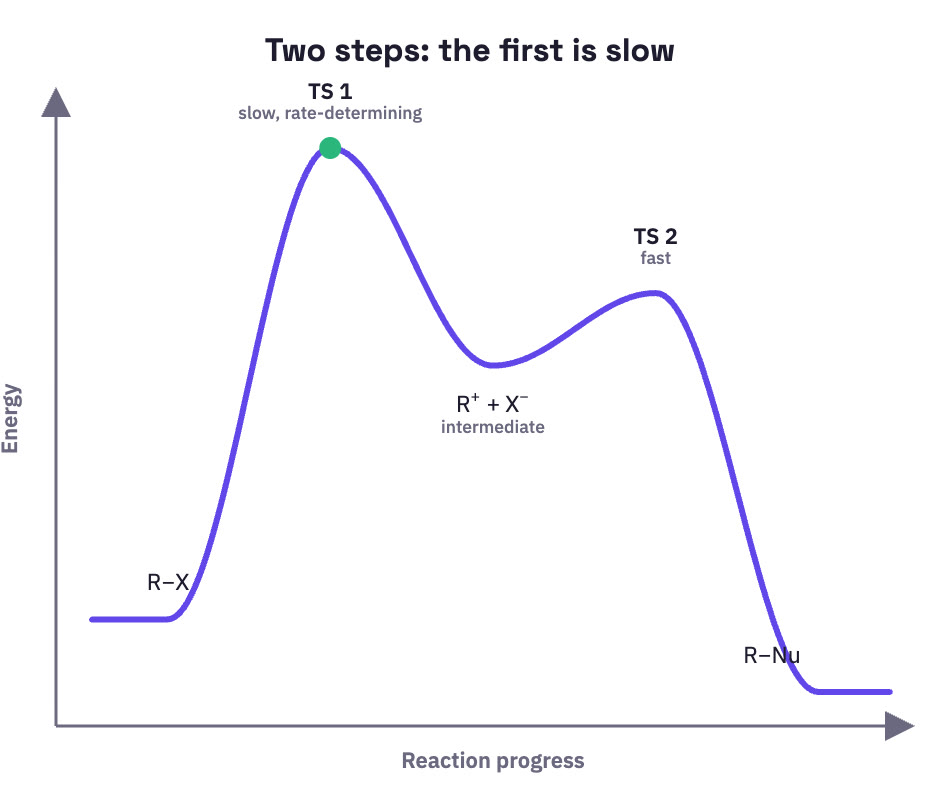
A carbocation valley
The first hump (ionisation) is higher and rate-determining; the carbocation is a true intermediate; the second hump is small. The energy for ionisation comes from ion–dipole bonds with the solvent.
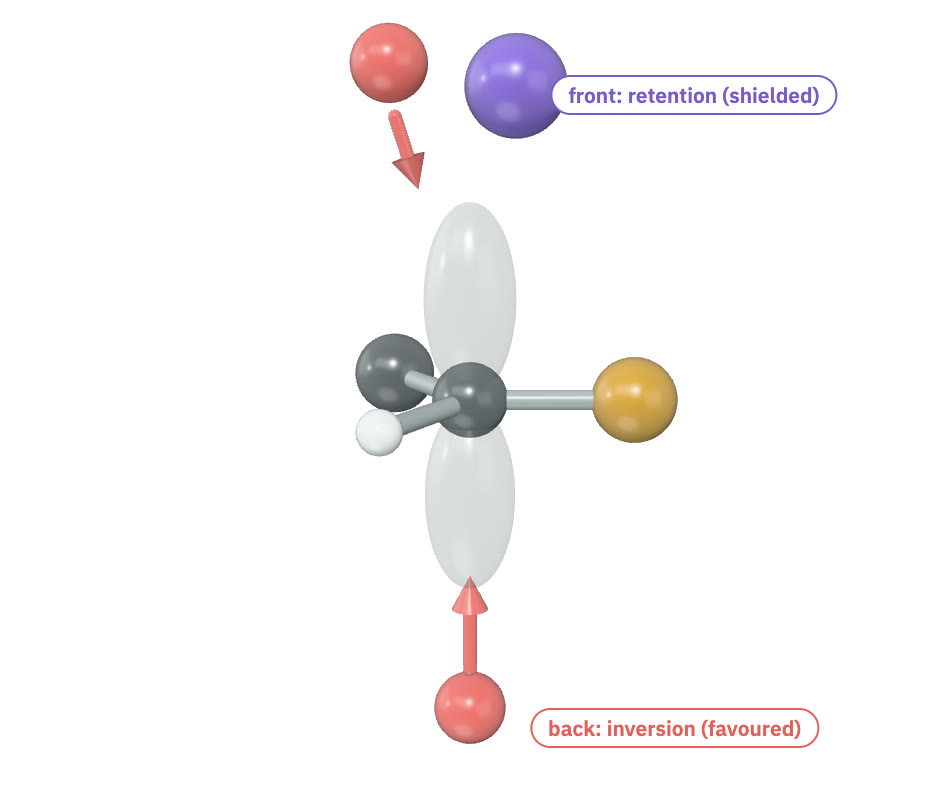
Racemisation, some inversion
The planar cation can be attacked from both faces, so a chiral substrate is racemised ((−)-2-bromobutane → butan-2-ol with loss of optical activity). The departing shields the front face, so inversion slightly exceeds retention; the more stable the cation, the more complete the racemisation.
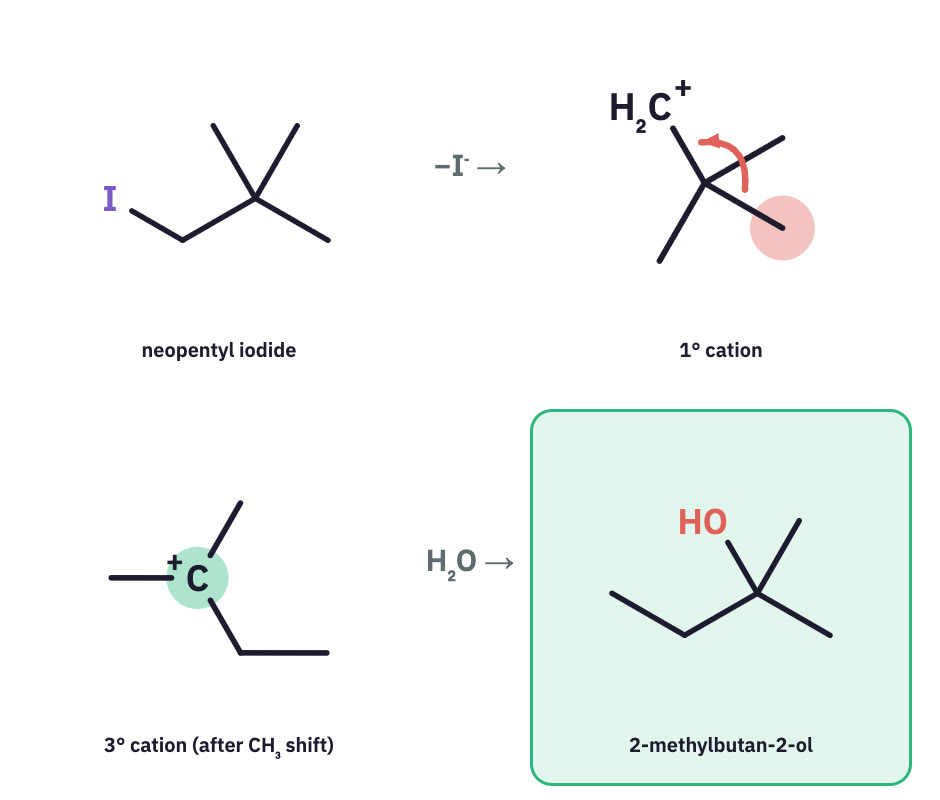
Neopentyl iodide
Ionisation gives a 1° cation; a 1,2-methyl shift gives the 3° cation, which water captures: 2-methylbutan-2-ol, not the neopentyl alcohol.
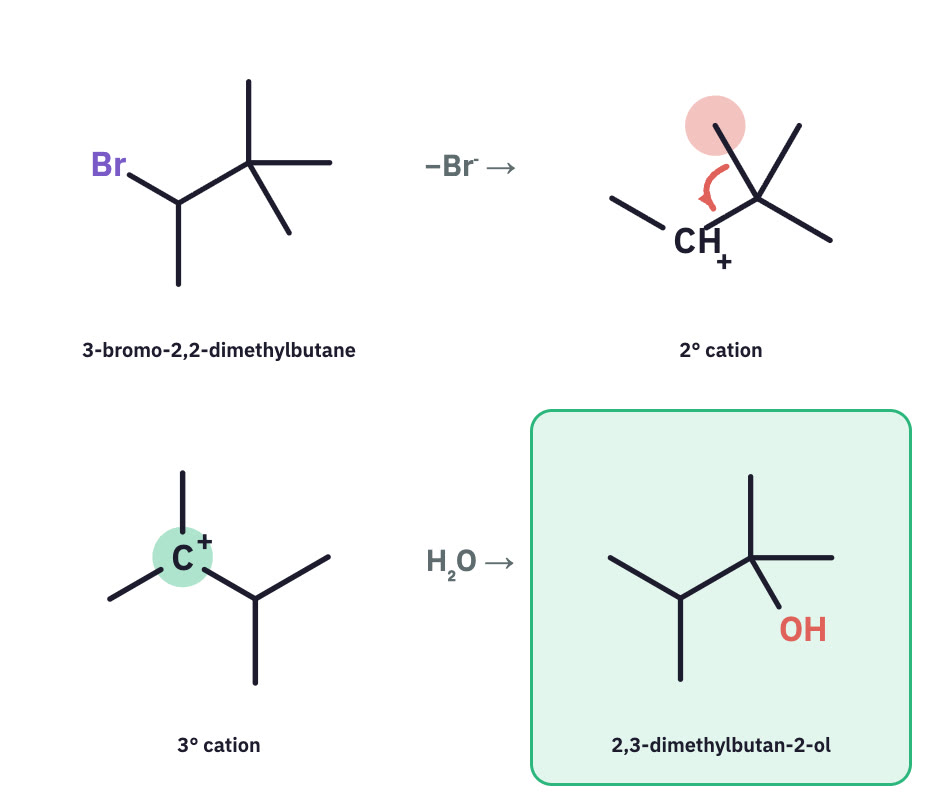
3-Bromo-2,2-dimethylbutane
2° cation → 1,2- shift → 3° cation → 2,3-dimethylbutan-2-ol.
Key formulas
One for every idea
1. 2-Chloro-2-methylpropane is hydrolysed in aqueous ethanol. If is doubled, what happens to the rate? Why?
- The slow step is ionisation of the substrate alone: Rate .
- joins only in the fast second step.
No change.
2. 3-Bromo-2,2-dimethylbutane is warmed in water. Give the main alcohol and the steps that lead to it.
- Ionisation gives the 2° cation .
- A 1,2-methyl shift gives the 3° cation .
- Water captures it.
2,3-Dimethylbutan-2-ol.
Your turn
2-Bromo-3-methylbutane is warmed in water. The main alcohol formed is:
Show the answer and the traps
2-Methylbutan-2-ol, option b: the 2° cation takes a hydride from C-3 and becomes 3°.
3-Methylbutan-2-ol is the unrearranged product, only minor.
3-Methylbutan-1-ol would need a 1° cation.
And so would 2-methylbutan-1-ol.
Common mistakes
Try these
1. Which statement is true for an SN1 reaction of a chiral 3° alkyl halide? (a) Rate depends on [Nu⁻] (b) Complete inversion occurs (c) Racemisation with some inversion occurs (d) No intermediate is formed
(c).
2. Neopentyl bromide is heated in ethanol. What is the main substitution product, and why isn't it neopentyl ethyl ether?
2-Ethoxy-2-methylbutane: the 1° cation rearranges by a methyl shift to the 3° cation before ethanol captures it.
3. (S)-3-Bromo-3-methylhexane undergoes SN1 hydrolysis. Is the product optically active?
Largely racemic (slight excess of the inverted alcohol), so it shows little or no optical activity.