 layrd.liveLayer by Layer
- 1. Inductive Effect
- 2. Carboxylic Acid Strength
- 3. Alcohols, Hydrocarbons, Amines
- 4. Electromeric & Mesomeric
- 5. Hyperconjugation
- 6. Fission & Free Radicals
- 7. Carbocations
- 8. Carbanions
- 9. Carbenes
- 10. Nitrenes & Benzyne
- 11. Electrophiles & Nucleophiles
- 12. Reaction Types
- 13. Free Radical Substitution
- 14. SN2 Reaction
- 15. SN1 Reaction
- 16. SN1 vs SN2
- 17. Electrophilic Substitution
- 18. Markovnikov's Rule
- 19. Br₂ Addition & Dienes
- 20. Peroxide Effect
- 21. Nucleophilic Addition
- 22. E1, E1cB & Saytzeff
- 23. E2 Elimination
E2 Elimination and Anti-periplanar Geometry
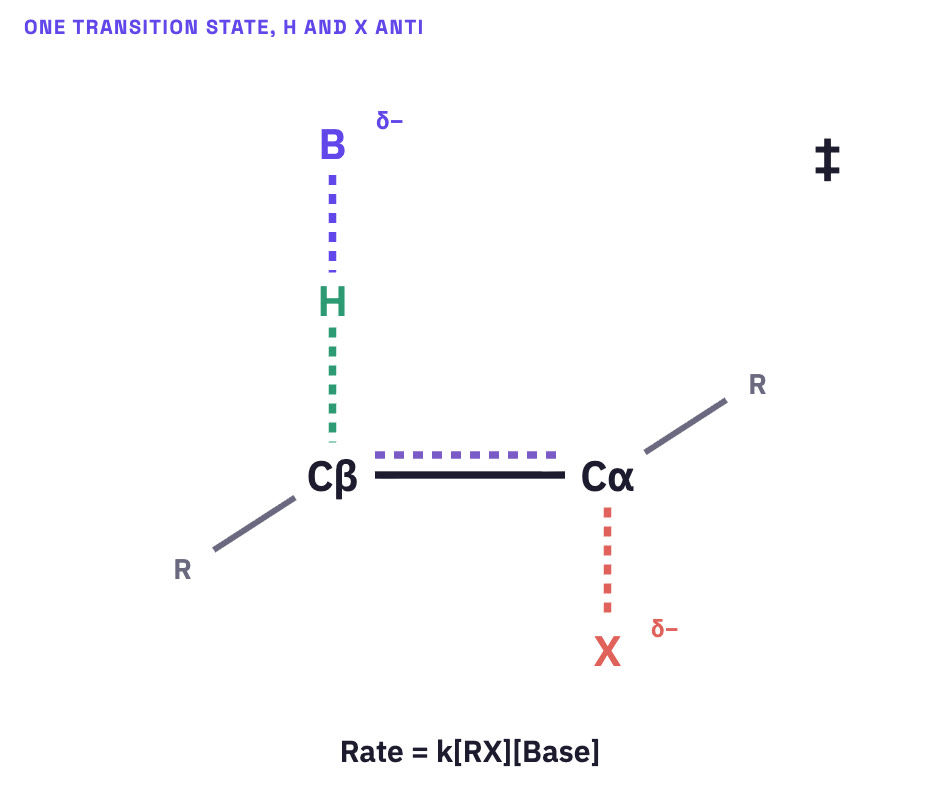
In E2 everything happens in one step: the base removes the β-H, the C=C forms and the leaving group departs together, through a single transition state. The rate depends on both the substrate and the base. Because the C–H and C–X orbitals must line up into the new π bond, H and X must be anti-periplanar. That makes E2 stereospecific: the conformer that reacts fixes the geometry of the alkene.
Builds on: Part 14 · SN2 Reaction: Mechanism, Walden Inversion and Rates, Part 22 · E1 and E1cB Eliminations: Saytzeff vs Hofmann.
 Video coming soon
One transition state
Rate = k[RX][Base]. In the transition state the base, the β-H, both carbons and X lie in one plane, with partial bonds B···H···Cβ···Cα···X and H anti to X. Example: . Primary alcohols dehydrate this way too.
The leaving group matters
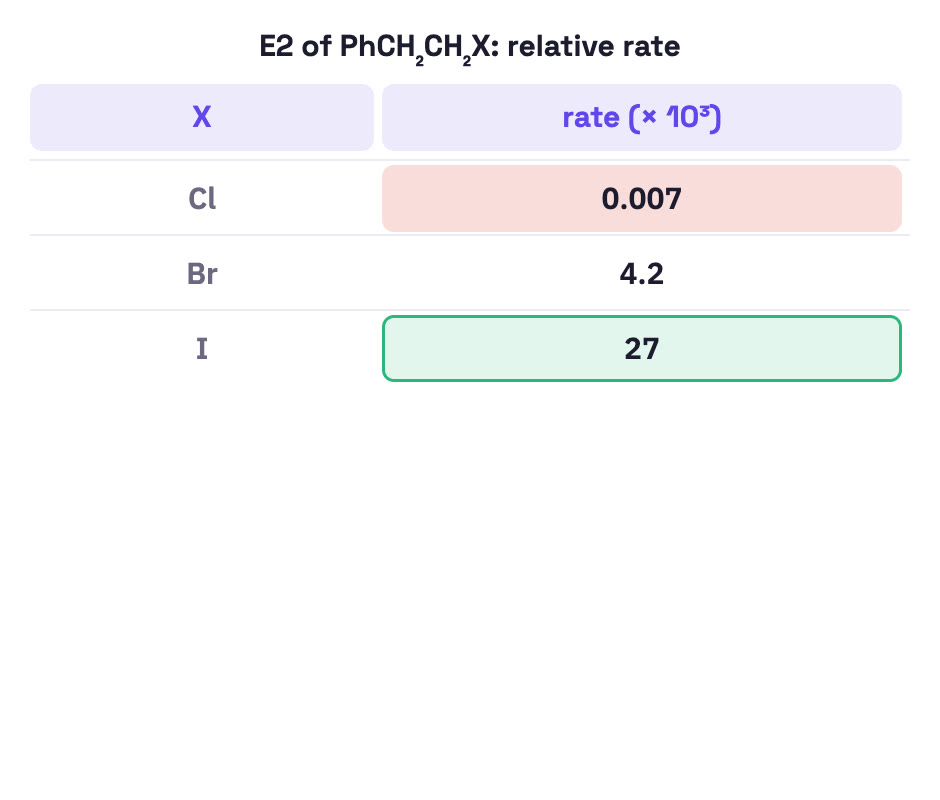
Relative E2 rates for (× 10³): Cl 0.007, Br 4.2, I 27. C–X breaks in the rate-determining step, so the better leaving group reacts faster. E2 has the lowest-energy path of the three eliminations, so it is the most common.
Syn- vs anti-periplanar
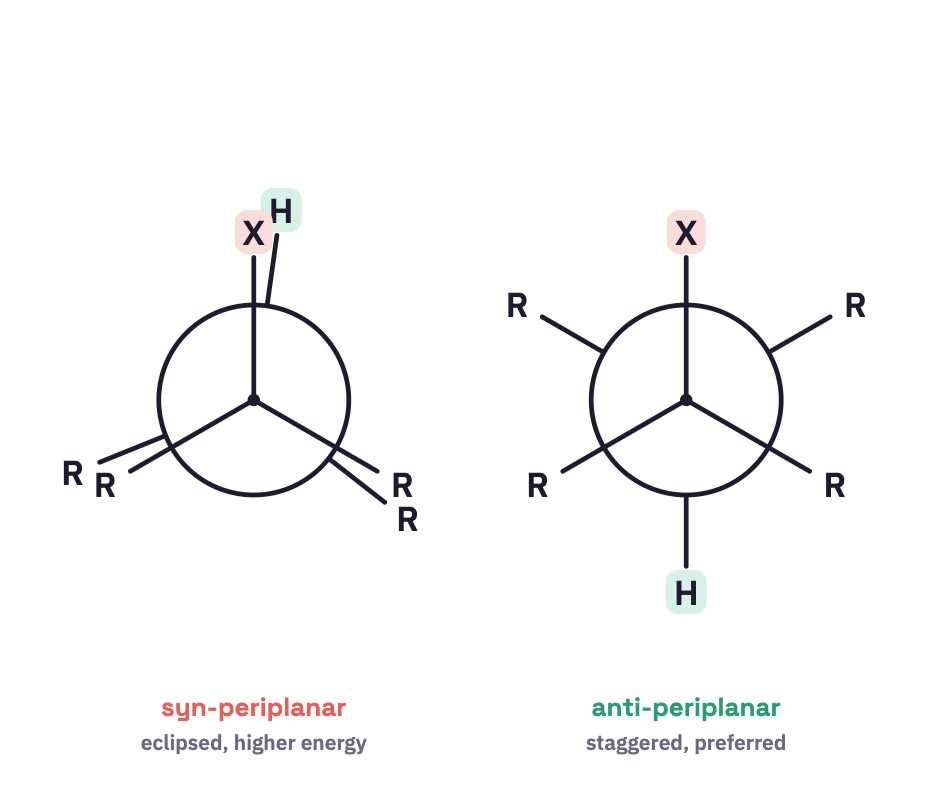
Periplanar: H, the two carbons and X in one plane. Syn-periplanar (same side) is eclipsed and higher in energy; anti-periplanar (opposite sides) is staggered, lower in energy and preferred.
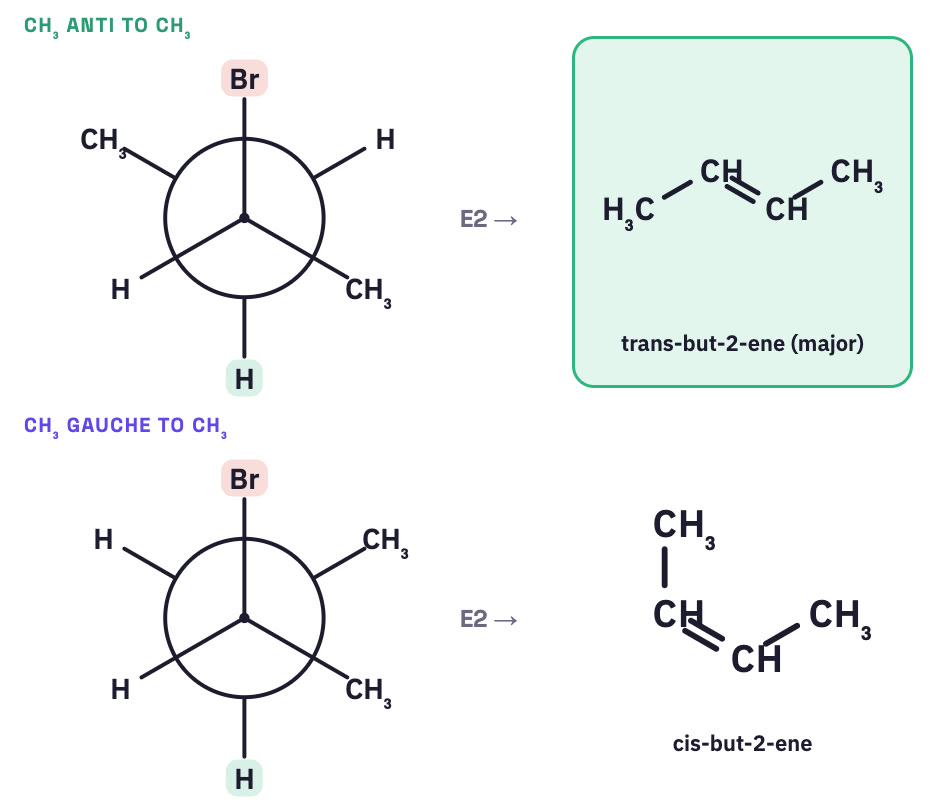
2-Bromobutane: trans or cis
Two conformers of 2-bromobutane put an H on C-3 anti to Br. With the methyls also anti, E2 gives trans-but-2-ene (major, more stable); with the methyls gauche, it gives cis-but-2-ene.
Key formulas
One for every idea
1. Using the book's relative E2 rates (PhCH₂CH₂Cl 0.007 × 10³, PhCH₂CH₂Br 4.2 × 10³), how many times faster does the bromide react? What does this show?
- .
- C–X breaks in the rate-determining step.
600 times faster: a better leaving group (Br⁻ vs Cl⁻) speeds E2.
2. In 2-bromobutane, rotate about C2–C3 so that H on C-3 is anti to Br. In the conformer where the two CH₃ groups are also anti, which but-2-ene forms by E2?
- H and Br leave from opposite sides; the other groups keep their places around the new C=C.
- The anti methyls end up on opposite sides of the double bond.
trans-But-2-ene, also the more stable, major product.
Your turn
An elimination follows Rate = k[RX][Base], shows no rearrangement and needs the β-H anti-periplanar to X. The mechanism is:
Show the answer and the traps
E2, option c: one step, second order, anti-periplanar.
E1 is first order and goes through a carbocation, which can rearrange.
E1cB goes through a carbanion, and SN2 gives substitution, not an alkene.
Common mistakes
Try these
1. For an E2 reaction, the preferred arrangement of the β-H and the leaving group is: (a) syn-periplanar (b) anti-periplanar (c) gauche (d) perpendicular
(b) Anti-periplanar: staggered and lower in energy.
2. Write the rate law for E2 and say what doubling [base] does.
Rate = k[RX][Base]; doubling [base] doubles the rate.
3. 1-Bromo-1-methylcyclohexane is heated with (a) C₂H₅ONa and (b) KO-t-Bu. Which alkene does each base favour?
(a) 1-Methylcyclohexene (endocyclic, Saytzeff). (b) The bulky base removes the less hindered CH₃ hydrogens, shifting the product towards methylenecyclohexane (exocyclic, Hofmann).
4. Neopentyl bromide, (CH₃)₃CCH₂Br, is heated in ethanol. Why does it give 2-methylbut-2-ene and not a simple alkene?
It has no β-H, so E2 is impossible; ionisation gives a 1° cation that undergoes a 1,2-methyl shift to the 3° cation, which loses H⁺ (E1) to give 2-methylbut-2-ene.