 layrd.liveLayer by Layer
- 1. Inductive Effect
- 2. Carboxylic Acid Strength
- 3. Alcohols, Hydrocarbons, Amines
- 4. Electromeric & Mesomeric
- 5. Hyperconjugation
- 6. Fission & Free Radicals
- 7. Carbocations
- 8. Carbanions
- 9. Carbenes
- 10. Nitrenes & Benzyne
- 11. Electrophiles & Nucleophiles
- 12. Reaction Types
- 13. Free Radical Substitution
- 14. SN2 Reaction
- 15. SN1 Reaction
- 16. SN1 vs SN2
- 17. Electrophilic Substitution
- 18. Markovnikov's Rule
- 19. Br₂ Addition & Dienes
- 20. Peroxide Effect
- 21. Nucleophilic Addition
- 22. E1, E1cB & Saytzeff
- 23. E2 Elimination
Peroxide Effect: Anti-Markovnikov Addition
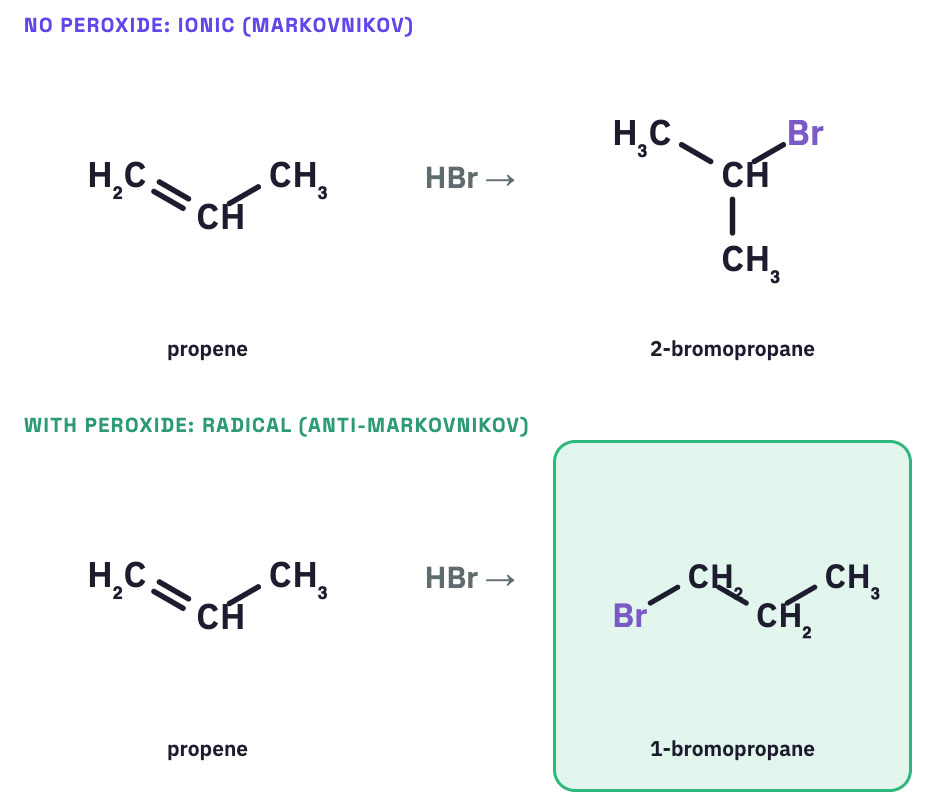
Propene and HBr give 2-bromopropane, as Markovnikov's rule predicts. With a trace of peroxide the product becomes 1-bromopropane. This is the Kharasch (peroxide) effect. The addition switches to a radical chain in which Br• adds first, to the end that gives the more stable radical. Only HBr shows it. Alkenes carrying −I/−M groups, and radical addition of halogens, are other routes to anti-Markovnikov products.
Builds on: Part 13 · Free Radical Substitution: Chlorination of Methane and NBS, Part 18 · Electrophilic Addition: Markovnikov's Rule and Rearrangements.
 Video coming soon
Same reagents, opposite product
Without peroxide the addition is ionic: H⁺ adds first to give the 2° cation, so the product is 2-bromopropane. With a peroxide such as benzoyl peroxide the addition is radical and gives 1-bromopropane (anti-Markovnikov).
The radical chain
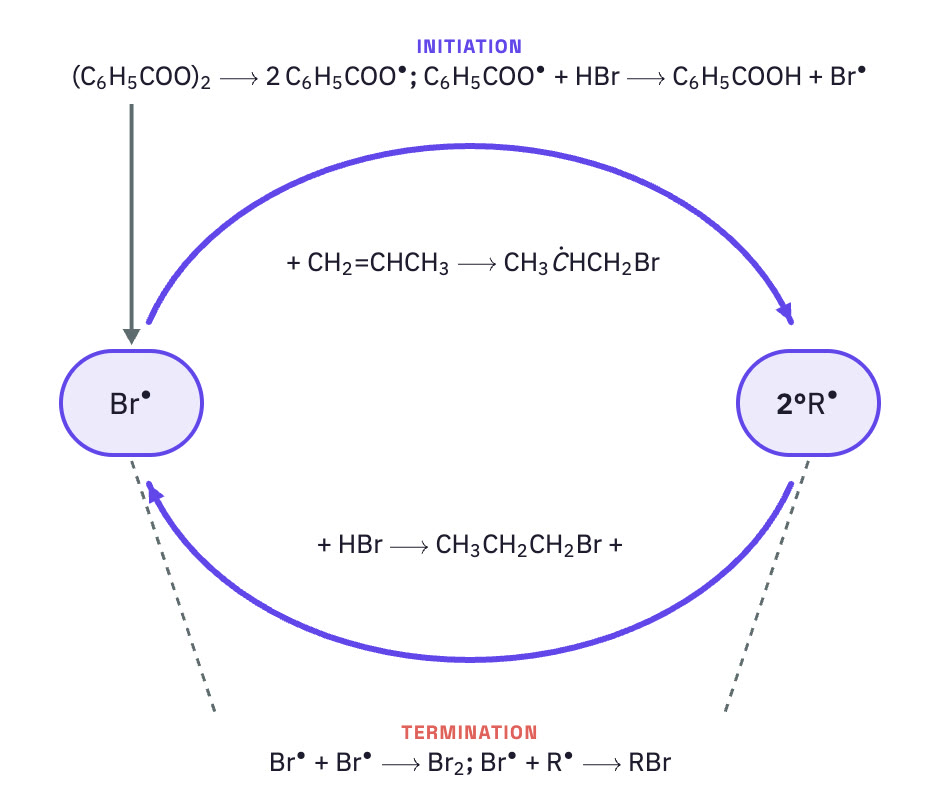
Initiation: ; . Propagation: adds to the end, giving the 2° radical , which takes H from HBr to give . Termination: ; .
2-Methylpropene + HBr
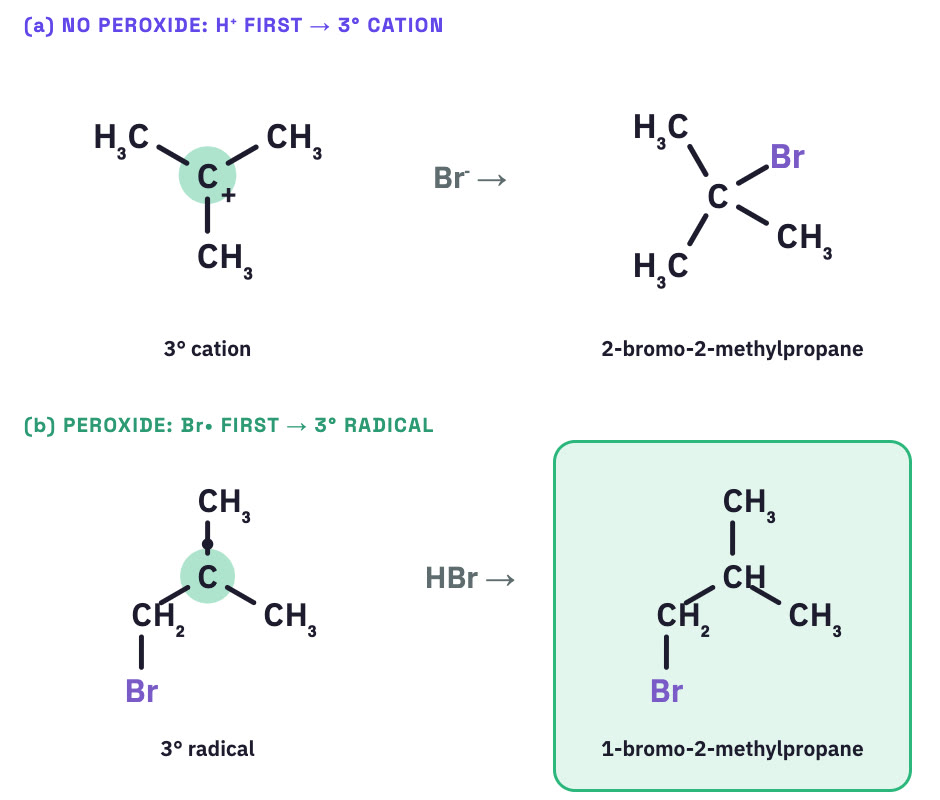
(a) No peroxide: H⁺ gives the 3° cation, so the product is 2-bromo-2-methylpropane. (b) Peroxide: Br• gives the 3° radical , which takes H from HBr, so the product is 1-bromo-2-methylpropane.
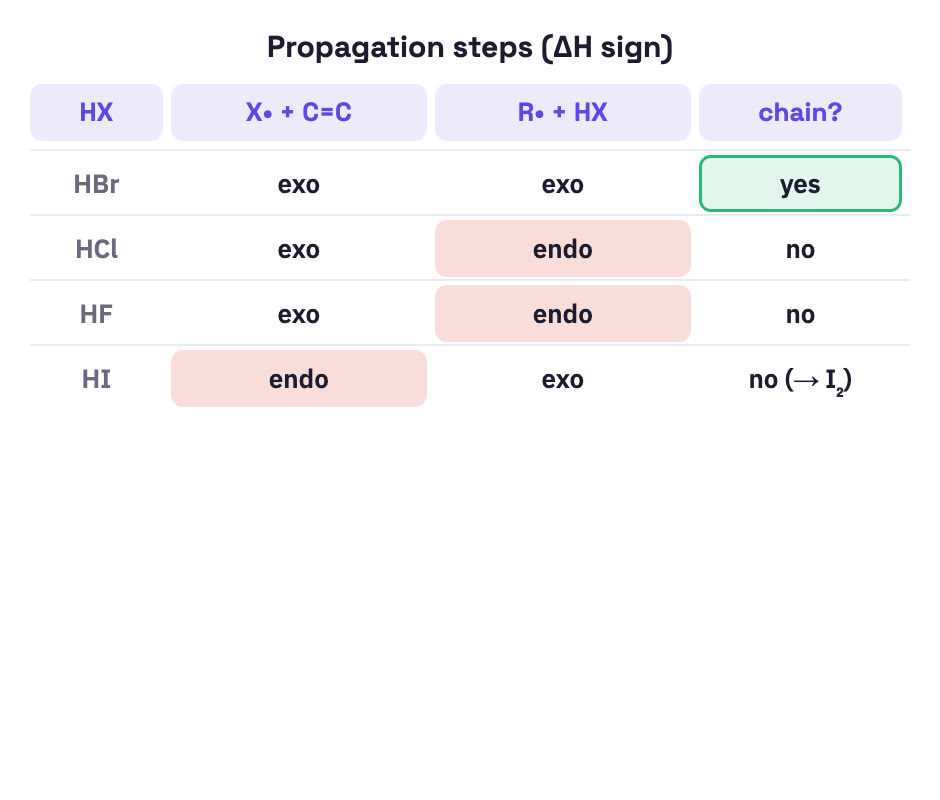
Both steps must be exothermic
A chain runs only if both propagation steps are exothermic. HBr: both are. HCl and HF: the strong H–X bond makes the second step (R• + HX) endothermic. HI: the first step (I• + alkene) is endothermic, so iodine atoms combine to I₂ instead.
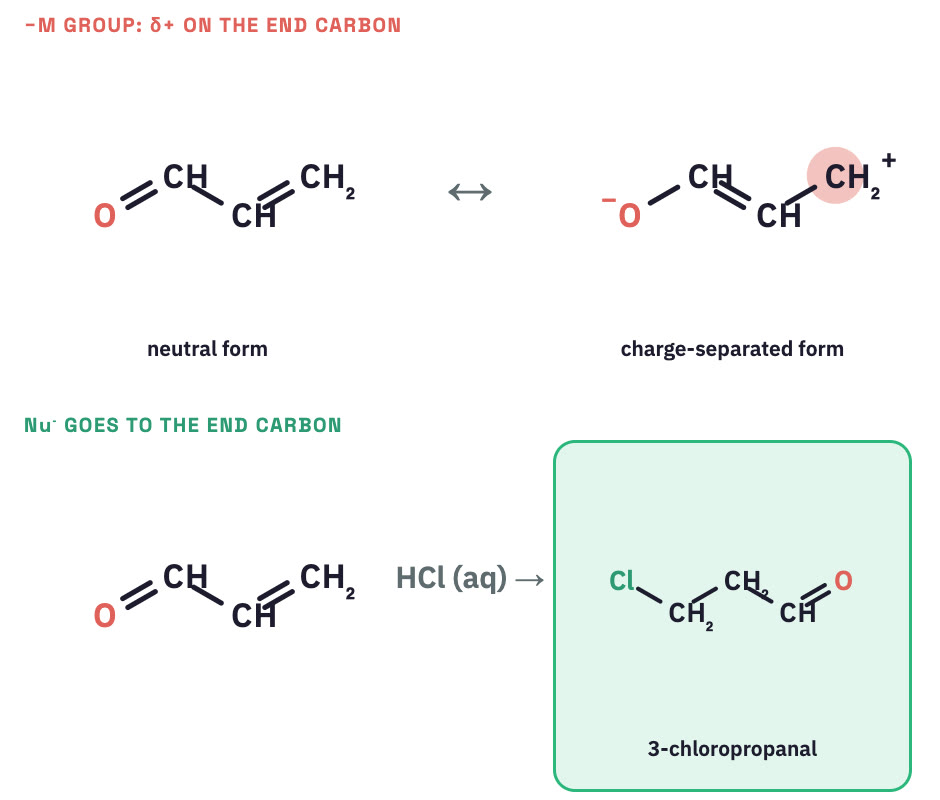
Acrolein + HCl
With –NO₂, –CN, –CHO, –COR or –CX₃ on the C=C, even ionic addition can go anti-Markovnikov. Acrolein: puts δ+ on the end carbon, so aqueous HCl gives 3-chloropropanal.
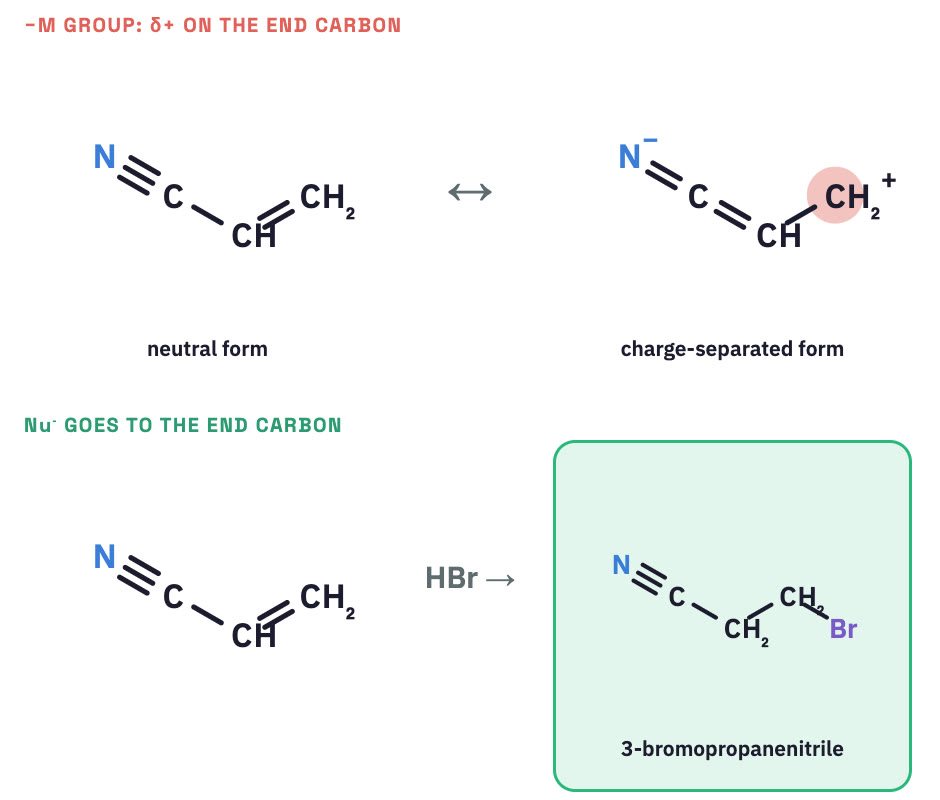
Acrylonitrile + HBr
–CN is −M: , so the terminal is electron-poor and Br⁻ ends up there: (3-bromopropanenitrile).
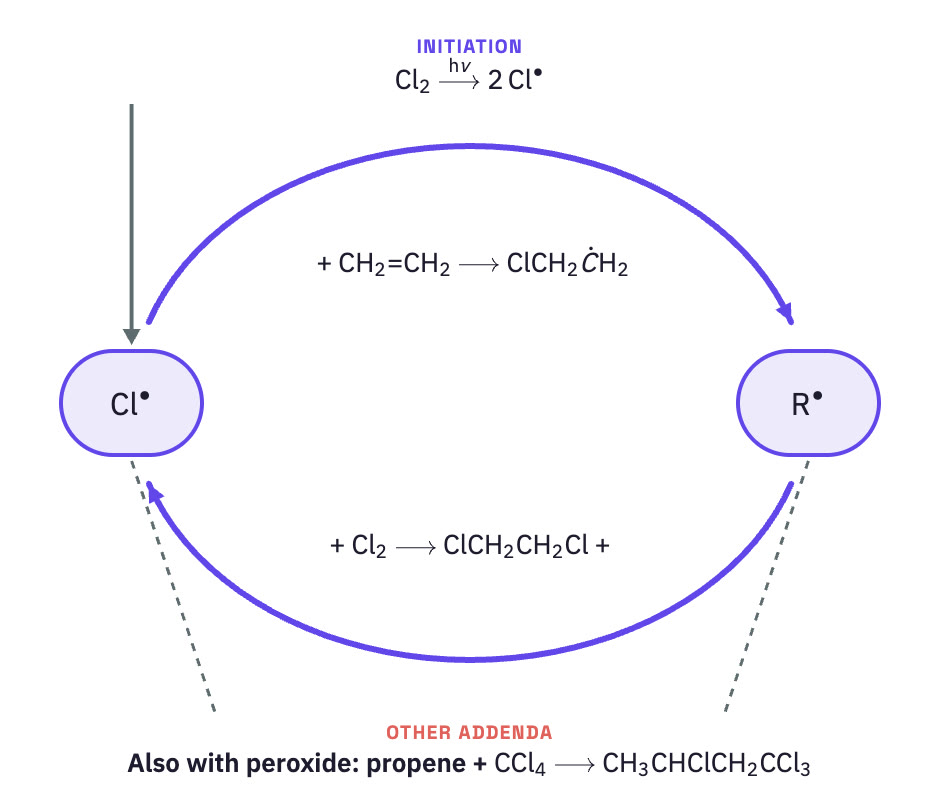
Halogens add by a chain
In the vapour phase or non-polar solvents, under light or with peroxide: ; ; . and add the same way with peroxide: propene + .
One for every idea
1. Predict the products of 2-methylpropene with HBr (a) without and (b) with benzoyl peroxide.
- (a) Ionic: H⁺ adds first, giving the 3° cation ; Br⁻ captures it.
- (b) Radical: Br• adds to , giving the 3° radical , which takes H from HBr.
(a) 2-Bromo-2-methylpropane; (b) 1-bromo-2-methylpropane.
2. Predict the product of HBr with acrylonitrile (CH₂=CH–CN), and say why it is not the Markovnikov product.
- –CN is −M: .
- The terminal is electron-poor, so Br⁻ adds there.
(3-bromopropanenitrile).
3. Write the propagation steps for the light-induced addition of Cl₂ to propene, and give the product.
- (2° radical).
1,2-Dichloropropane.
Your turn
Propene reacts with HBr in the presence of benzoyl peroxide. The main product is:
Show the answer and the traps
1-Bromopropane, option b: Br• adds to CH₂, giving the 2° radical.
2-Bromopropane is the product without peroxide, by the ionic path.
1,2-Dibromopropane needs Br₂, and 3-bromopropene comes from allylic substitution, as with NBS.
Common mistakes
Try these
1. The peroxide effect is observed with: (a) HCl (b) HBr (c) HI (d) HF
(b) HBr: only with HBr are both propagation steps exothermic.
2. Give the product of but-1-ene + HBr in the presence of peroxide.
1-Bromobutane (Br• adds to C-1, giving the 2° radical).
3. Why does HI not show the peroxide effect?
I• + alkene is endothermic, so iodine atoms combine to I₂ instead of adding.
4. Propene + CCl₄ with peroxide gives what?
CH₃CHClCH₂CCl₃ (1,1,1,3-tetrachlorobutane): •CCl₃ adds to CH₂, the 2° radical takes Cl from CCl₄.