 layrd.liveLayer by Layer
- 1. Inductive Effect
- 2. Carboxylic Acid Strength
- 3. Alcohols, Hydrocarbons, Amines
- 4. Electromeric & Mesomeric
- 5. Hyperconjugation
- 6. Fission & Free Radicals
- 7. Carbocations
- 8. Carbanions
- 9. Carbenes
- 10. Nitrenes & Benzyne
- 11. Electrophiles & Nucleophiles
- 12. Reaction Types
- 13. Free Radical Substitution
- 14. SN2 Reaction
- 15. SN1 Reaction
- 16. SN1 vs SN2
- 17. Electrophilic Substitution
- 18. Markovnikov's Rule
- 19. Br₂ Addition & Dienes
- 20. Peroxide Effect
- 21. Nucleophilic Addition
- 22. E1, E1cB & Saytzeff
- 23. E2 Elimination
Nitrenes and Benzyne
Two more electron-deficient intermediates (both JEE Advanced). A nitrene, R–N:, is nitrogen's version of a carbene: neutral, with a sextet; it forms from azides and gives aziridines or C–H insertion. Benzyne, C₆H₄, is benzene missing two neighbouring H atoms; its extra 'triple bond' is a weak in-plane overlap, so nucleophiles add at either end, giving cine-substitution.
Builds on: Part 9 · Carbenes: Singlet, Triplet and Their Reactions.
 Video coming soon
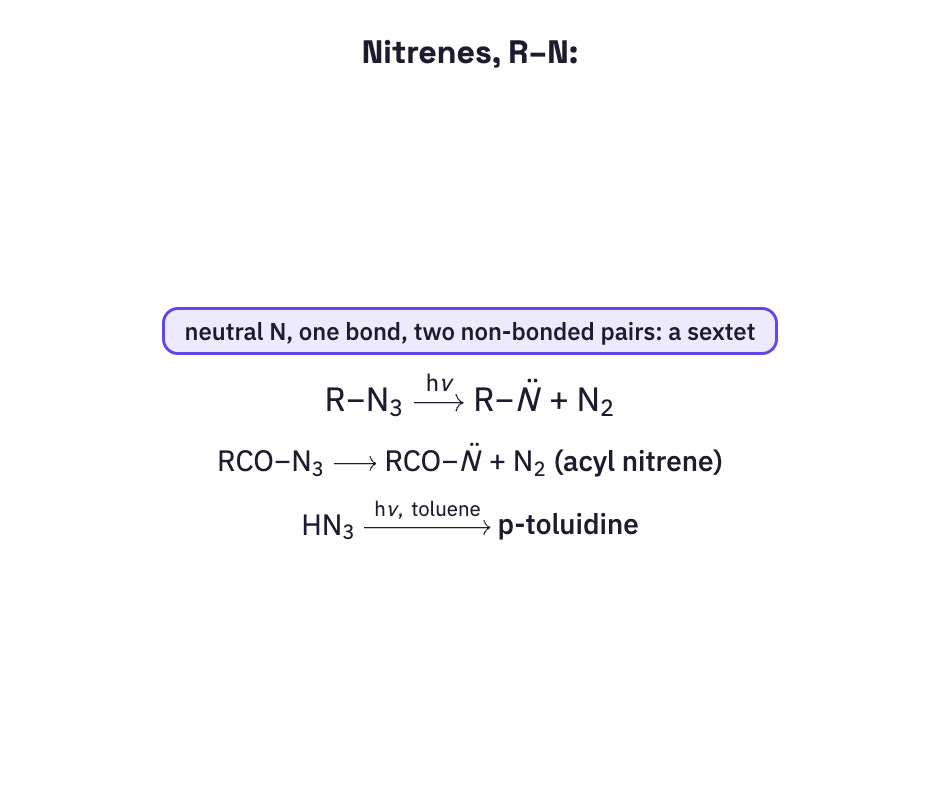
R–N: with a sextet
One bond and two non-bonded pairs on a neutral N: a strong electrophile. The triplet is the ground state. Formed from azides (), acyl azides (acyl nitrenes), or under UV (in toluene: p-toluidine).
What nitrenes do
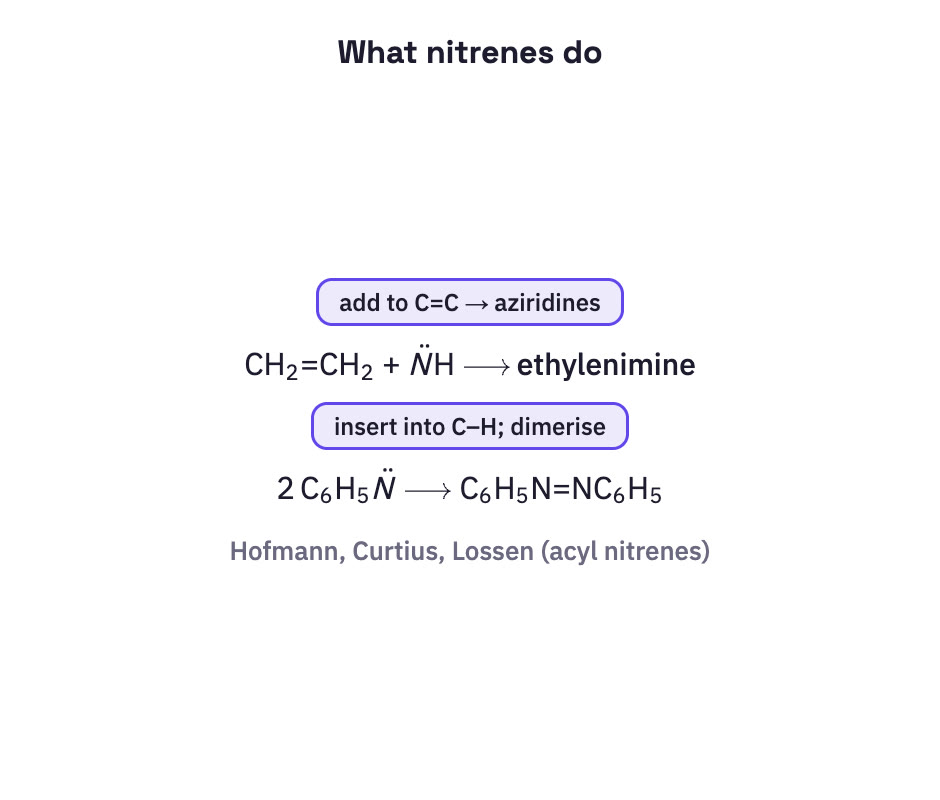
Add to C=C to give aziridines (ethylene → ethylenimine), insert into C–H bonds (acetylnitrene + isobutane → acetyl tert-butylamine), and dimerise (phenylnitrene → azobenzene). Acyl nitrenes appear in the Hofmann, Curtius and Lossen rearrangements.
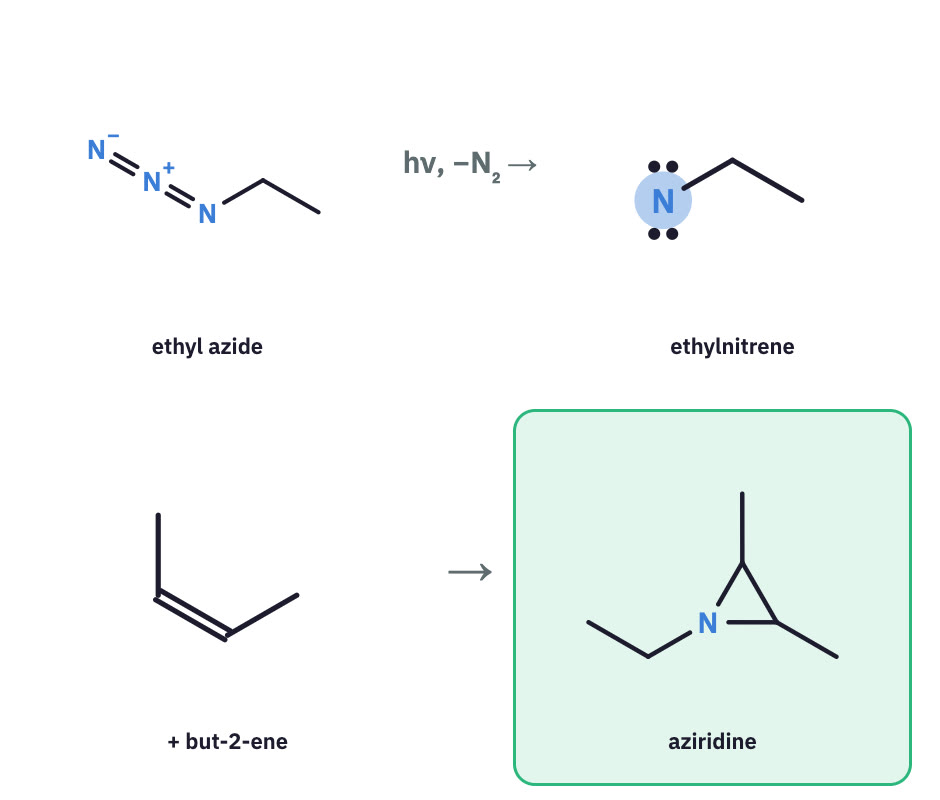
Ethyl azide + but-2-ene
; the nitrene adds across C=C to give 1-ethyl-2,3-dimethylaziridine.
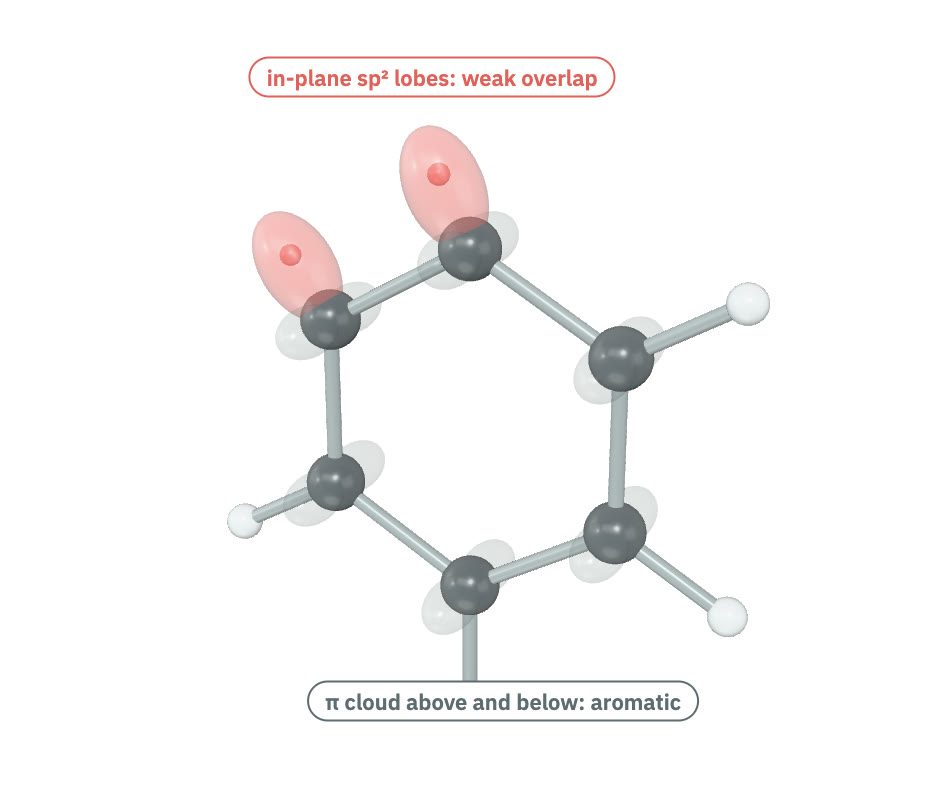
A weak in-plane bond
The extra bond is a sideways overlap of two sp² orbitals in the ring plane, separate from the aromatic π cloud. The ring holds them at the wrong angle, so the overlap (and the bond) is weak.
Making benzyne
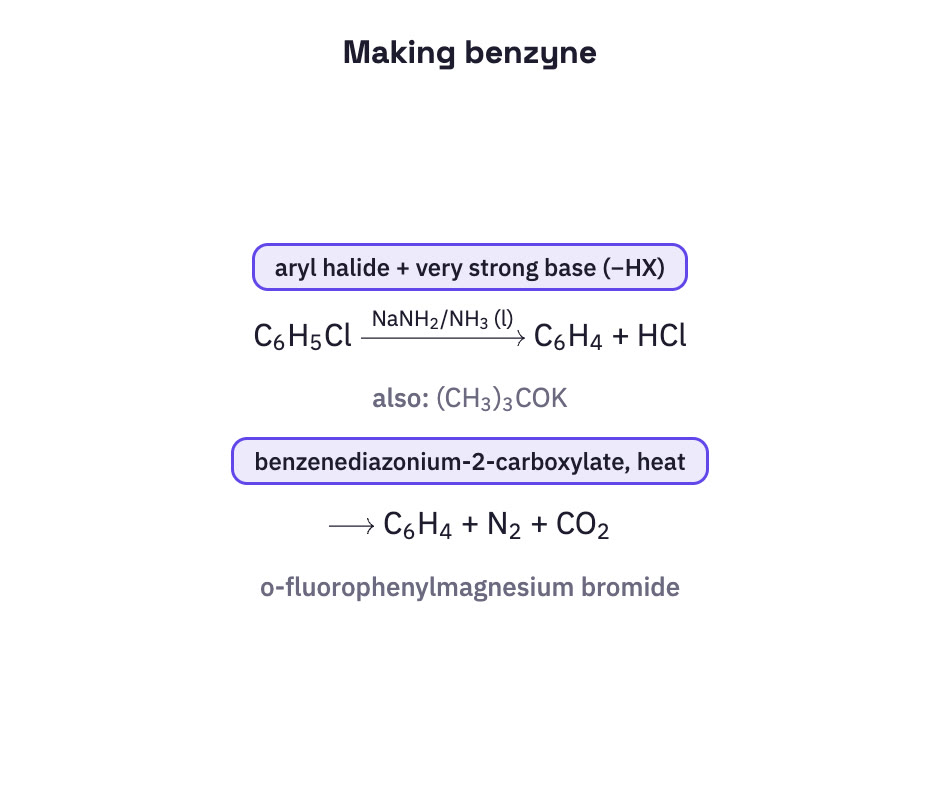
Aryl halide + /liq. or (−HX); benzenediazonium-2-carboxylate on heating (−N₂, −CO₂); o-fluorophenylmagnesium bromide.
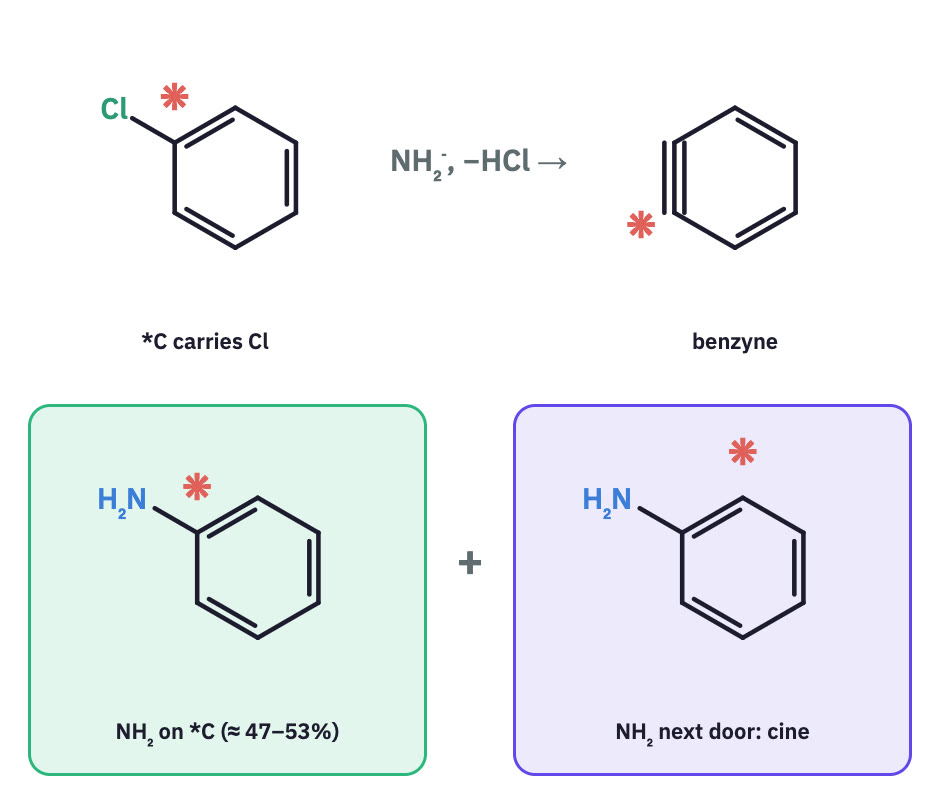
Cine-substitution
With ¹⁴C on the carbon carrying Cl, chlorobenzene + gives two anilines in about equal amounts (47 % and 53 %): NH₂ on the labelled carbon, or on its neighbour (cine-substitution).
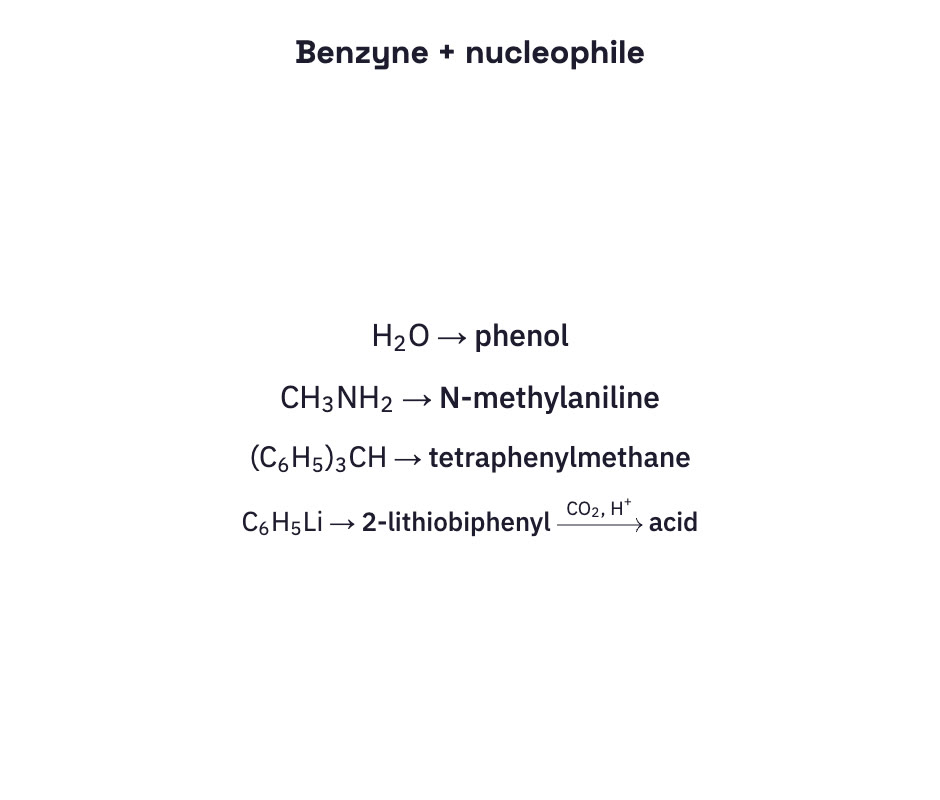
Benzyne + nucleophile
→ phenol; → N-methylaniline; → tetraphenylmethane; → 2-lithiobiphenyl → (CO₂, H⁺) biphenyl-2-carboxylic acid.
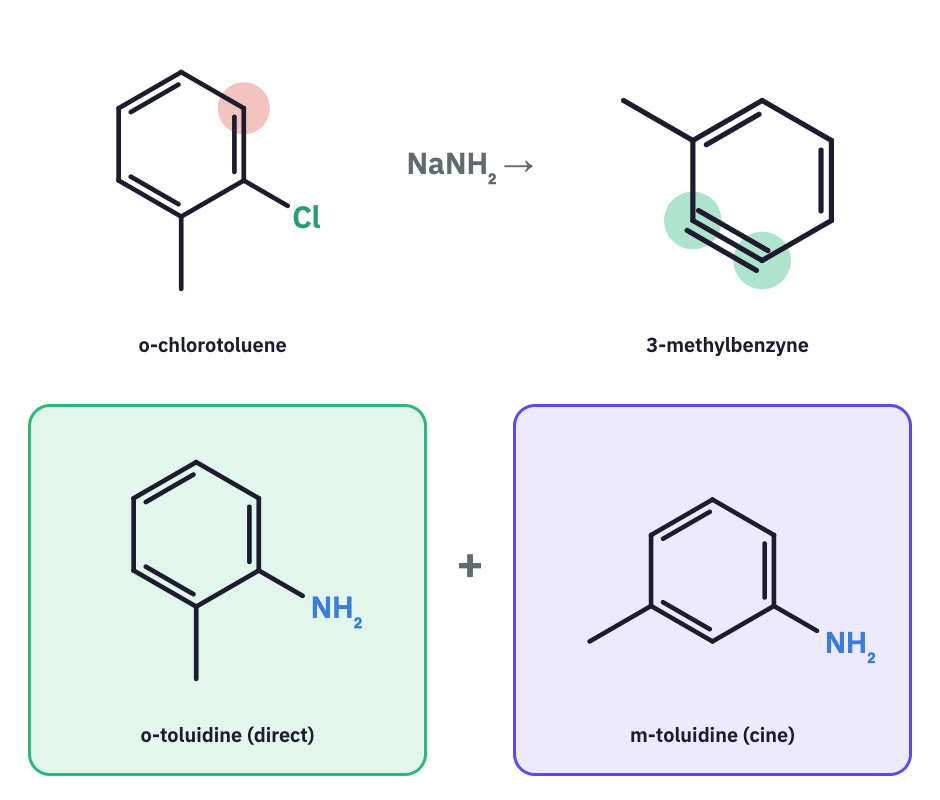
o-Chlorotoluene + NaNH₂
Only C-6 has an H next to Cl, so 3-methylbenzyne forms (C-1≡C-6). adds at C-1 (o-toluidine) or C-6 (m-toluidine, cine).
One for every idea
1. Ethyl azide is photolysed in the presence of but-2-ene. Name the intermediate and the type of product.
- (ethylnitrene).
- The nitrene adds across the C=C.
An aziridine: 1-ethyl-2,3-dimethylaziridine.
2. Why is the 'triple bond' in benzyne much weaker than the one in ethyne?
- Benzyne's extra bond is a sideways overlap of two sp² orbitals in the ring plane, held at the wrong angle.
- Ethyne's π bonds come from good p–p overlap on a linear molecule.
Poor overlap makes benzyne's extra bond weak and very reactive.
3. o-Chlorotoluene is treated with in liquid . Which benzyne forms, and which toluidines can result?
- H at C-6 is removed and Cl leaves: 3-methylbenzyne (triple bond C-1/C-6).
- adds at C-1 or C-6.
o-Toluidine (NH₂ at the old Cl carbon) and m-toluidine (cine product).
Your turn
p-Chlorotoluene is treated with NaNH2 in liquid NH3. The products are:
Show the answer and the traps
p- and m-toluidine, option c. NH₂⁻ adds at either end of the benzyne.
Only p-toluidine misses the cine product.
Only m-toluidine misses the direct product.
And o-toluidine would need NH₂ next to CH₃, which neither end of the benzyne is.
Common mistakes
Try these
1. Which species has a nitrogen atom with only six electrons in its valence shell? (a) (b) (c) (d)
(b) phenylnitrene.
2. m-Chloroanisole (Cl and OCH₃ meta) is treated with /liq. . Which anilines can form via the benzyne routes?
Removing H at C-2 or C-4 gives two benzynes; amination gives o-, m- and p-anisidine (via addition at either end).
3. What product does benzyne give with water?
Phenol.
4. Name the product of phenylnitrene dimerisation.
Azobenzene, .