 layrd.liveLayer by Layer
- 1. Inductive Effect
- 2. Carboxylic Acid Strength
- 3. Alcohols, Hydrocarbons, Amines
- 4. Electromeric & Mesomeric
- 5. Hyperconjugation
- 6. Fission & Free Radicals
- 7. Carbocations
- 8. Carbanions
- 9. Carbenes
- 10. Nitrenes & Benzyne
- 11. Electrophiles & Nucleophiles
- 12. Reaction Types
- 13. Free Radical Substitution
- 14. SN2 Reaction
- 15. SN1 Reaction
- 16. SN1 vs SN2
- 17. Electrophilic Substitution
- 18. Markovnikov's Rule
- 19. Br₂ Addition & Dienes
- 20. Peroxide Effect
- 21. Nucleophilic Addition
- 22. E1, E1cB & Saytzeff
- 23. E2 Elimination
Carbanions: Structure and Stability
A carbanion is a carbon that keeps the bonding pair: eight electrons, a negative charge, and a lone pair that makes it a nucleophile. Simple carbanions are pyramidal like ammonia. Everything that stabilised a carbocation now works in reverse: +I alkyl groups destabilise, while −I groups, s-character and resonance spread the charge.
Builds on: Part 7 · Carbocations: Structure and Stability.
 Video coming soon
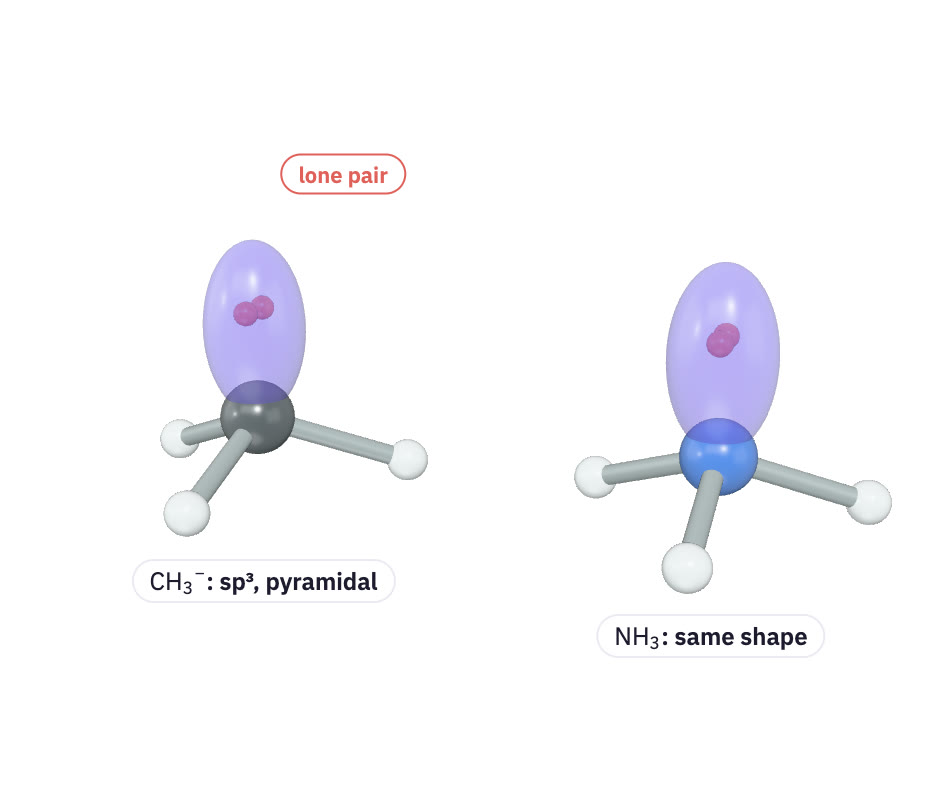
Pyramidal, like ammonia
A simple carbanion is sp³ with its lone pair in one hybrid orbital, the same shape as . All electrons are paired, so it is diamagnetic.
Ethyl acetoacetate carbanion
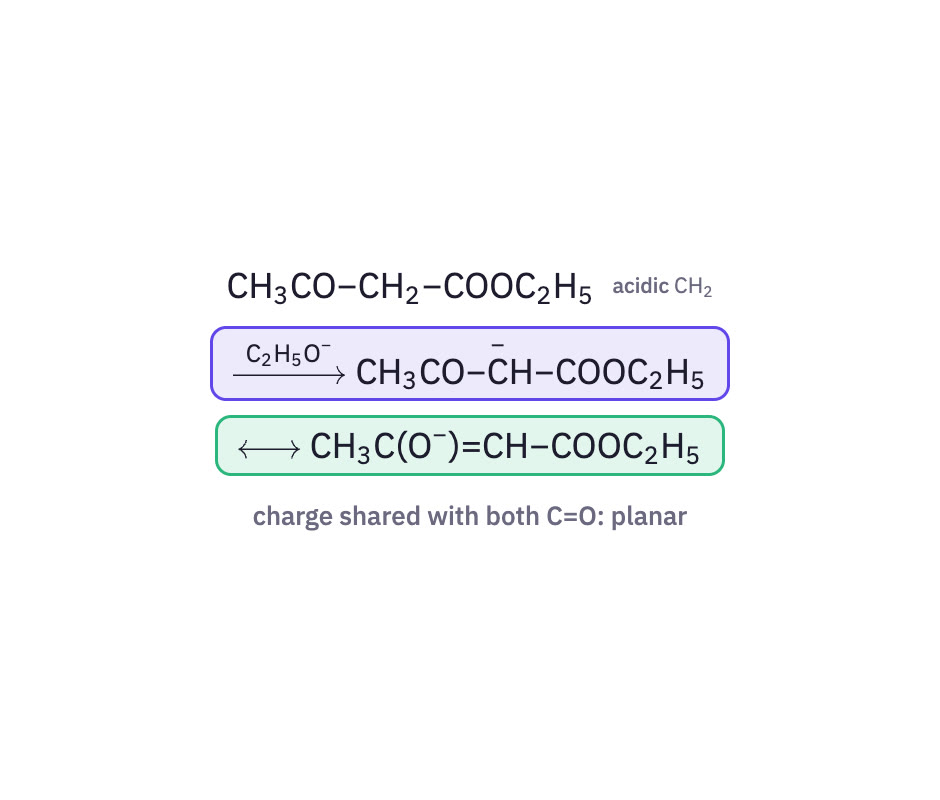
Ethoxide removes an H from the between the two C=O groups. The carbanion carbon has 8 valence electrons; because its charge is shared with both carbonyl oxygens, it is planar (sp²) in practice, not sp³.
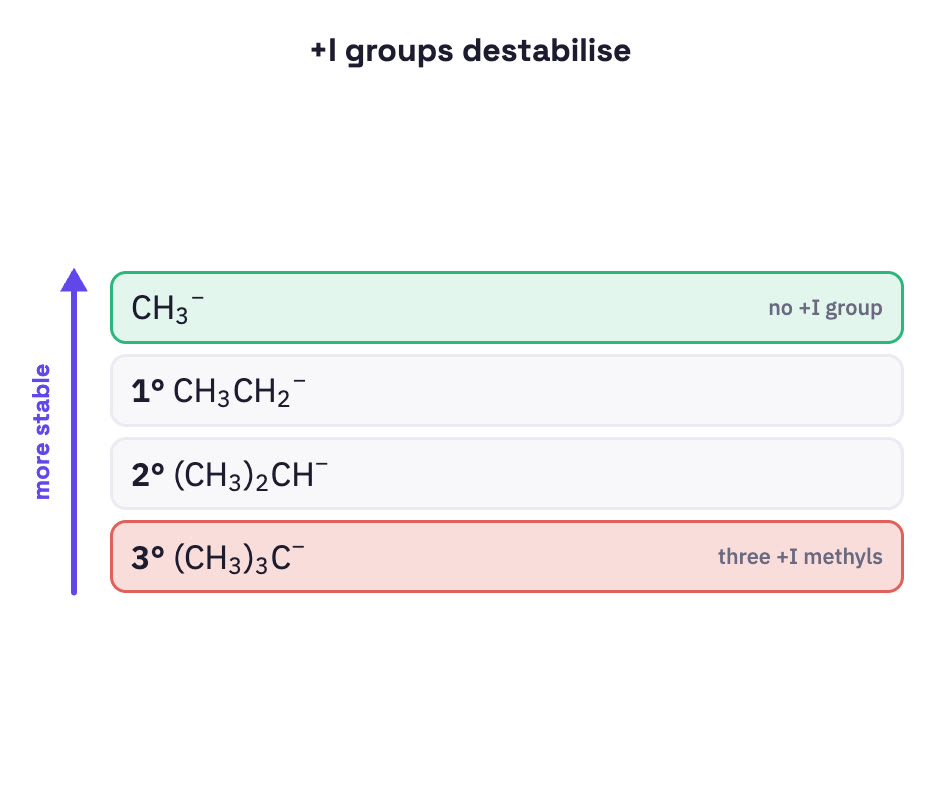
> 1° > 2° > 3°
+I alkyl groups push more charge onto the carbanion and destabilise it: the reverse of the carbocation order.
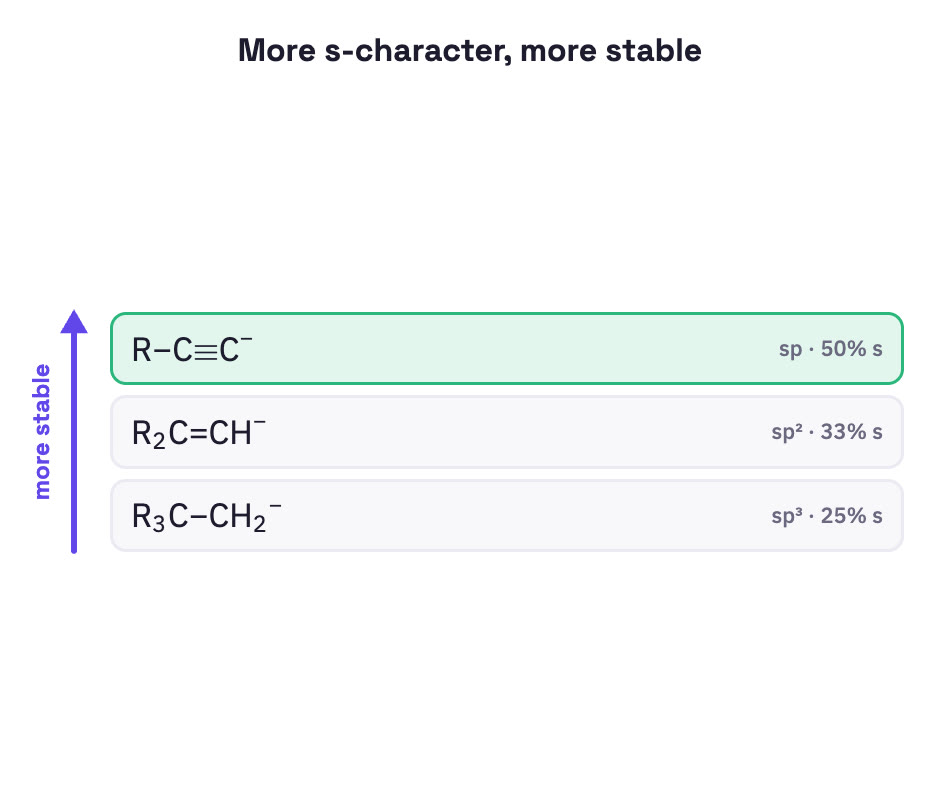
More s-character, more stable
(50 % s) > (33 %) > (25 %).
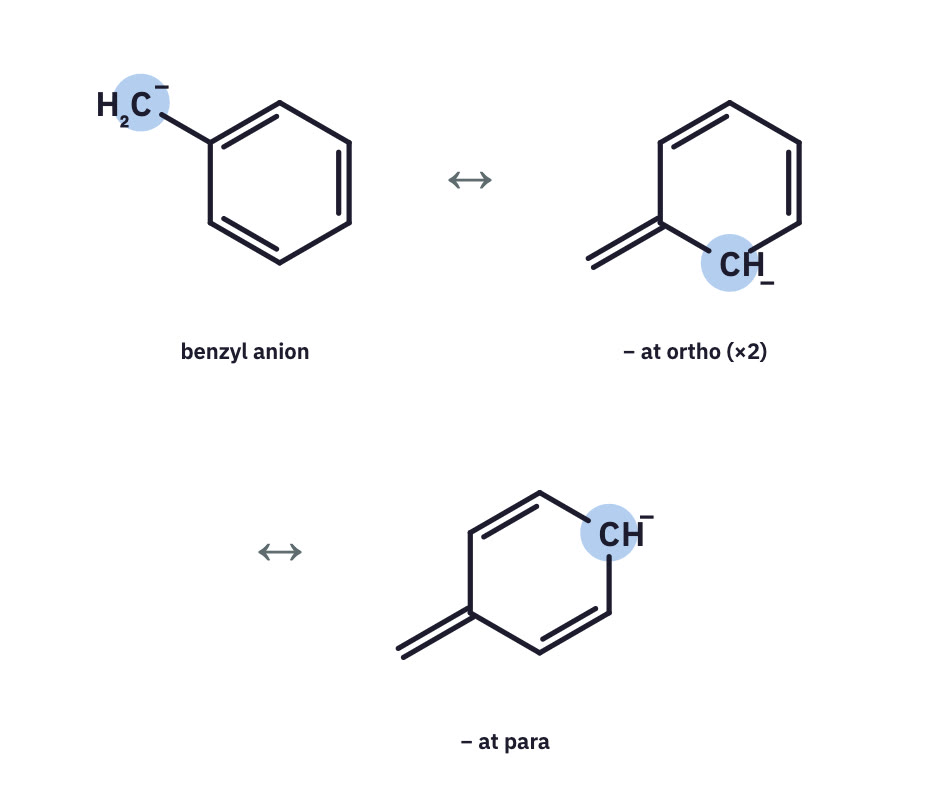
The benzyl anion
The charge spreads to the ortho and para carbons. > > ; substituted benzyl anions: p-NO₂ > H > p-CH₃ > p-OCH₃. The book lists benzyl and allyl above ; by (ethyne 25, toluene ≈ 41) the acetylide is actually the more stable anion.
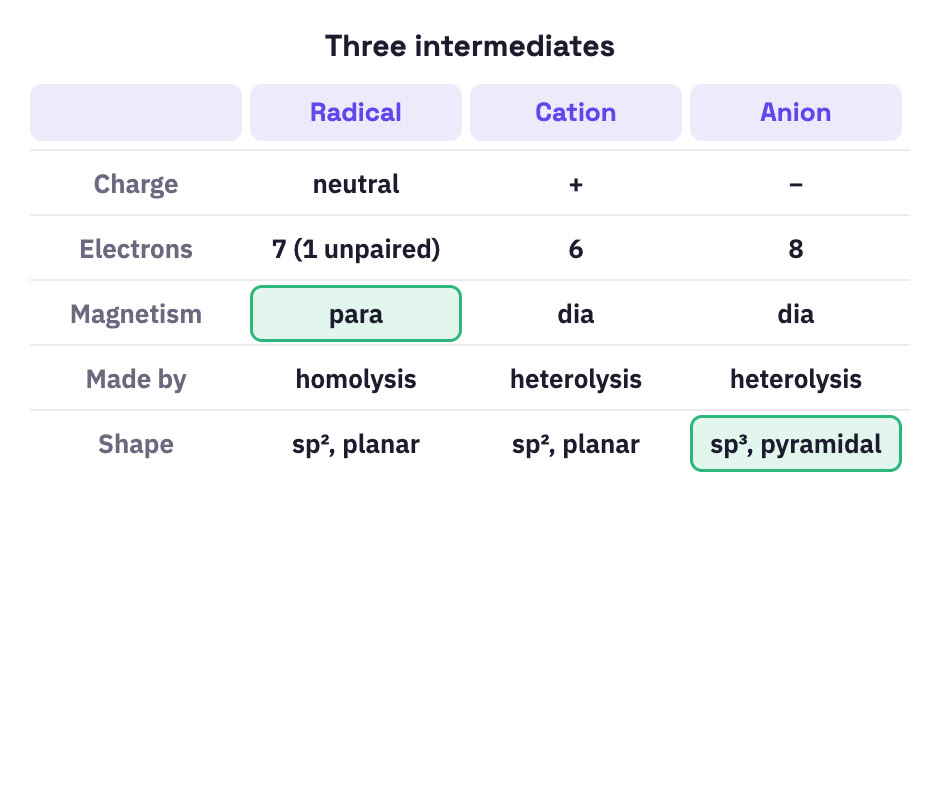
Radical, cation, anion
Charge: neutral, +, −. Electrons: 7, 6, 8. Magnetism: para, dia, dia. Made by homolysis, heterolysis, heterolysis. Shape: sp² planar, sp² planar, sp³ pyramidal.
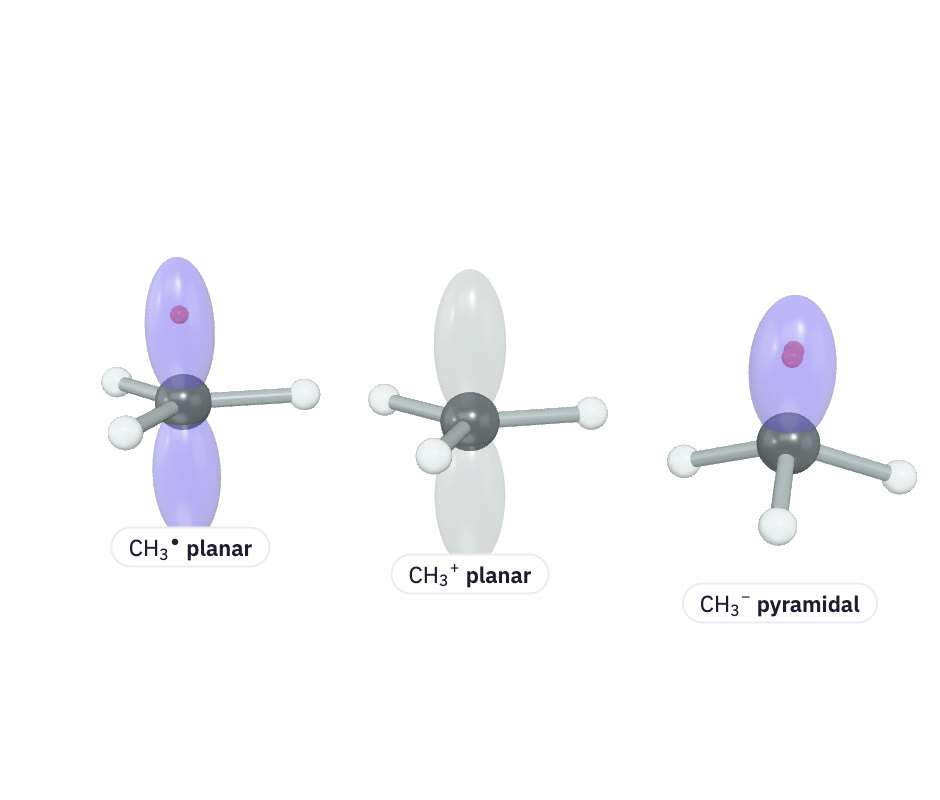
, ,
The radical and the cation are planar; the anion is pyramidal.
One for every idea
1. Ethyl acetoacetate loses a proton to ethoxide. Write the carbanion formed and give its hybridisation and electron count.
- .
- The carbanionic carbon has 8 valence electrons.
- Its charge is delocalised onto both C=O oxygens (enolate forms), which makes it planar.
8 electrons; a simple carbanion would be sp³, but this delocalised one is planar (sp²). (Corrected from the brief, which says sp³.)
2. Arrange in decreasing stability: , , , .
- Benzyl: resonance with the ring.
- Vinyl: lone pair in an sp² orbital (33 % s).
- : no +I group; : three +I methyls.
. (Replaces the brief's set, where the book's benzyl > HC≡C⁻ conflicts with pKa data.)
3. Which of , and is (a) pyramidal, (b) paramagnetic, (c) isoelectronic with ?
- has a lone pair: sp³, pyramidal.
- has an unpaired electron.
- has 6 valence electrons and is planar, like .
(a) , (b) , (c) .
Your turn
Which carbanion is the most stable?
Show the answer and the traps
HC≡C⁻, option d: its pair sits in an sp orbital, 50% s-character.
CH₃CH₂⁻ has a +I methyl and only 25% s.
(CH₃)₃C⁻ is the least stable of all: three +I methyls.
And CH₂=CH⁻ is sp², 33% s: better, but not as good as sp.
Common mistakes
Try these
1. The shape of is: (a) planar (b) linear (c) pyramidal (d) tetrahedral with no lone pair
(c) pyramidal.
2. Arrange in decreasing stability: , , , .
.
3. Why is more stable than ?
Its charge is delocalised over three rings instead of one.
4. Which is more stable: p-nitrobenzyl anion or p-methoxybenzyl anion?
p-Nitrobenzyl: NO₂ withdraws (−M, −I) and spreads the negative charge; OCH₃ donates and concentrates it.
5. How many valence electrons does the carbanionic carbon have, and is it a nucleophile or an electrophile?
8; a nucleophile (electron-rich).