 layrd.liveLayer by Layer
- 1. Inductive Effect
- 2. Carboxylic Acid Strength
- 3. Alcohols, Hydrocarbons, Amines
- 4. Electromeric & Mesomeric
- 5. Hyperconjugation
- 6. Fission & Free Radicals
- 7. Carbocations
- 8. Carbanions
- 9. Carbenes
- 10. Nitrenes & Benzyne
- 11. Electrophiles & Nucleophiles
- 12. Reaction Types
- 13. Free Radical Substitution
- 14. SN2 Reaction
- 15. SN1 Reaction
- 16. SN1 vs SN2
- 17. Electrophilic Substitution
- 18. Markovnikov's Rule
- 19. Br₂ Addition & Dienes
- 20. Peroxide Effect
- 21. Nucleophilic Addition
- 22. E1, E1cB & Saytzeff
- 23. E2 Elimination
Free Radical Substitution: Chlorination of Methane and NBS
Free radical substitution runs as a chain: initiation makes radicals, propagation regenerates them, termination removes them. In the chlorination of methane, step enthalpies explain why F₂ > Cl₂ > Br₂ > I₂: the hydrogen-abstraction step decides the rate. Radicals form most easily at benzylic and allylic C–H bonds, which NBS exploits for selective allylic bromination.
Builds on: Part 6 · Bond Fission and Free Radicals, Part 12 · Types of Organic Reactions.
 Video coming soon
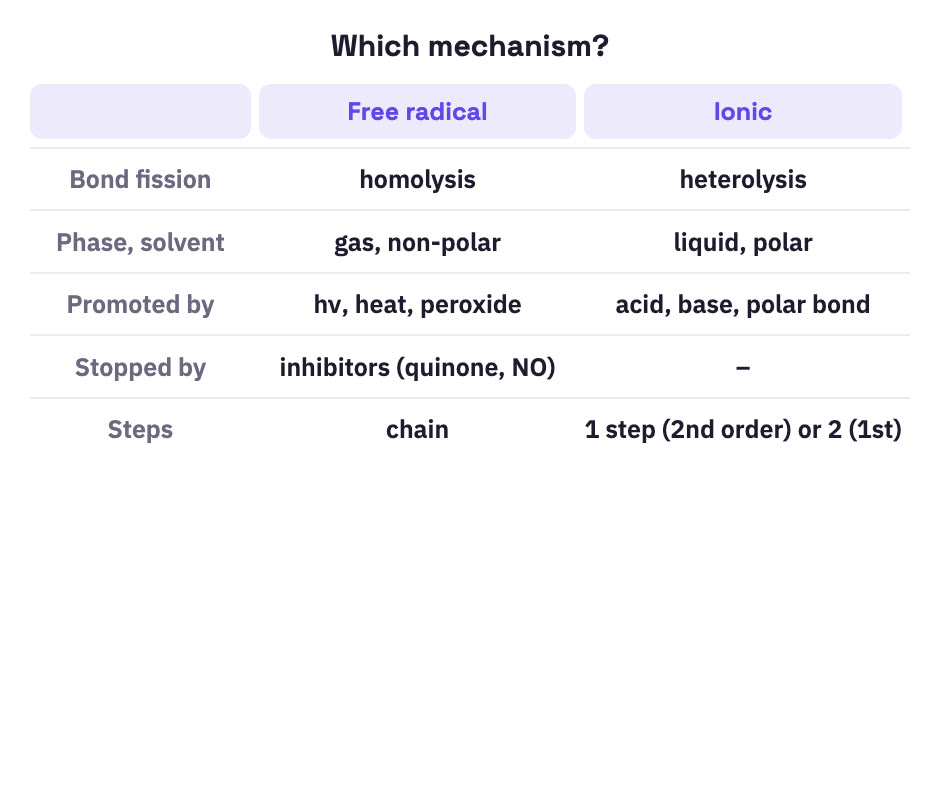
Free radical vs ionic
Radical: homolysis; gas phase, non-polar solvents, hν, heat, peroxides; chain steps; stopped by inhibitors (benzoquinone, phenols, amines, NO). Ionic: heterolysis; liquid phase, polar solvents, acids or bases, polarised bonds; two stages (first order) or one stage via a transition state (second order).
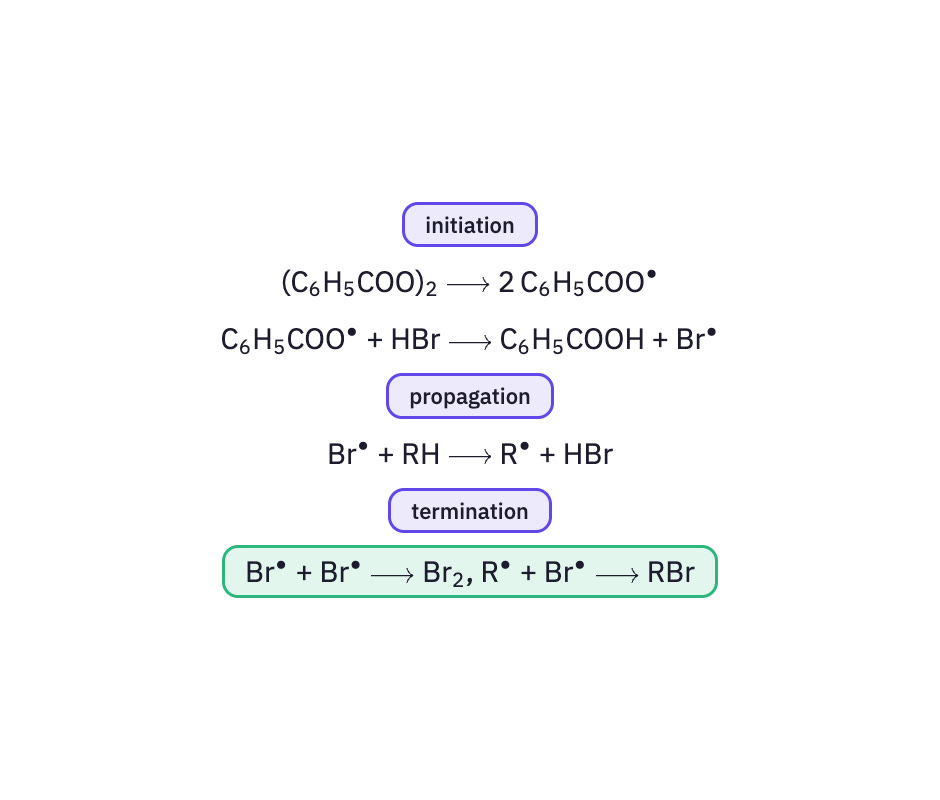
A peroxide-started chain
; ; propagation ; termination .
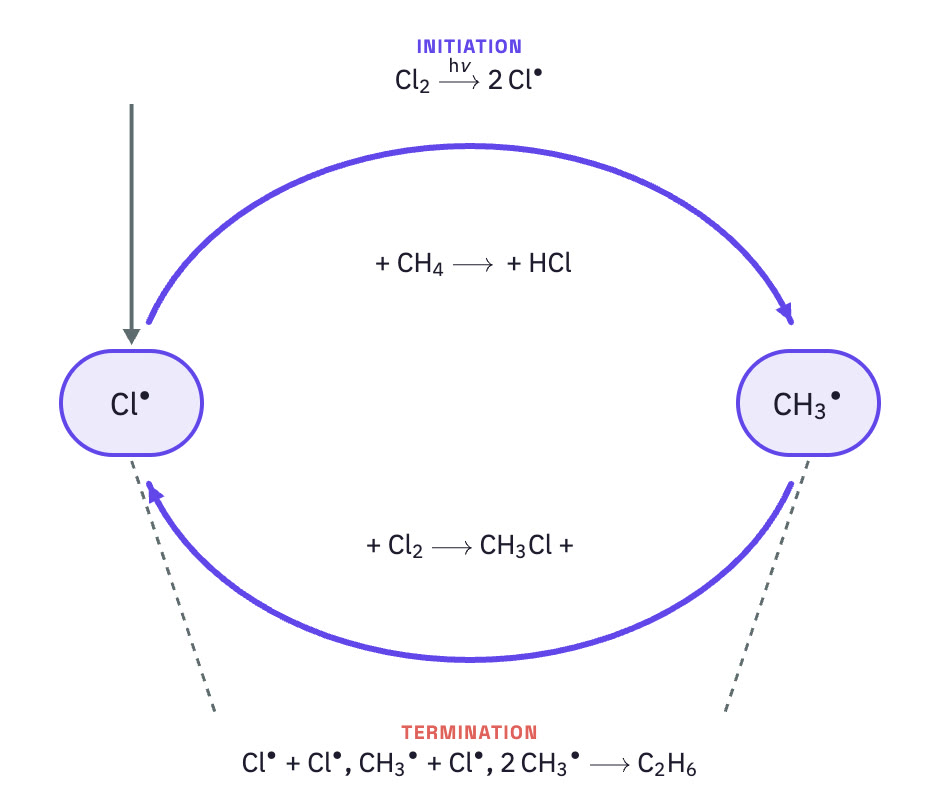
The chain
; ; ; termination by any two radicals. Evidence: no reaction in the dark; tetraethyl lead starts it in the dark at 140 °C; inhibits it.
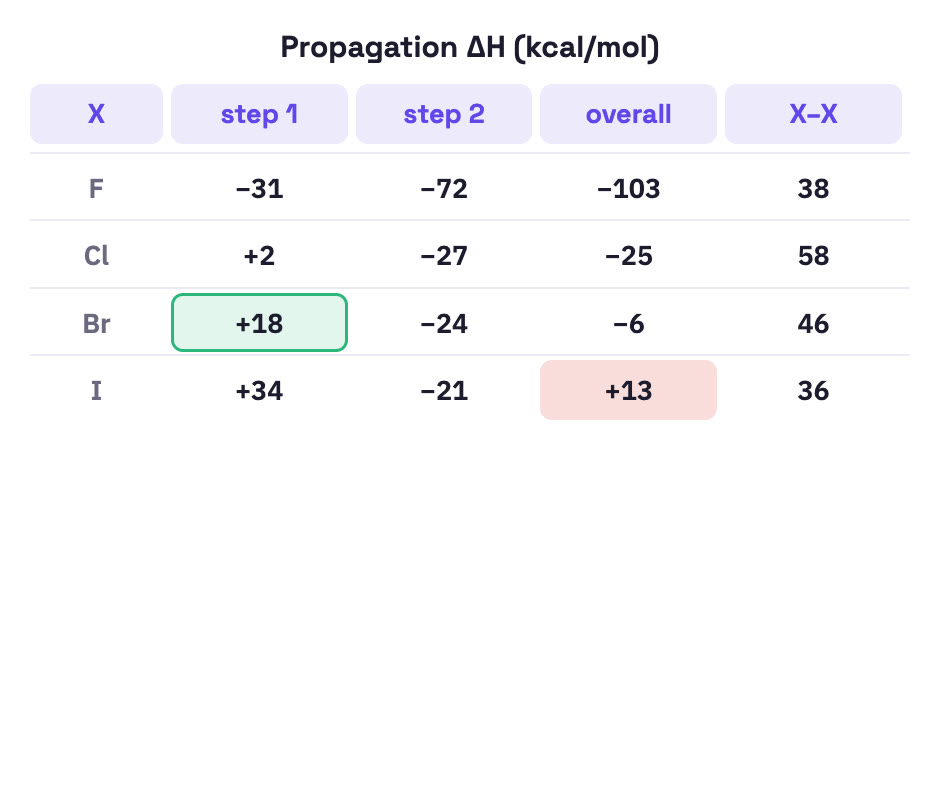
Propagation ΔH (kcal/mol)
Step 1 / step 2 / overall: F −31/−72/−103; Cl +2/−27/−25; Br +18/−24/−6; I +34/−21/+13. X–X: F₂ 38, Cl₂ 58, Br₂ 46, I₂ 36. Reactivity F₂ > Cl₂ > Br₂ > I₂; iodination is endothermic.
Bromination vs chlorination
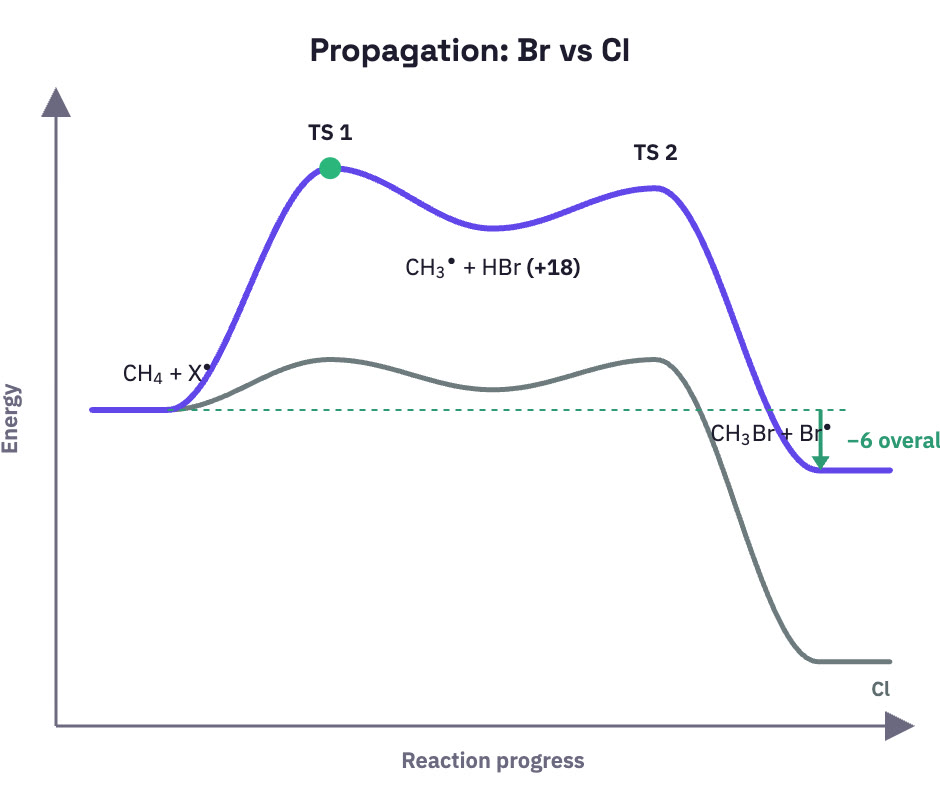
Overall ΔH = +18 + (−24) = −6 kcal/mol. The first step is strongly endothermic (+18 vs +2 for Cl), so bromine atoms abstract H slowly.
Gomberg, Wurtz, side chain, ring
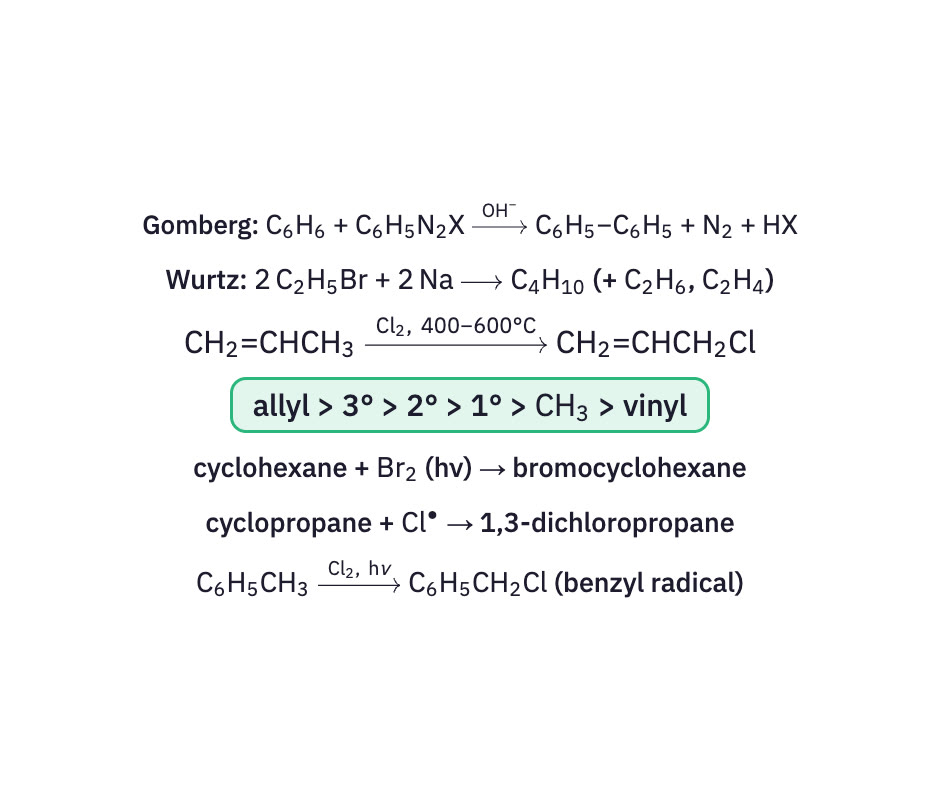
Gomberg (biphenyl via Ph•); Wurtz (butane + ethane + ethylene); propene + Cl₂ at 400–600 °C → allyl chloride; ease of radical formation allyl > 3° > 2° > 1° > CH₃ > vinyl; cyclohexane + Br₂ (hν) → bromocyclohexane; cyclopropane + Cl• → 1,3-dichloropropane; toluene + Cl₂ (hν) → benzyl chloride.
Benzylic chlorination
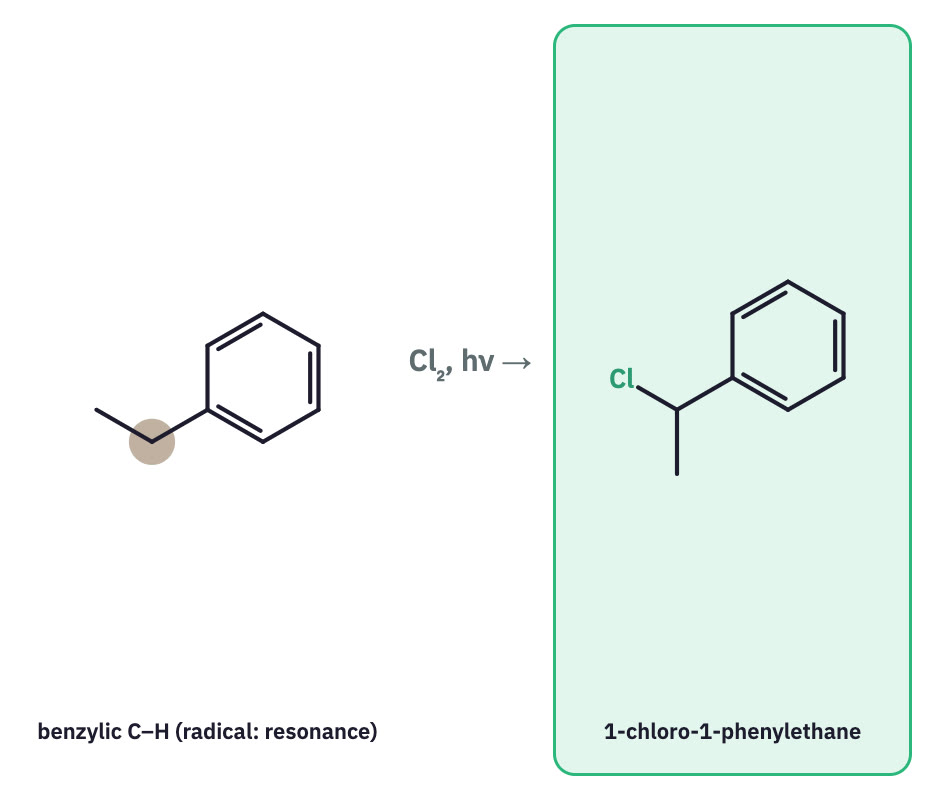
The benzylic radical is resonance-stabilised, so chlorination occurs there: .
Allylic bromination
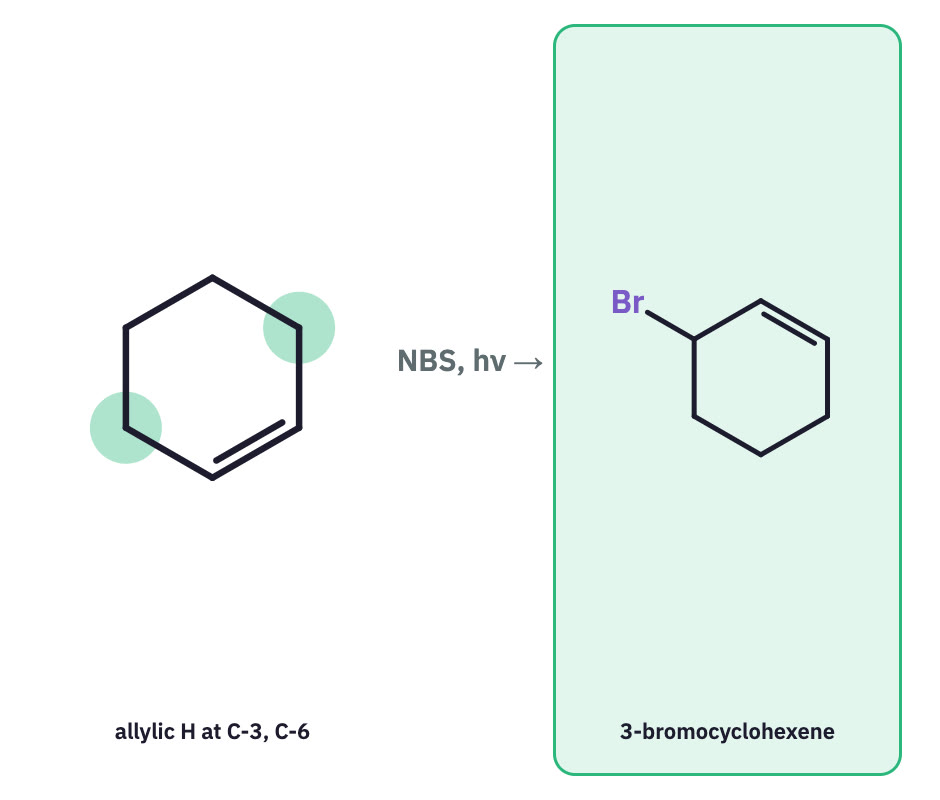
NBS brominates allylic and benzylic positions: propene → allyl bromide; toluene → benzyl bromide; cyclohexene → 3-bromocyclohexene; pent-1-ene → 3-bromopent-1-ene; 4,4-dimethylcyclohexene gives three products.
The NBS cycle
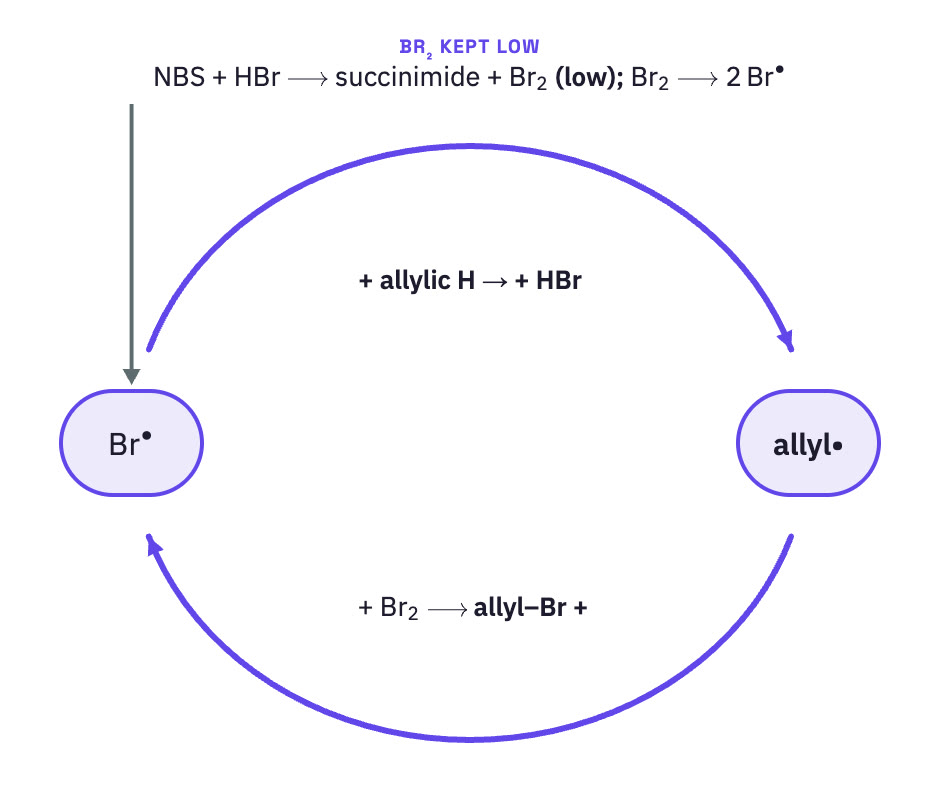
keeps low; ; takes an allylic H; the allyl radical takes Br from . Low favours substitution because Br• addition to C=C is reversible.
But-1-ene + NBS
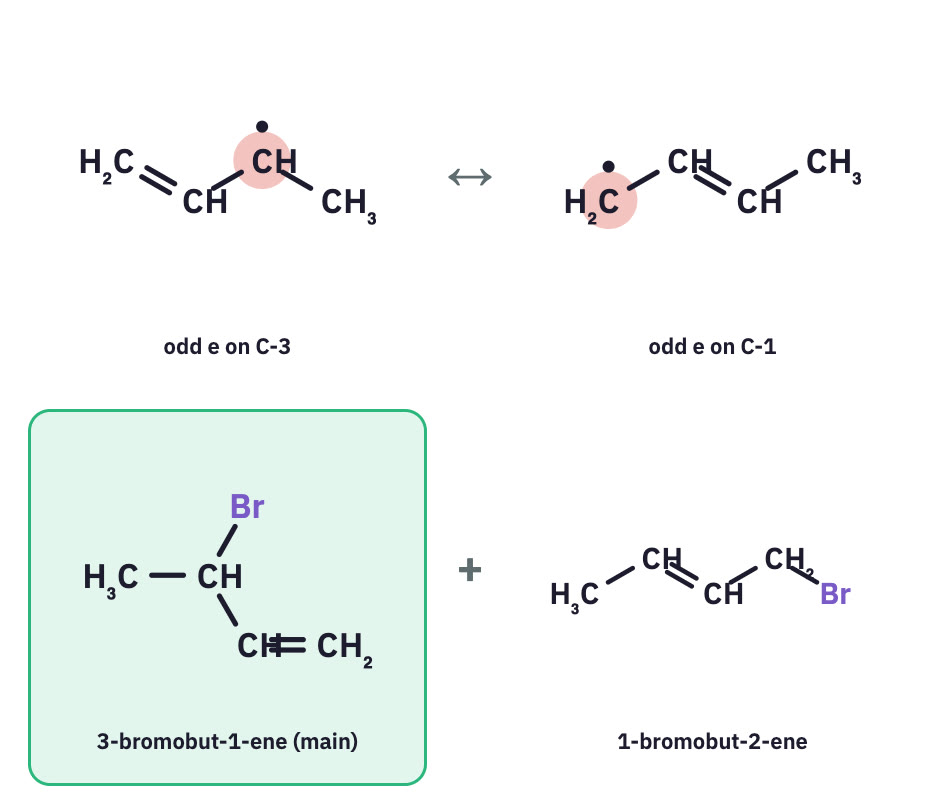
The allylic radical gives 3-bromobut-1-ene (main) and 1-bromobut-2-ene.
Key formulas
One for every idea
1. Write initiation, one propagation step and one termination step for HBr + benzoyl peroxide producing .
- Initiation: ; .
- Propagation (with RH): .
Termination: (or ).
2. For bromination of methane, step 1 () has ΔH = +18 kcal/mol and step 2 () has ΔH = −24 kcal/mol. Find the overall ΔH. Why is bromination slower than chlorination?
- ΔH = +18 + (−24) = −6 kcal/mol.
- Step 1 is strongly endothermic (+18 vs +2 for Cl).
−6 kcal/mol; bromine atoms abstract H much more slowly.
3. Ethylbenzene is treated with in sunlight. Where does chlorination occur and why?
- The benzylic radical is resonance-stabilised, so the benzylic H is removed first.
At the benzylic : .
4. Predict the main product of but-1-ene with NBS under light, and name the intermediate.
- Br• removes an allylic H from C-3: .
3-Bromobut-1-ene (with some 1-bromobut-2-ene); intermediate: the allylic radical.
Your turn
Cyclohexene reacts with NBS in CCl4 under light. The main product is:
Show the answer and the traps
3-Bromocyclohexene, option b: allylic substitution.
trans-1,2-Dibromocyclohexane needs a high Br₂ concentration: that's addition.
Bromocyclohexane would need HBr to add across C=C.
And 1-bromocyclohexene would mean breaking a strong vinylic C–H, which NBS doesn't attack.
Common mistakes
Try these
1. The free-radical halogenation of methane that is overall endothermic is: (a) fluorination (b) chlorination (c) bromination (d) iodination
(d) iodination (+13 kcal/mol).
2. Why does chlorination of methane not occur in the dark at room temperature?
No radicals form: light (or heat, or an initiator) is needed to split .
3. Toluene + in light gives which product? Through which intermediate?
Benzyl chloride, via the benzyl radical.
4. Why does oxygen slow down the chlorination of methane?
It traps methyl radicals as , breaking the chain.
5. Which product forms when propene reacts with NBS (light)?
Allyl bromide, .