 layrd.liveLayer by Layer
- 1. Inductive Effect
- 2. Carboxylic Acid Strength
- 3. Alcohols, Hydrocarbons, Amines
- 4. Electromeric & Mesomeric
- 5. Hyperconjugation
- 6. Fission & Free Radicals
- 7. Carbocations
- 8. Carbanions
- 9. Carbenes
- 10. Nitrenes & Benzyne
- 11. Electrophiles & Nucleophiles
- 12. Reaction Types
- 13. Free Radical Substitution
- 14. SN2 Reaction
- 15. SN1 Reaction
- 16. SN1 vs SN2
- 17. Electrophilic Substitution
- 18. Markovnikov's Rule
- 19. Br₂ Addition & Dienes
- 20. Peroxide Effect
- 21. Nucleophilic Addition
- 22. E1, E1cB & Saytzeff
- 23. E2 Elimination
Electromeric and Mesomeric (Resonance) Effects
π electrons are looser than σ electrons. Under an attacking reagent a π pair moves completely to one atom (the temporary electromeric effect); in a conjugated system π electrons and lone pairs shift permanently along the whole chain (the mesomeric, or resonance, effect). When both the inductive and mesomeric effects act, the mesomeric effect usually wins.
Builds on: Part 1 · Inductive Effect: −I and +I Groups.
 Video coming soon
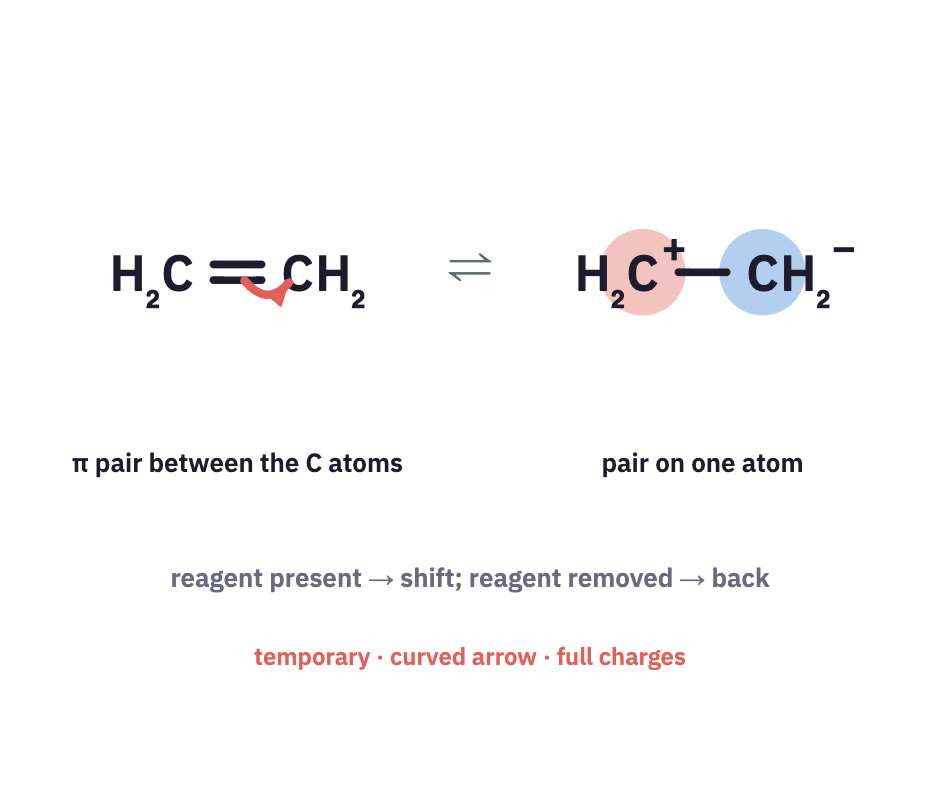
A complete π shift on demand
When a reagent approaches, the π pair moves completely to one atom, which becomes negative; the other becomes positive. The effect lasts only while the reagent is present.
Towards or away from the reagent
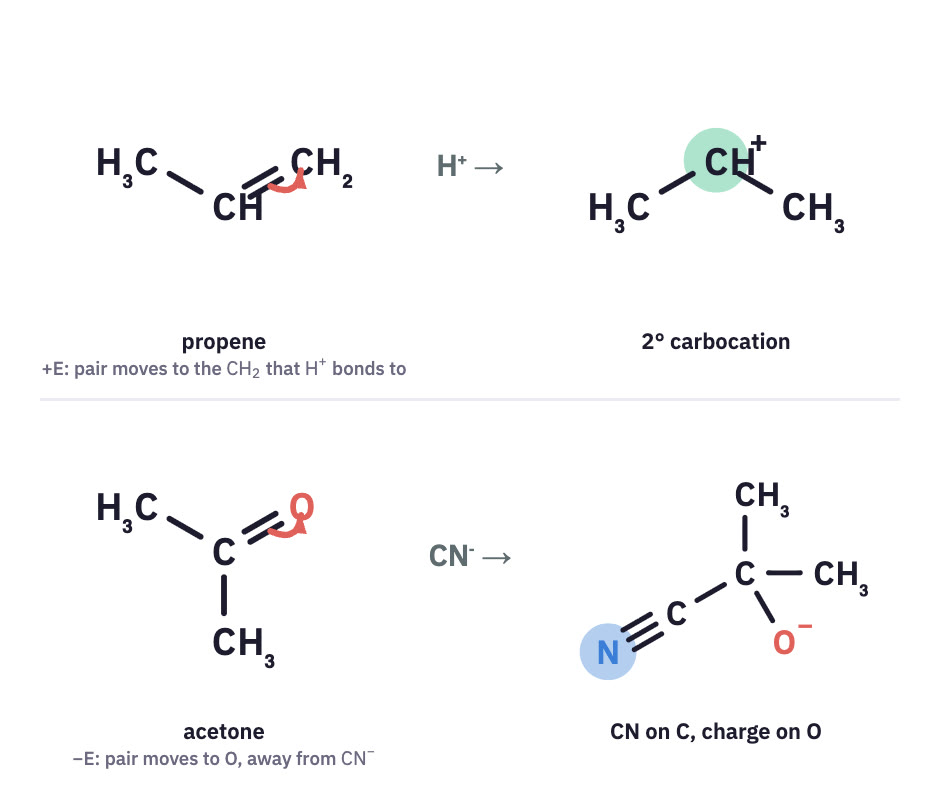
+E: the pair moves towards the attacking reagent, which bonds to that atom ( on propene gives the 2° cation). −E: the pair moves away from the reagent, which bonds to the other atom ( on acetone puts the charge on O).
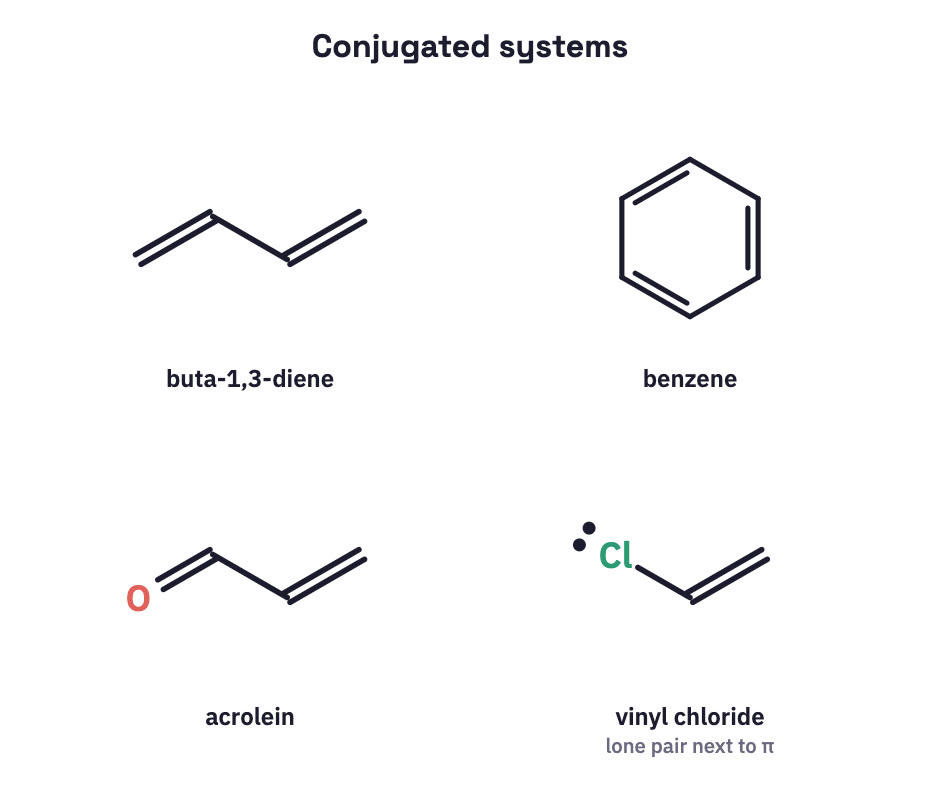
Alternating π bonds, or a lone pair next to π
Buta-1,3-diene, benzene and acrolein have alternating single and double bonds; vinyl chloride has a lone pair next to a π bond.
Polarisation runs along the chain
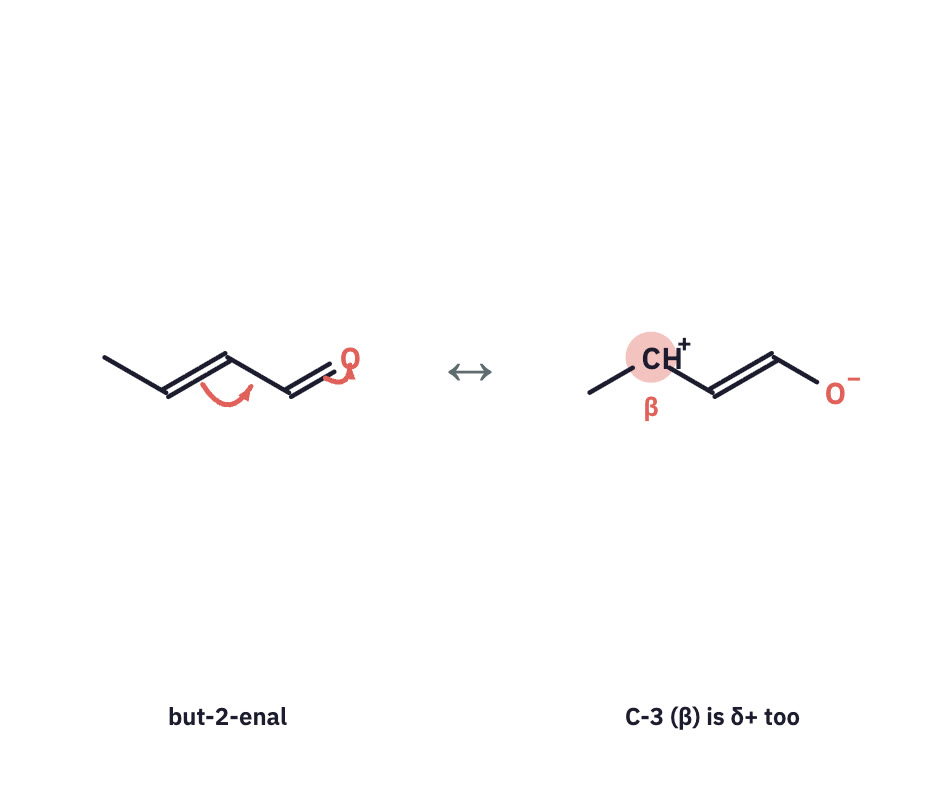
In but-2-enal the C=O pair moves to O and the C=C pair towards the carbonyl carbon, so C-3 (the β-carbon) carries a positive charge in the canonical form.
Lone pair into the ring
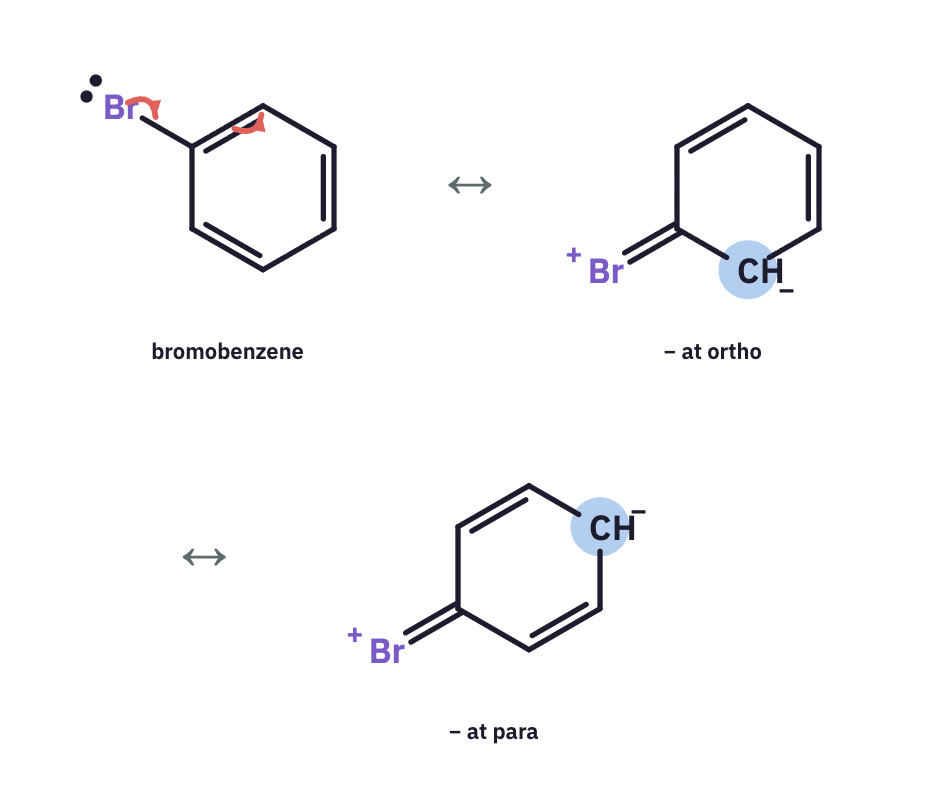
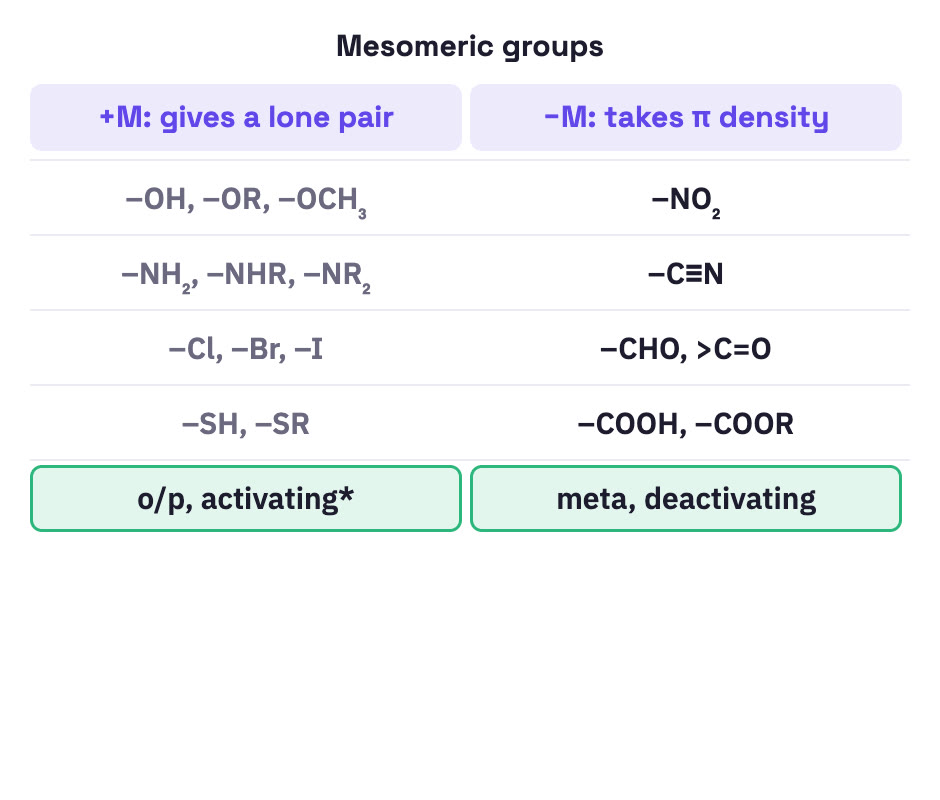
Bromine's lone pair is delocalised into the ring, putting negative charge on the ortho and para carbons.
+M and −M groups
+M: –OH, –OR, –NH₂, –NHR, –NR₂, –Cl, –Br, –I, –SH, –SR (o/p-directing, activating except halogens). −M: –NO₂, –C≡N, >C=O, –CHO, –COOH, –COOR (meta-directing, deactivating).
Inductive vs mesomeric
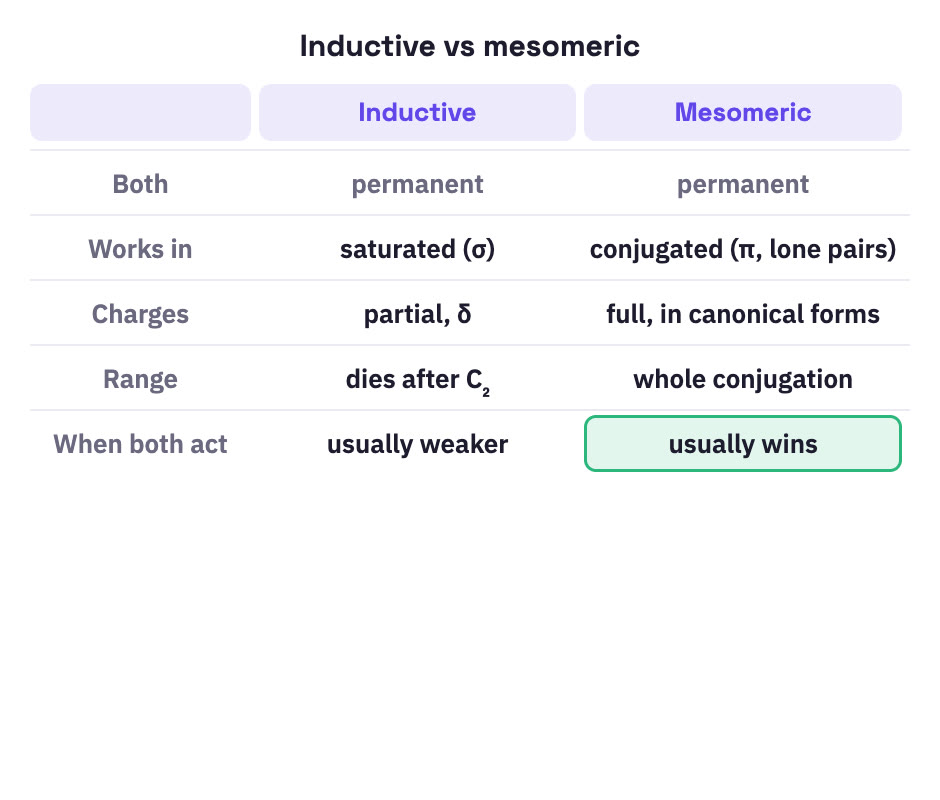
Both are permanent. Inductive: saturated compounds, σ electrons, partial charges, dies out after C₂. Mesomeric: conjugated systems, π electrons or lone pairs, full charges in canonical forms, whole conjugation. The mesomeric effect usually wins.
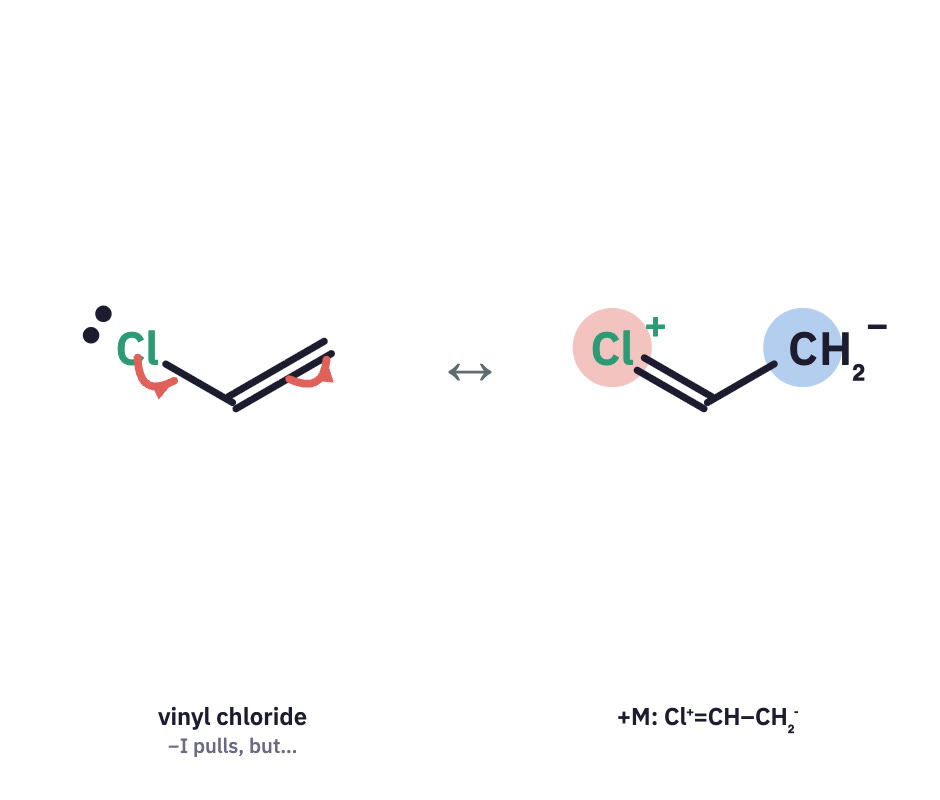
Vinyl chloride
Chlorine's lone pair is delocalised into the C=C: the canonical form contributes, so Cl is slightly positive despite its −I effect.
One for every idea
1. When approaches propene, on which carbon does the π pair end up, and what is the resulting carbocation? Is this +E or −E?
- The +I methyl pushes the π pair to the terminal , which bonds to .
- The positive charge is left on the central carbon: .
The pair moved towards the attacking reagent: +E; the 2° (isopropyl) cation forms.
2. Draw the polarisation of but-2-enal (). Which carbon becomes electron-poor apart from the carbonyl carbon?
- O pulls the C=O π pair onto itself.
- The C=C π pair shifts towards the carbonyl carbon: .
C-3, the β-carbon.
3. Classify –OCH₃, –CHO, –NH₂ and –NO₂ as +M or −M, and say which of them direct an incoming electrophile to the meta position of benzene.
- –OCH₃ and –NH₂ have a lone pair to give: +M, o/p-directing activators.
- –CHO and –NO₂ pull π density out of the ring: −M, deactivating.
–CHO and –NO₂ (−M) direct to meta.
4. In vinyl chloride, chlorine is more electronegative than carbon, yet it carries a slight positive charge. Explain.
- Cl's lone pair is delocalised into the C=C (+M), giving the canonical form .
The +M effect outweighs the −I effect, so Cl ends up slightly positive.
Your turn
Which group is ortho/para-directing but deactivates the benzene ring?
Show the answer and the traps
–Cl, option c: +M directs o/p, but its −I effect wins on reactivity.
–CH₃ activates the ring, by +I and hyperconjugation.
–OH is a strong +M activator.
And –NO₂ is −M: deactivating, but meta-directing.
Common mistakes
Try these
1. Which group shows a −M effect? (a) –OH (b) –NH₂ (c) –CN (d) –OCH₃
(c) –CN: it pulls π density towards itself.
2. In which direction does the π pair of a C=O group shift when a nucleophile attacks, and is this +E or −E?
Towards O, away from the attacking nucleophile: −E.
3. Why is chlorobenzene much less reactive than chloromethane towards nucleophiles?
Cl's lone pair is delocalised into the ring (+M), giving the C–Cl bond partial double-bond character, so it is harder to break.
4. Which positions of anisole () carry extra electron density, and why?
Ortho and para: the O lone pair is delocalised into the ring (+M).
5. Is vinyl cyanide () a +R or −R system? Which carbon becomes electron-poor?
−R: the CN pulls π density, so the terminal becomes δ+.