 layrd.liveLayer by Layer
- 1. Inductive Effect
- 2. Carboxylic Acid Strength
- 3. Alcohols, Hydrocarbons, Amines
- 4. Electromeric & Mesomeric
- 5. Hyperconjugation
- 6. Fission & Free Radicals
- 7. Carbocations
- 8. Carbanions
- 9. Carbenes
- 10. Nitrenes & Benzyne
- 11. Electrophiles & Nucleophiles
- 12. Reaction Types
- 13. Free Radical Substitution
- 14. SN2 Reaction
- 15. SN1 Reaction
- 16. SN1 vs SN2
- 17. Electrophilic Substitution
- 18. Markovnikov's Rule
- 19. Br₂ Addition & Dienes
- 20. Peroxide Effect
- 21. Nucleophilic Addition
- 22. E1, E1cB & Saytzeff
- 23. E2 Elimination
Nucleophilic Addition to the Carbonyl Group
In C=O the oxygen pulls the π electrons towards itself, so the carbonyl carbon is electron-poor and nucleophiles attack it. In the slow step the nucleophile bonds to carbon and the negative charge moves onto oxygen. A proton then completes the addition. Alkyl groups lower reactivity in two ways: their +I effect reduces δ+ on the carbon, and their bulk blocks the attack. So aldehydes react faster than ketones.
Builds on: Part 4 · Electromeric and Mesomeric (Resonance) Effects, Part 11 · Electrophiles, Nucleophiles and Ambident Reagents.
 Video coming soon
HCN adds to acetone
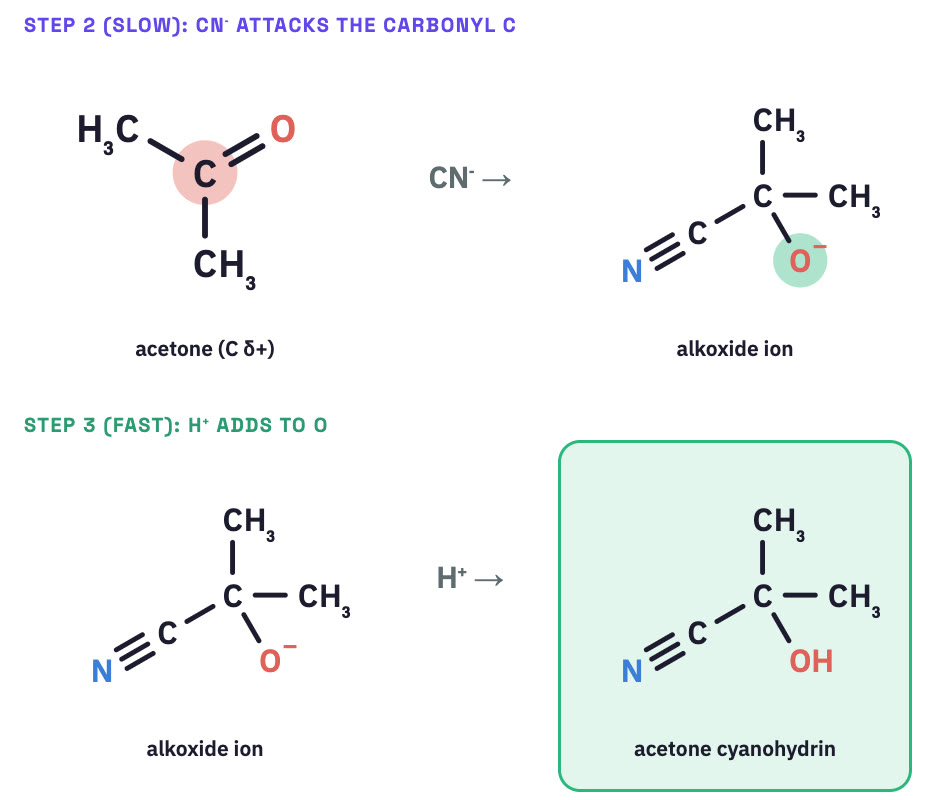
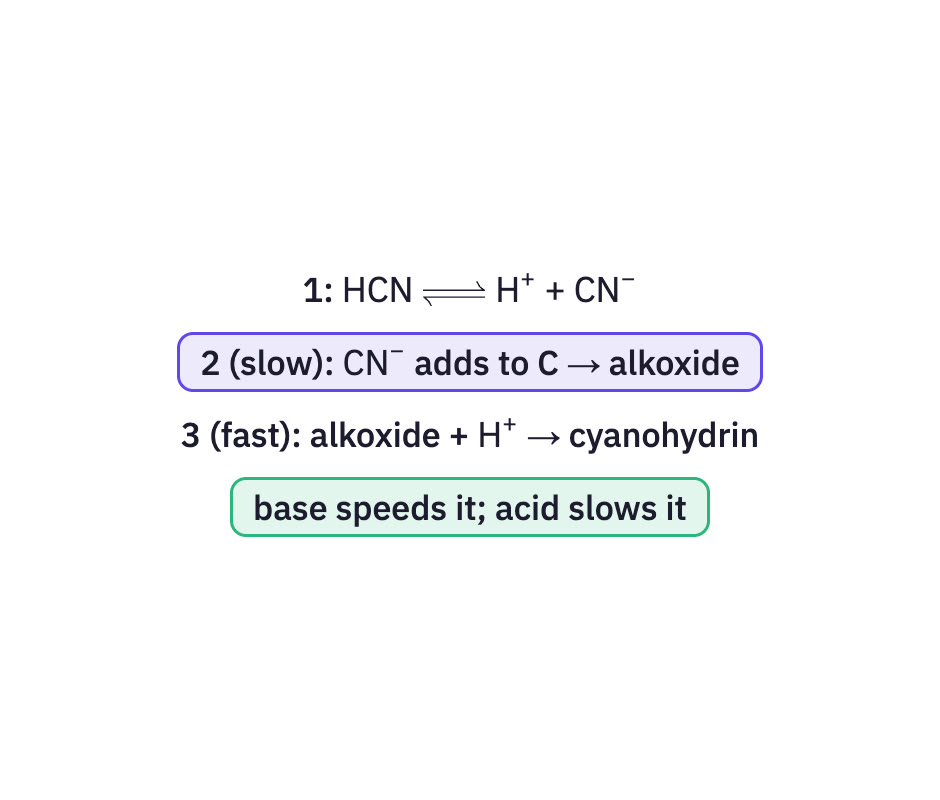
Step 1: . Step 2 (slow): attacks the carbonyl carbon, giving an alkoxide ion. The negative charge sits on oxygen, which holds it far better than carbon would hold a positive charge. Step 3 (fast): adds to O, giving acetone cyanohydrin.
Base speeds it, acid slows it
The attacking species is , not HCN. A base (or KCN) raises [] and speeds the reaction; acid pushes to the left and slows it. Pure HCN hardly reacts.
Order towards nucleophiles
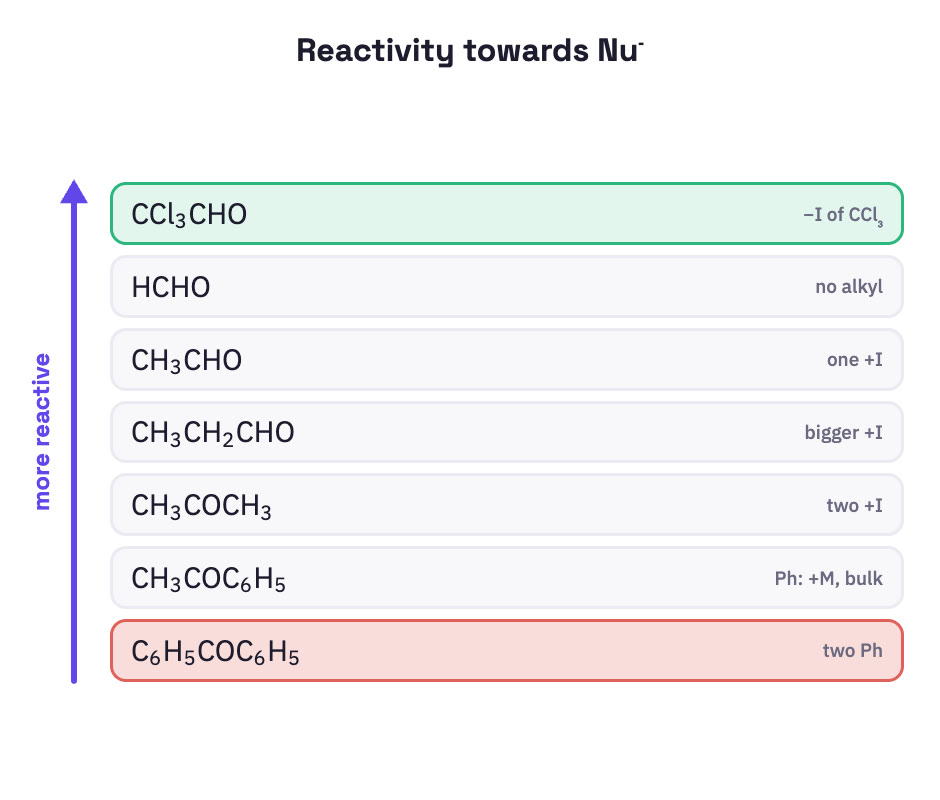
> HCHO > > > > > . Each +I alkyl group lowers δ+ and adds bulk; phenyl donates by resonance. is −I, so chloral is the most reactive.
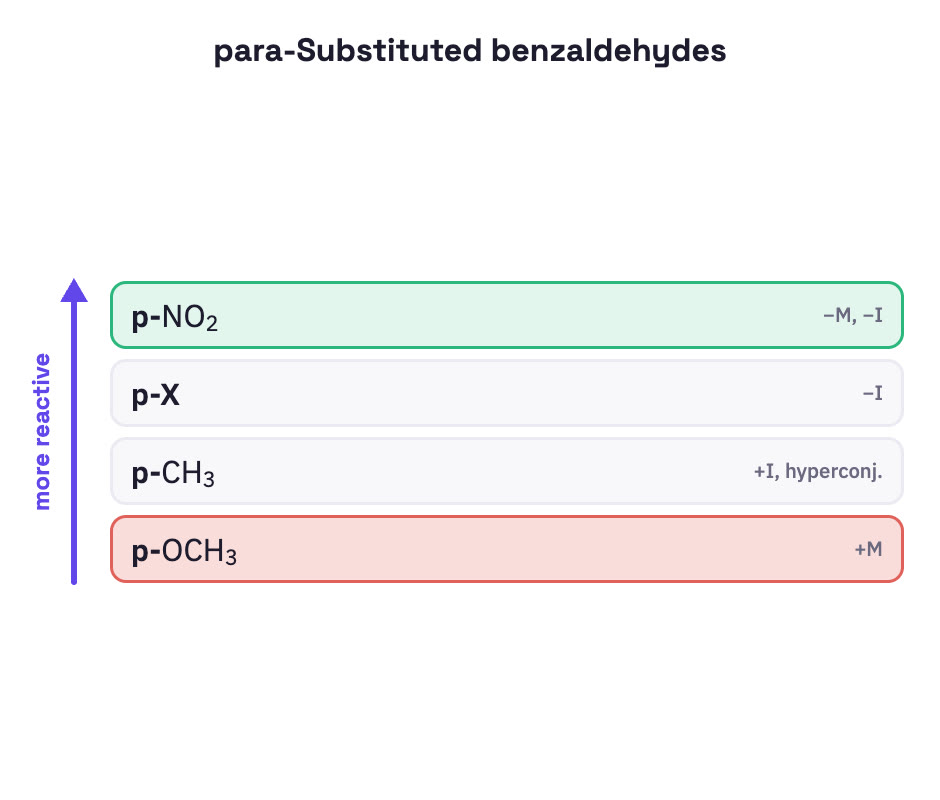
Substituted benzaldehydes
p- > p-X > p- > p- benzaldehyde: electron-withdrawing groups raise δ+ on the carbonyl carbon, donating groups lower it.
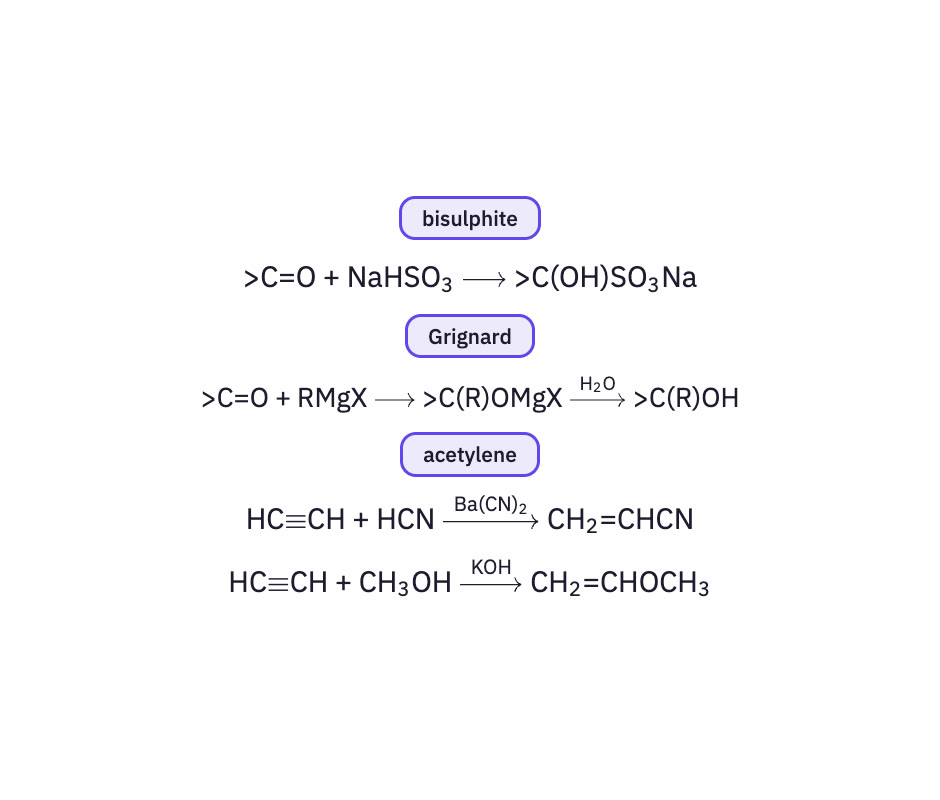
Bisulphite, Grignard, acetylene
adds through S, giving a bisulphite compound. Grignard: , then water gives the alcohol. Acetylene + HCN () → acrylonitrile and acetylene + (KOH) → methyl vinyl ether, with and as the attacking species.
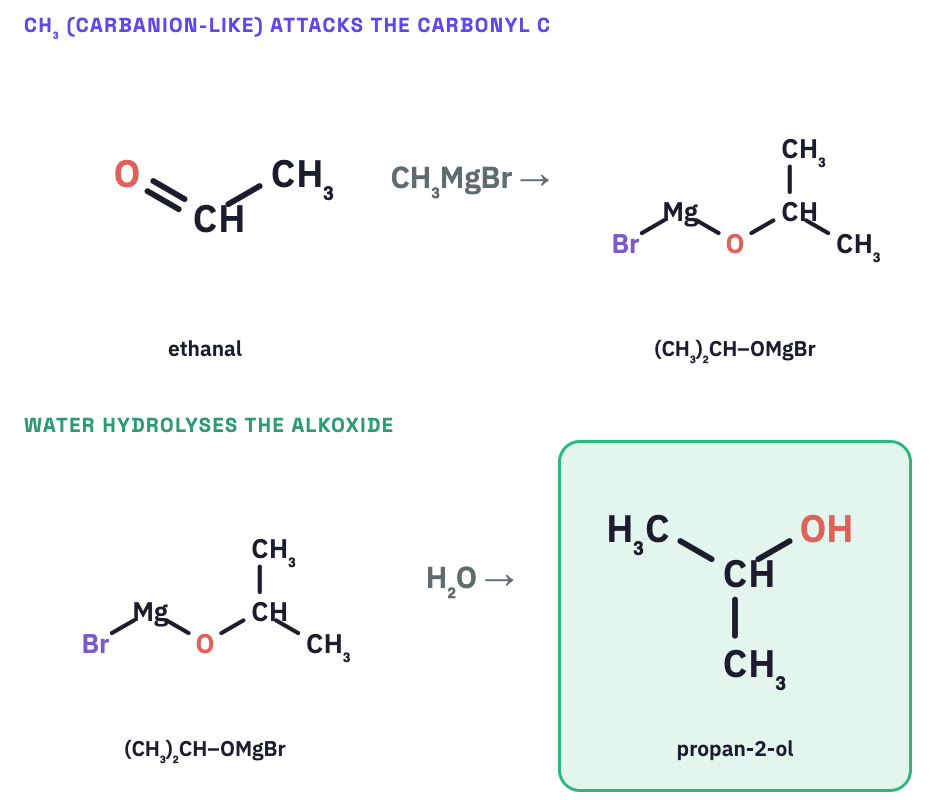
Ethanal + CH₃MgBr
The carbanion-like attacks the carbonyl carbon, giving ; water then gives propan-2-ol.
One for every idea
1. Why does the addition of HCN to propanal speed up when a little KCN is added, and slow down in strong acid?
- The nucleophile is ; it attacks the carbonyl carbon in the slow step.
- KCN supplies directly.
- Strong acid pushes to the left, removing .
The rate depends on [CN⁻]: KCN raises it, acid lowers it.
2. Arrange in decreasing reactivity towards HCN: acetone, benzaldehyde, formaldehyde, acetaldehyde.
- Formaldehyde: two H, no +I, no bulk. Acetaldehyde: one methyl.
- Benzaldehyde: phenyl lowers δ+ by resonance, but it is still an aldehyde.
- Acetone: two +I methyls.
Formaldehyde > acetaldehyde > benzaldehyde > acetone.
3. Ethanal is treated with CH₃MgBr and then with water. Give the product and say which part of the Grignard reagent attacks the carbonyl carbon.
- The carbanion-like CH₃ attacks the carbonyl carbon: .
- Hydrolysis: .
Propan-2-ol; the CH₃ group attacks.
Your turn
Which compound is least reactive towards nucleophilic addition of HCN?
Show the answer and the traps
Benzophenone, option d: two phenyl groups donate by resonance and block the carbonyl carbon.
Formaldehyde is the most reactive: two H, no +I, no bulk.
Acetaldehyde is an aldehyde; acetone has two small methyls and still beats benzophenone.
Common mistakes
Try these
1. Which compound is most reactive towards nucleophilic addition? (a) CH₃COCH₃ (b) C₆H₅COCH₃ (c) CH₃CHO (d) CCl₃CHO
(d) CCl₃CHO: the −I CCl₃ group makes the carbonyl carbon most electron-poor.
2. Arrange p-nitrobenzaldehyde, p-methoxybenzaldehyde and benzaldehyde in decreasing reactivity towards HCN.
p-Nitrobenzaldehyde > benzaldehyde > p-methoxybenzaldehyde.
3. Propanone + CH₃MgI, then water: give the product.
2-Methylpropan-2-ol, (CH₃)₃COH.
4. Why is the alkoxide intermediate formed in preference to a carbocation in carbonyl additions?
Oxygen is more electronegative and carries a negative charge far better than carbon carries a positive one.