 layrd.liveLayer by Layer
- 1. Inductive Effect
- 2. Carboxylic Acid Strength
- 3. Alcohols, Hydrocarbons, Amines
- 4. Electromeric & Mesomeric
- 5. Hyperconjugation
- 6. Fission & Free Radicals
- 7. Carbocations
- 8. Carbanions
- 9. Carbenes
- 10. Nitrenes & Benzyne
- 11. Electrophiles & Nucleophiles
- 12. Reaction Types
- 13. Free Radical Substitution
- 14. SN2 Reaction
- 15. SN1 Reaction
- 16. SN1 vs SN2
- 17. Electrophilic Substitution
- 18. Markovnikov's Rule
- 19. Br₂ Addition & Dienes
- 20. Peroxide Effect
- 21. Nucleophilic Addition
- 22. E1, E1cB & Saytzeff
- 23. E2 Elimination
Acid Strength: pKa and Carboxylic Acids
An acid is as strong as its anion is stable. and put a number on acid strength; the inductive effect explains the numbers: −I groups spread the carboxylate's charge and strengthen the acid, +I groups concentrate it and weaken the acid.
Builds on: Part 1 · Inductive Effect: −I and +I Groups.
 Video coming soon
, , ,
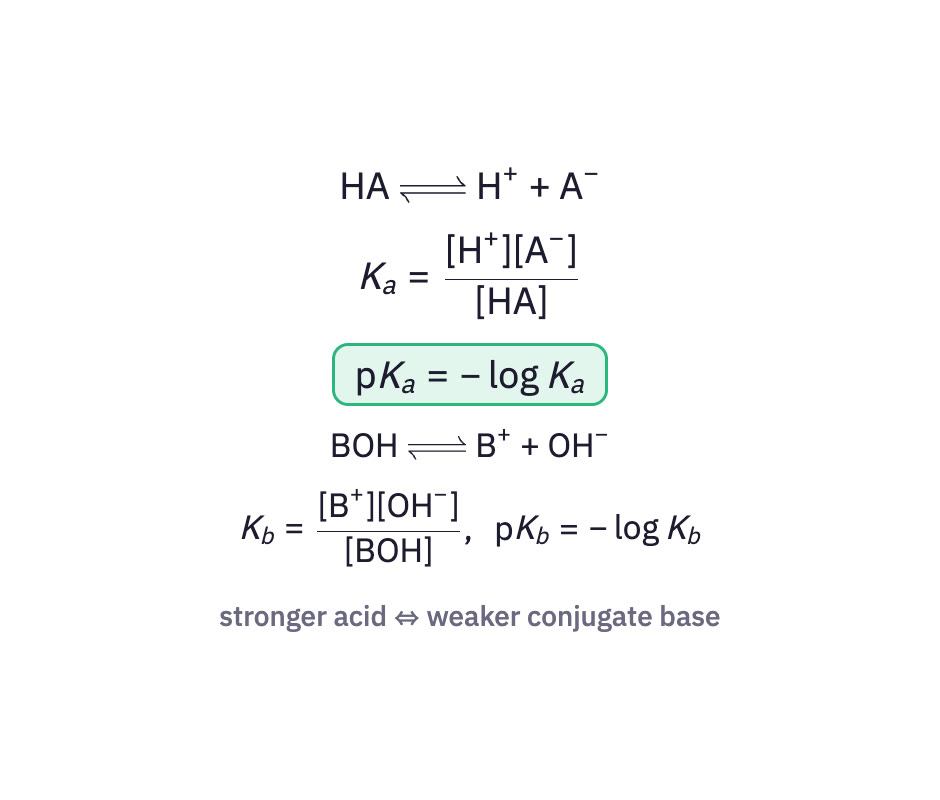
For , and . A larger (smaller ) means a stronger acid. Bases use and the same way.
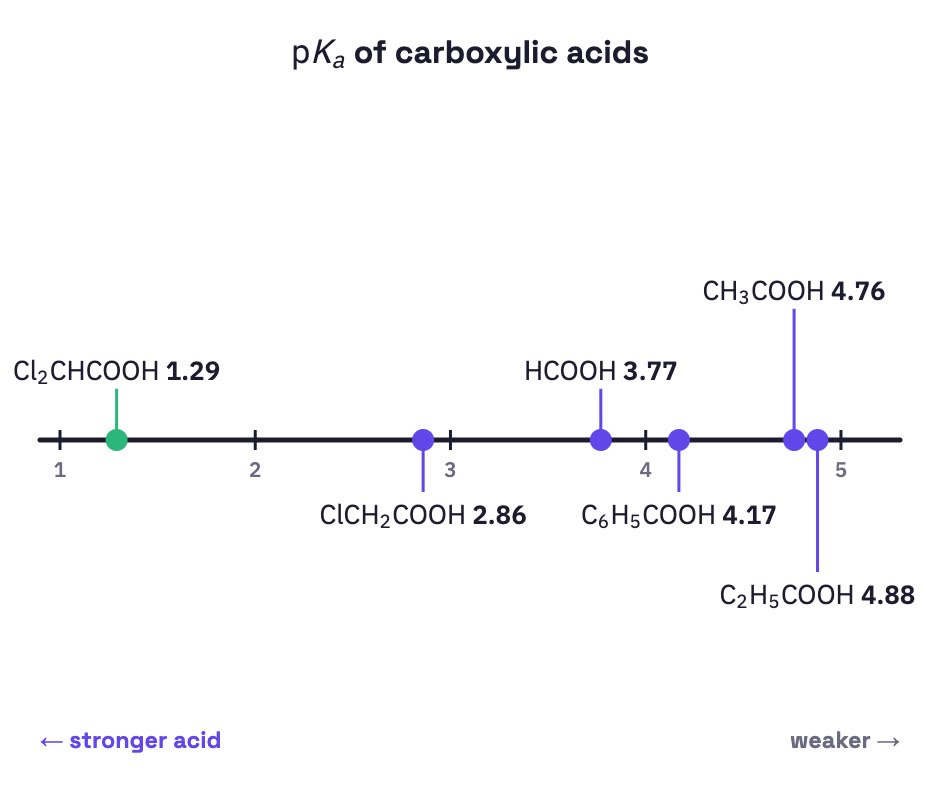
of carboxylic acids
1.29, 2.86, 3.77, 4.17, 4.76, 4.88. The lower the , the stronger the acid.
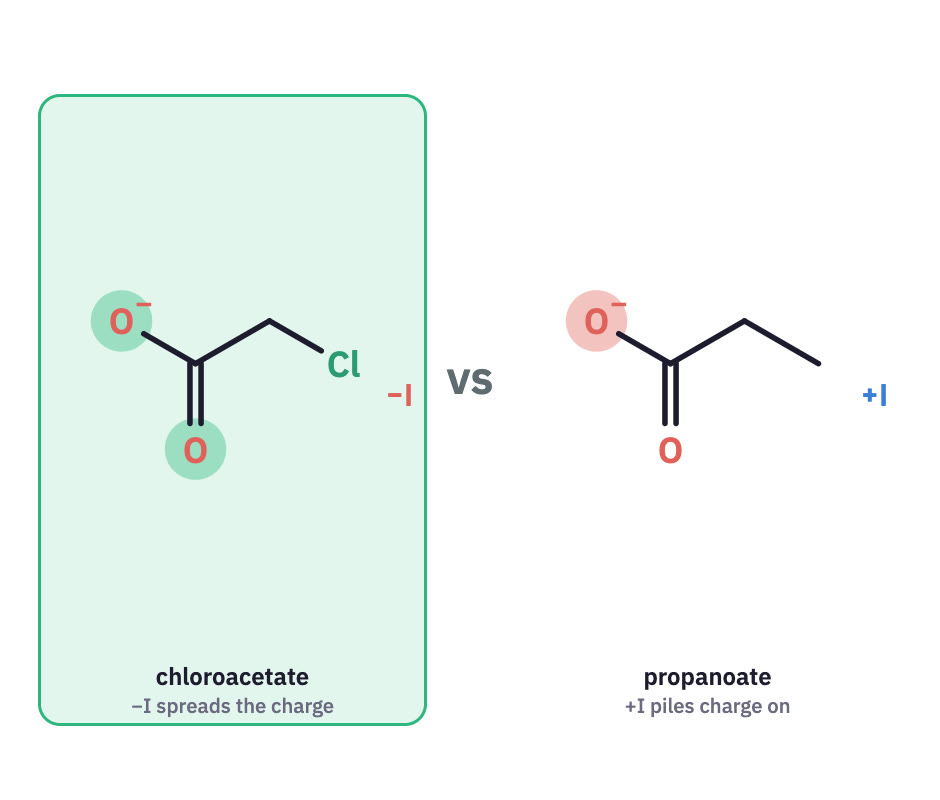
Spread charge, stronger acid
In chloroacetate the −I chlorine pulls charge away from the carboxylate and spreads it, so the anion is more stable and the acid stronger. In propanoate the +I ethyl group pushes charge in.
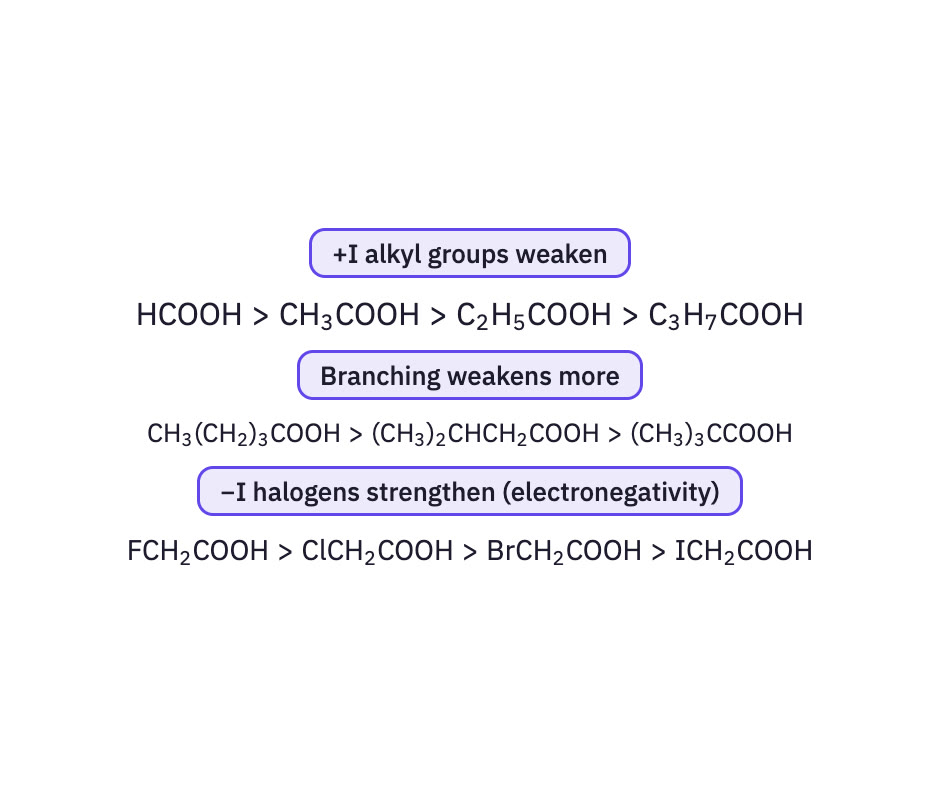
Alkyl, branching, halogen
; branching weakens further; , following electronegativity.
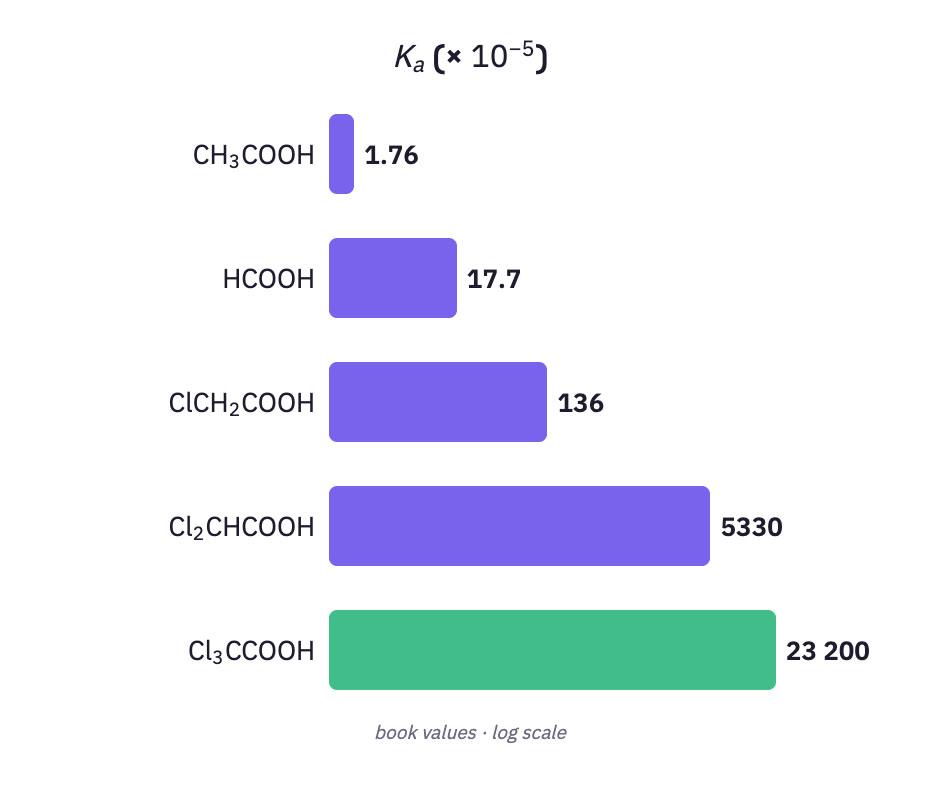
The chloroacetic acid series
(× ): 1.76, 17.7, 136, 5330, 23 200 (book values).
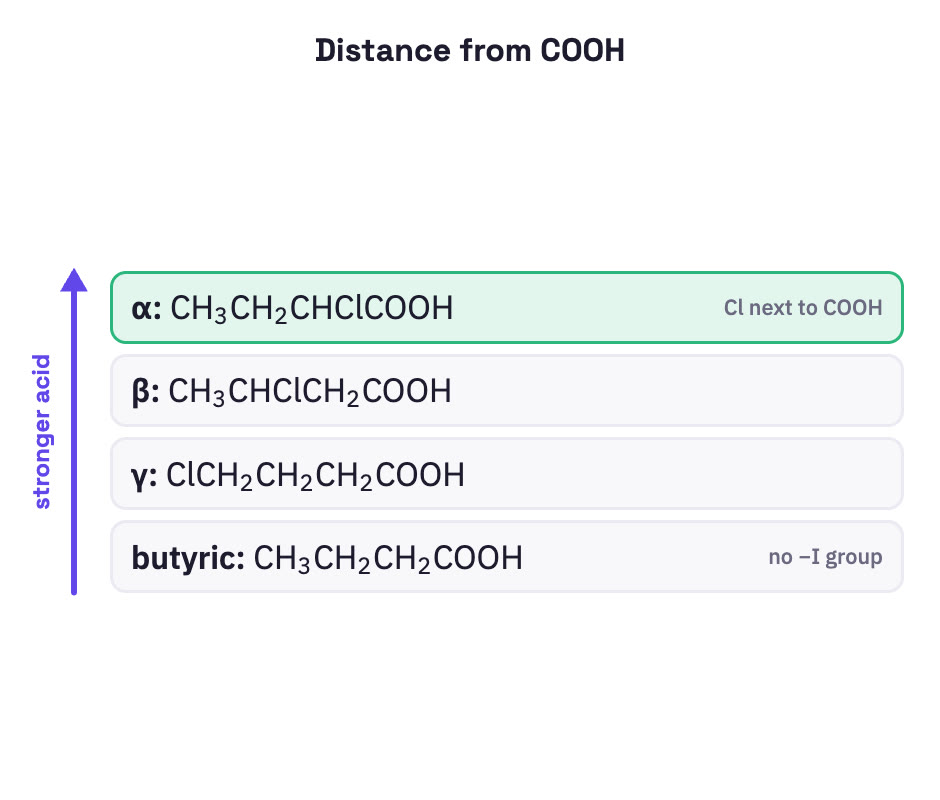
α > β > γ > butyric
The −I effect fades with each carbon, so a chlorine next to COOH strengthens the acid most.
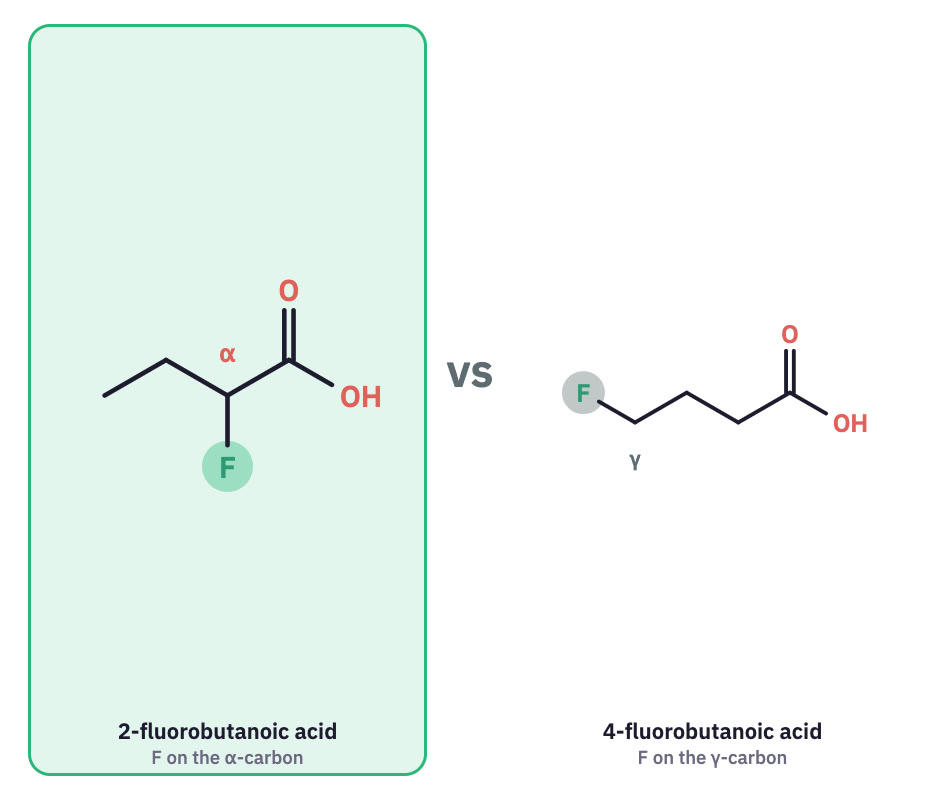
2-fluoro vs 4-fluorobutanoic acid
F on the α-carbon stabilises the carboxylate strongly; on the γ-carbon its effect has almost died out.
Key formulas
One for every idea
1. An organic acid has . Find its . Is it stronger or weaker than acetic acid ( 4.76)?
- .
, lower than 4.76: slightly stronger than acetic acid.
2. A base has . Find its .
- .
.
3. Arrange in decreasing acid strength: , , , .
- Two Cl atoms (−I) stabilise the anion most, one Cl less.
- HCOOH has no +I group; the ethyl group's +I makes propanoic acid the weakest.
.
4. Which is the stronger acid, 2-fluorobutanoic acid or 4-fluorobutanoic acid? Explain.
- In 2-fluorobutanoic acid F is on the α-carbon, next to COOH: its −I effect stabilises the carboxylate strongly.
- At the γ-position the effect has almost died out.
2-Fluorobutanoic acid.
Your turn
Which of the following has the lowest pKa?
Show the answer and the traps
The α-chloro acid, option a: Cl is right next to COOH, so the −I effect is strongest there.
The β-chloro acid has its Cl one carbon further away, so it is weaker.
At γ, the effect has nearly died out.
And butanoic acid has no −I group at all.
Common mistakes
Try these
1. Which of the following is the strongest acid? (a) (b) (c) (d)
(c) : F has the strongest −I effect.
2. Find the of an acid with .
.
3. An acid has . Find .
.
4. Arrange in decreasing acid strength: , , , .
(more Cl, stronger).