 layrd.liveLayer by Layer
- 1. Inductive Effect
- 2. Carboxylic Acid Strength
- 3. Alcohols, Hydrocarbons, Amines
- 4. Electromeric & Mesomeric
- 5. Hyperconjugation
- 6. Fission & Free Radicals
- 7. Carbocations
- 8. Carbanions
- 9. Carbenes
- 10. Nitrenes & Benzyne
- 11. Electrophiles & Nucleophiles
- 12. Reaction Types
- 13. Free Radical Substitution
- 14. SN2 Reaction
- 15. SN1 Reaction
- 16. SN1 vs SN2
- 17. Electrophilic Substitution
- 18. Markovnikov's Rule
- 19. Br₂ Addition & Dienes
- 20. Peroxide Effect
- 21. Nucleophilic Addition
- 22. E1, E1cB & Saytzeff
- 23. E2 Elimination
Acidity of Alcohols and Hydrocarbons, Basicity of Amines
The inductive effect also ranks alcohols, phenol and the hydrocarbons as acids, with hybridisation joining in: more s-character holds a carbanion's lone pair closer. For bases the logic runs in reverse, until water steps in: solvation of the cation reorders the amines, so trimethylamine falls behind methylamine.
Builds on: Part 2 · Acid Strength: pKa and Carboxylic Acids.
 Video coming soon
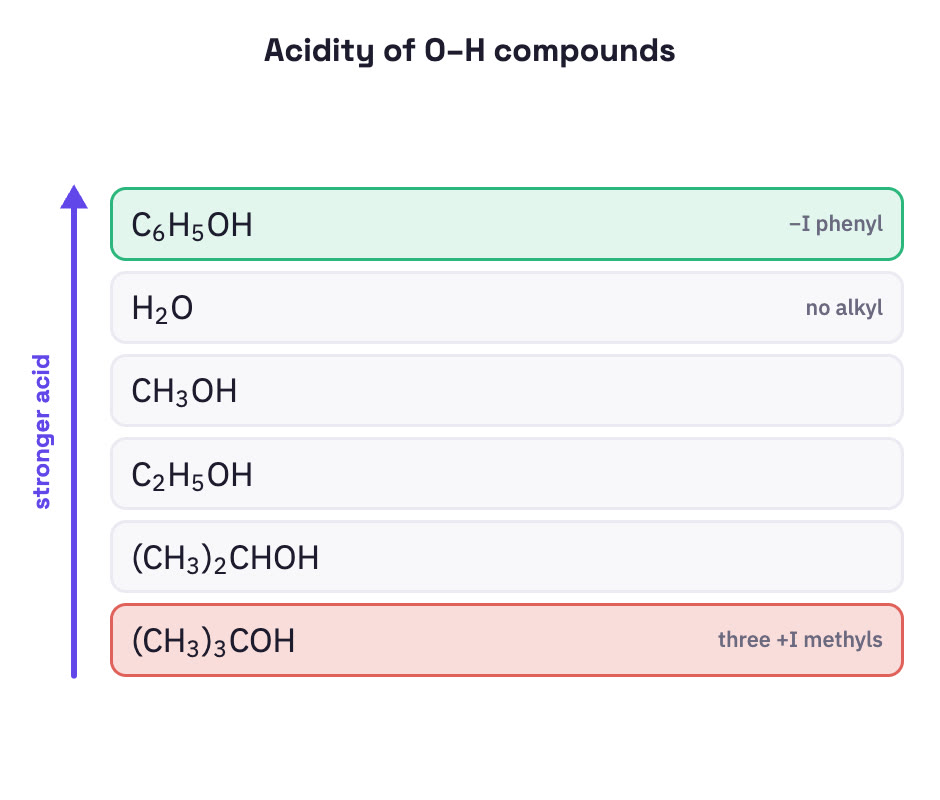
Phenol > water > alcohols
The −I phenyl group makes phenol the strongest; each +I alkyl group weakens an alcohol: (the book's inductive explanation).
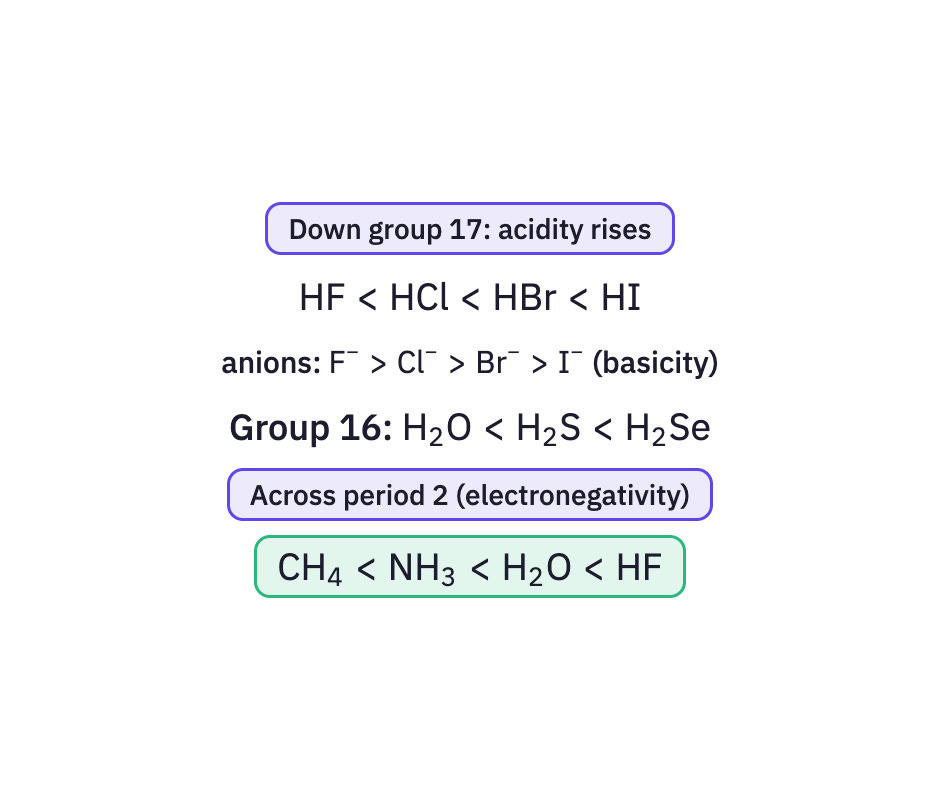
Down a group, across a period
and : down a group the bond to the bigger atom is longer and weaker. Across a period electronegativity decides: .
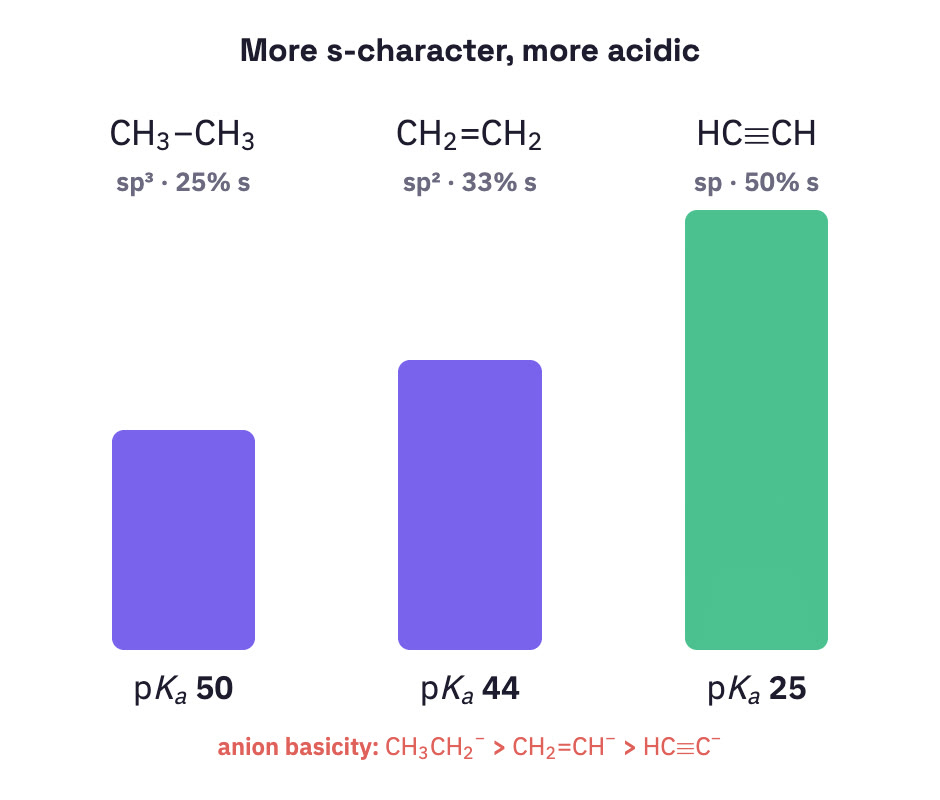
More s-character, more acidic
Ethyne ( 25) > ethene (44) > ethane (50). The carbanion's pair sits in an sp (50 % s), sp² (33 %) or sp³ (25 %) orbital; more s-character holds it closer.
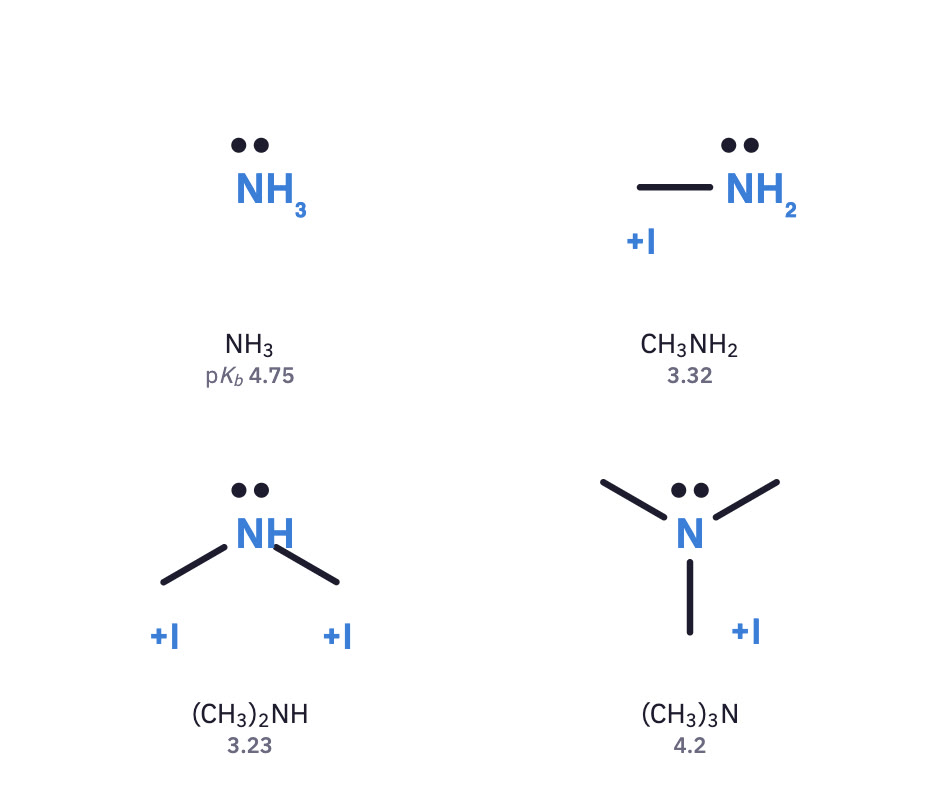
Ammonia and the methylamines
A base gives its lone pair to a proton. +I methyl groups push density onto N, so the amines are stronger bases than . : 3.23, 3.32, 4.2.
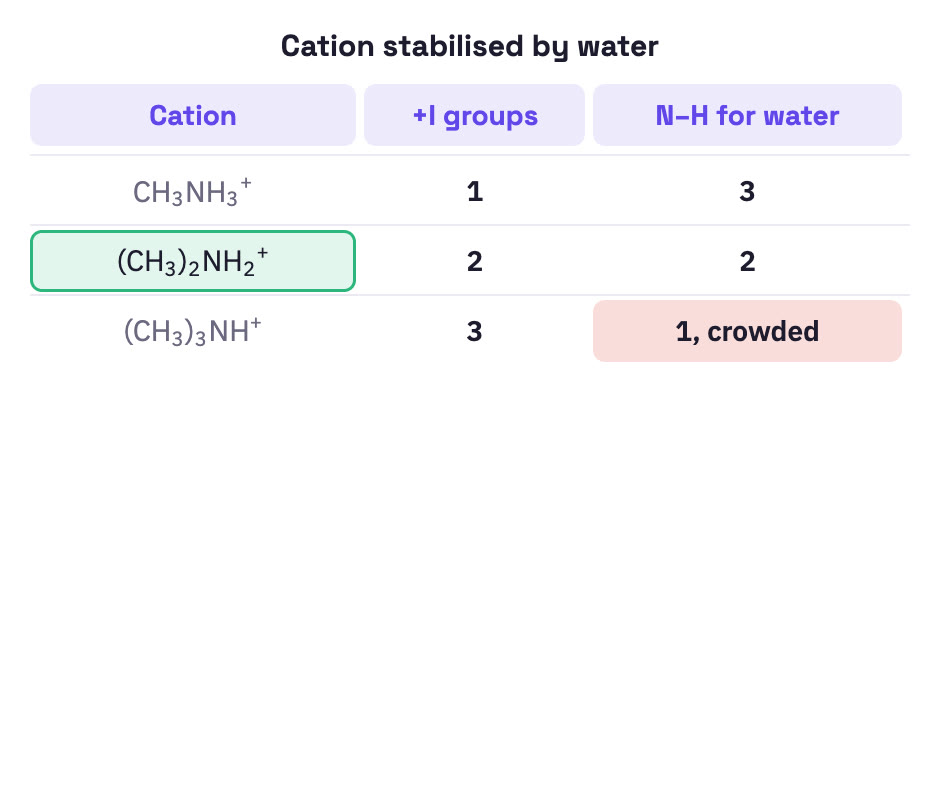
Solvation of the cation
has only one N–H to hydrogen-bond with water and is crowded, so it is poorly stabilised. That pushes below the 1° and 2° amines in water.
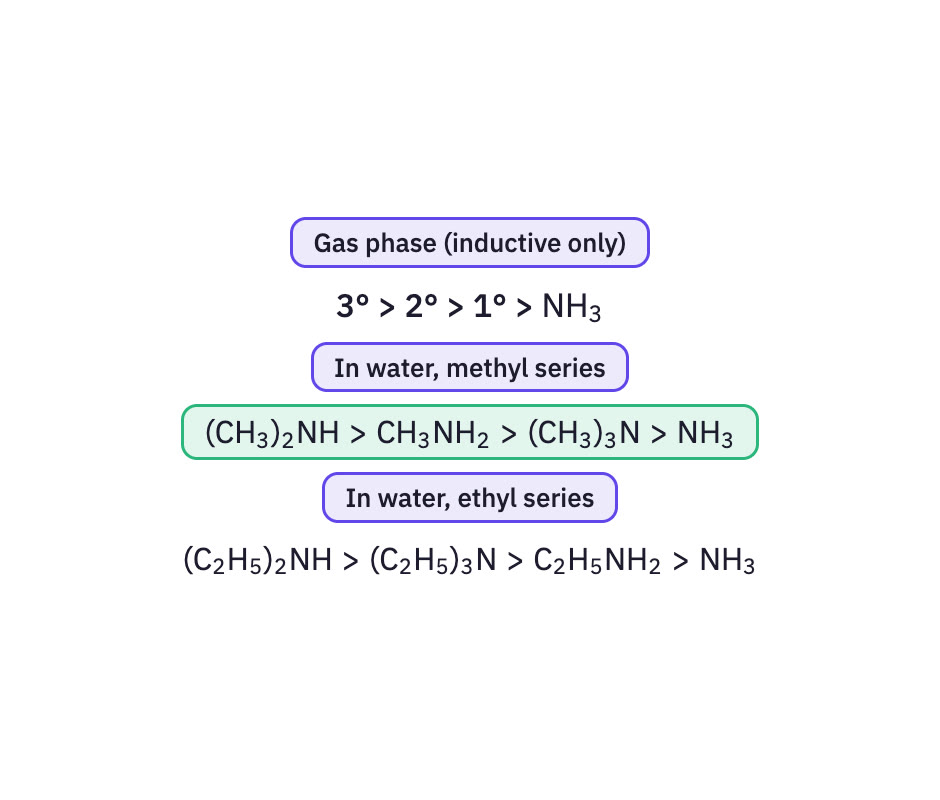
Gas phase vs water
Gas phase: 3° > 2° > 1° > . Water, methyl series: . Water, ethyl series: .
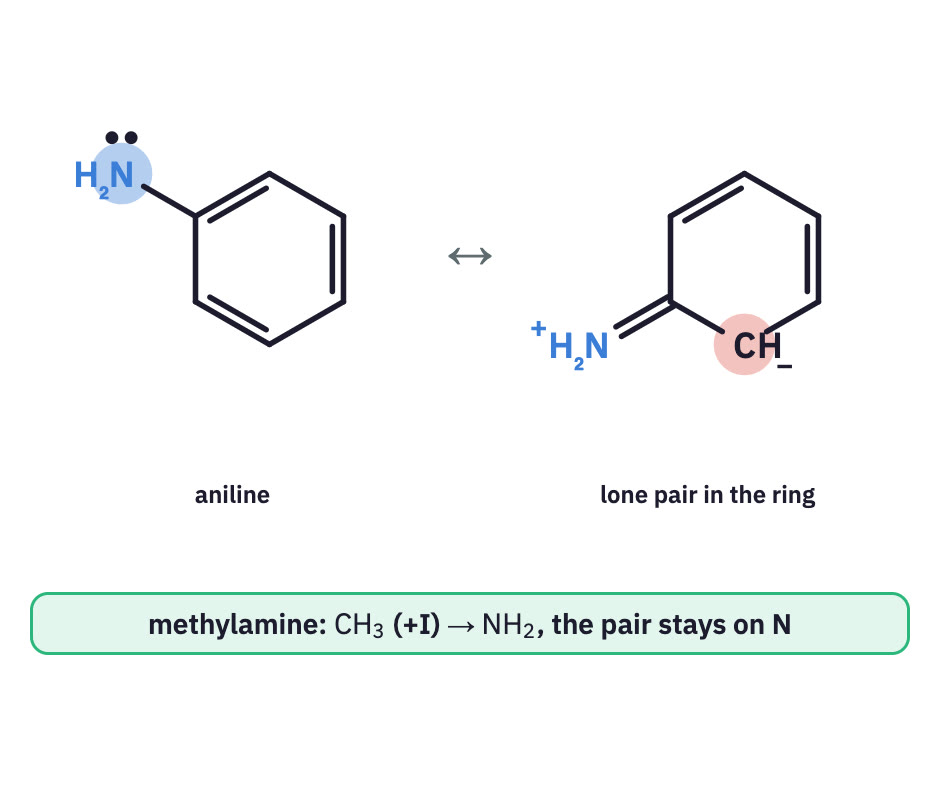
Aniline's lone pair is in the ring
Aniline's lone pair is delocalised into the ring (resonance form with N⁺ and a negative ortho carbon), so less is left for a proton. Methylamine's +I methyl keeps the pair on N.
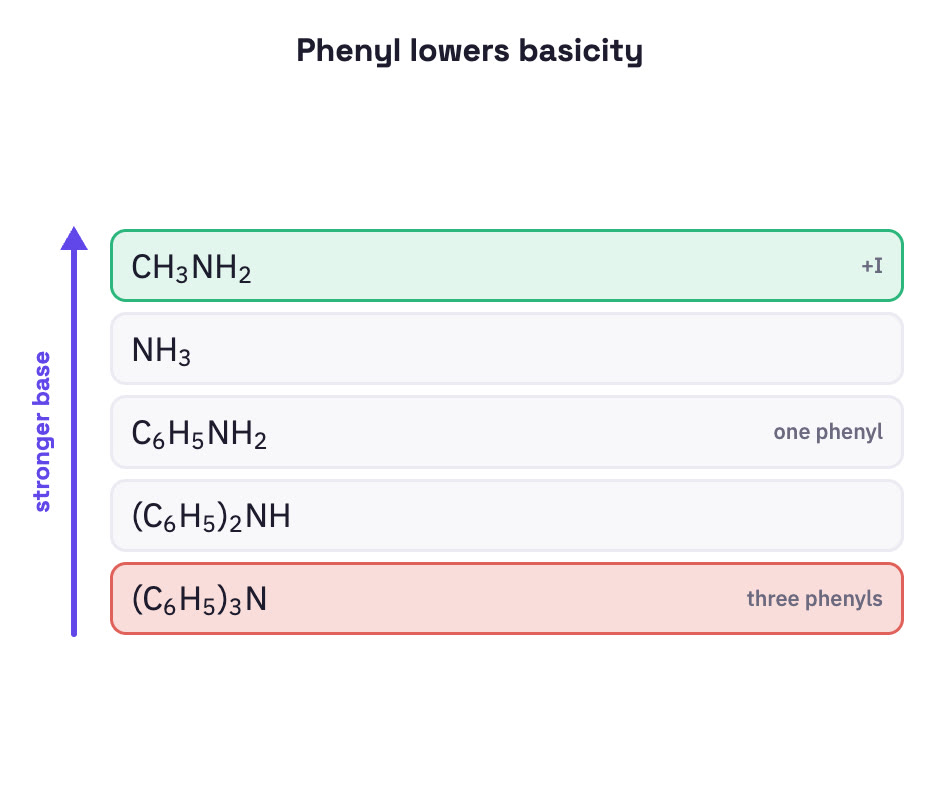
Each phenyl lowers basicity
.
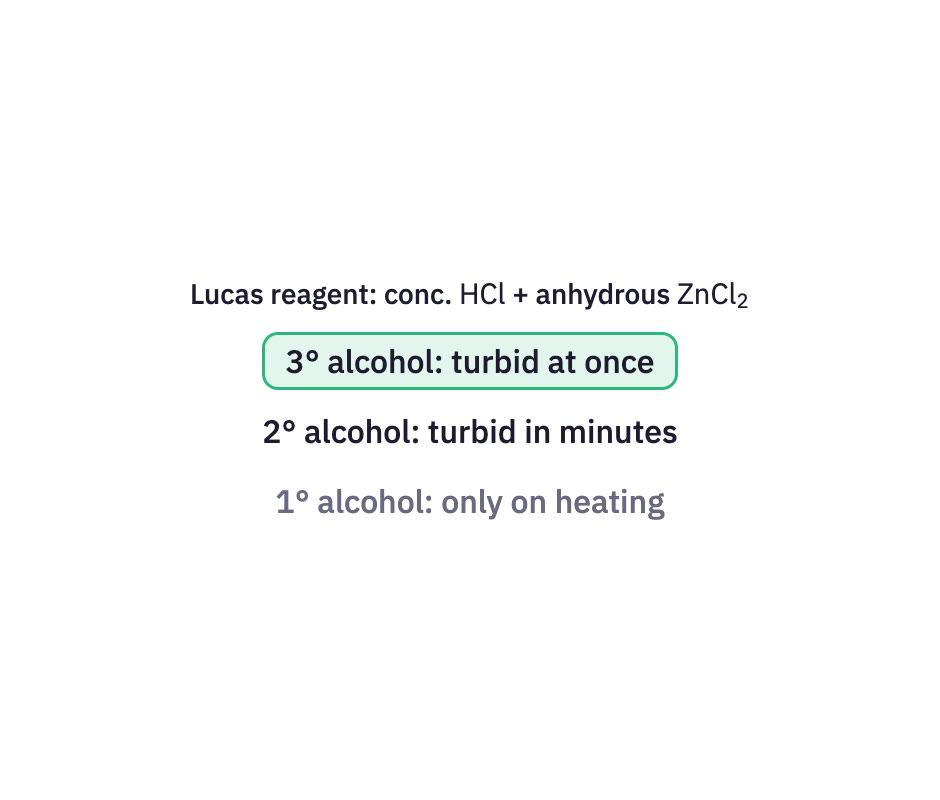
The Lucas test
Alcohols are bases too (3° > 2° > 1° > methyl). Conc. HCl with anhydrous turns turbid at once with a 3° alcohol, within minutes with a 2°, and only on heating with a 1°.
Key formulas
One for every idea
1. Arrange in increasing acidity: ethanol, tert-butyl alcohol, phenol, water.
- Three +I methyls make tert-butyl alcohol the weakest; ethanol (one ethyl) is next.
- Water has no alkyl group; the −I phenyl ring makes phenol the strongest.
.
2. Arrange in decreasing basic strength in aqueous solution: , , , .
- +I raises the basicity of every amine above .
- In water falls behind 1° and 2° because its cation is crowded and poorly solvated.
.
3. Why is aniline a weaker base than methylamine?
- The phenyl group is electron-withdrawing and the ring takes up N's lone pair (resonance).
- Methyl is +I and raises the electron density on N.
Less lone-pair density is left on N in aniline, so methylamine is the stronger base.
Your turn
Which of the following is the weakest base?
Show the answer and the traps
Aniline, option c: the ring withdraws and delocalises N's lone pair.
NH₃ is weaker than the alkylamines, but still stronger than aniline.
CH₃NH₂ has a +I methyl.
And (CH₃)₂NH is the strongest base of the four in water.
Common mistakes
Try these
1. In water, which amine is the strongest base? (a) (b) (c) (d)
(c) .
2. Arrange in increasing acidity: , , , .
(electronegativity across a period).
3. Why is ethyne more acidic than ethane?
The acetylide pair sits in an sp orbital (50 % s-character), held closer to the nucleus than an sp³ pair: 25 vs 50.
4. Arrange in decreasing basicity in water: , , , .
.