 layrd.liveLayer by Layer
- 1. Inductive Effect
- 2. Carboxylic Acid Strength
- 3. Alcohols, Hydrocarbons, Amines
- 4. Electromeric & Mesomeric
- 5. Hyperconjugation
- 6. Fission & Free Radicals
- 7. Carbocations
- 8. Carbanions
- 9. Carbenes
- 10. Nitrenes & Benzyne
- 11. Electrophiles & Nucleophiles
- 12. Reaction Types
- 13. Free Radical Substitution
- 14. SN2 Reaction
- 15. SN1 Reaction
- 16. SN1 vs SN2
- 17. Electrophilic Substitution
- 18. Markovnikov's Rule
- 19. Br₂ Addition & Dienes
- 20. Peroxide Effect
- 21. Nucleophilic Addition
- 22. E1, E1cB & Saytzeff
- 23. E2 Elimination
Hyperconjugation and the Baker–Nathan Effect
Next to a π bond, an empty p orbital or an odd electron, the C–H σ bonds of the neighbouring (α) carbon delocalise too. This σ–π conjugation, hyperconjugation, explains why methyl donates better than tert-butyl to a double bond, why more substituted alkenes and 3° cations are more stable, and why the C–C bond in propene is shorter than in propane. Count the α-hydrogens: each one gives a canonical form.
Builds on: Part 1 · Inductive Effect: −I and +I Groups, Part 4 · Electromeric and Mesomeric (Resonance) Effects.
 Video coming soon
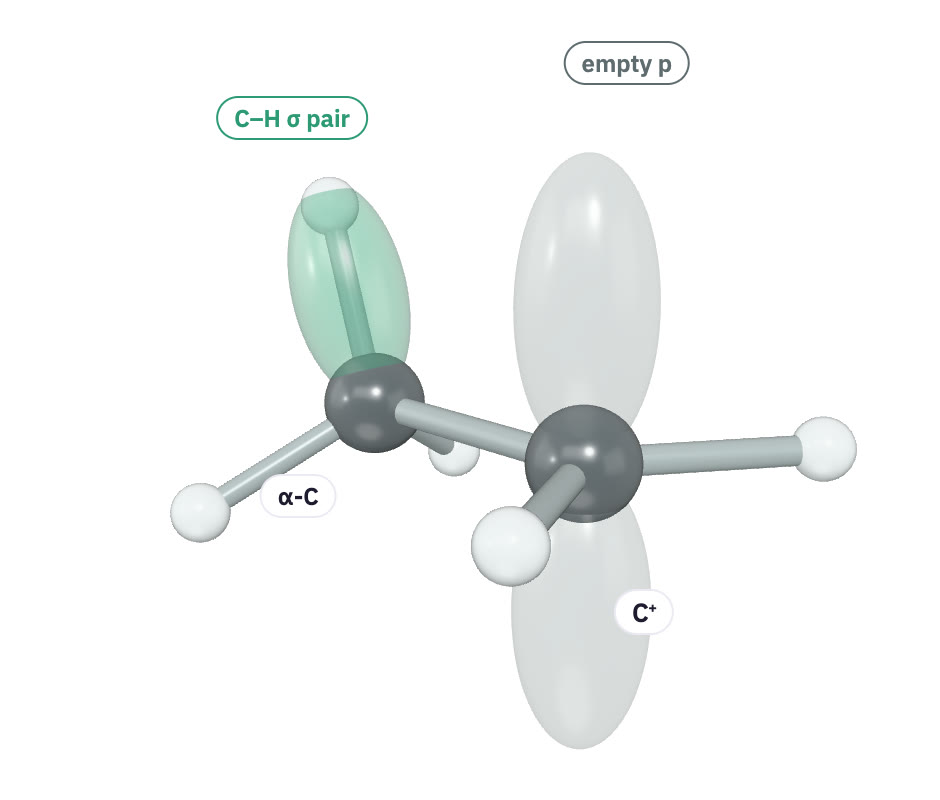
A C–H bond feeds an empty p orbital
A C–H σ bond on the α-carbon, lined up with the empty p orbital of a carbocation (or a π bond, or an odd-electron orbital), shares its electron density with it.
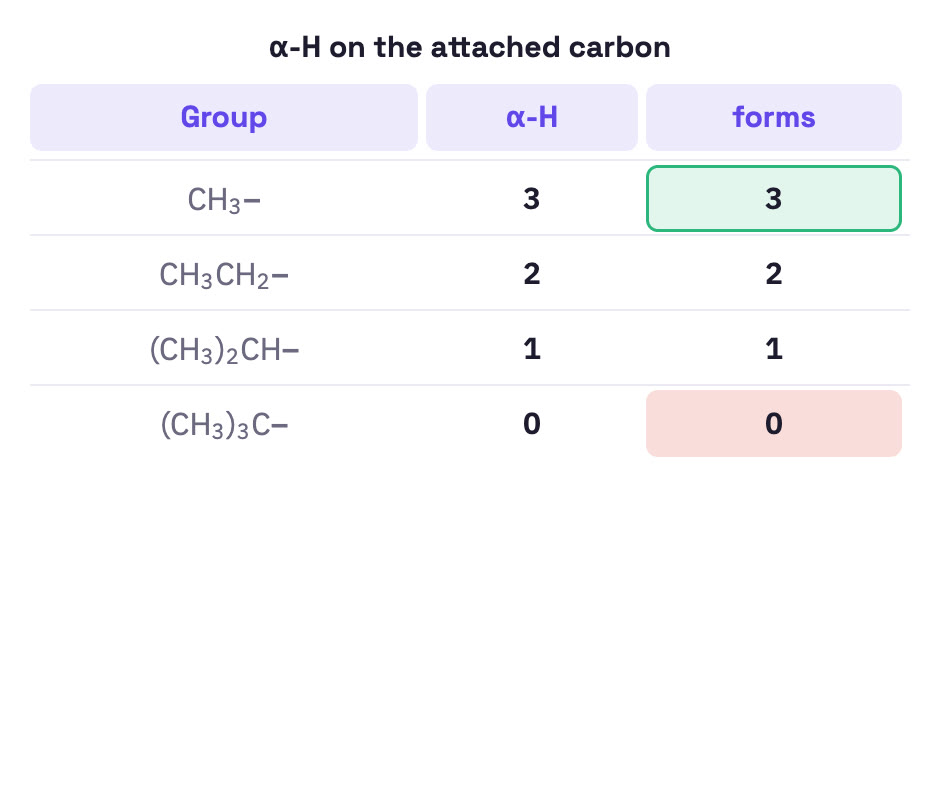
α-H on the attached carbon
– 3, – 2, – 1, – 0 α-H. On an unsaturated system the donating order is – > – > – > –, the reverse of the +I order.
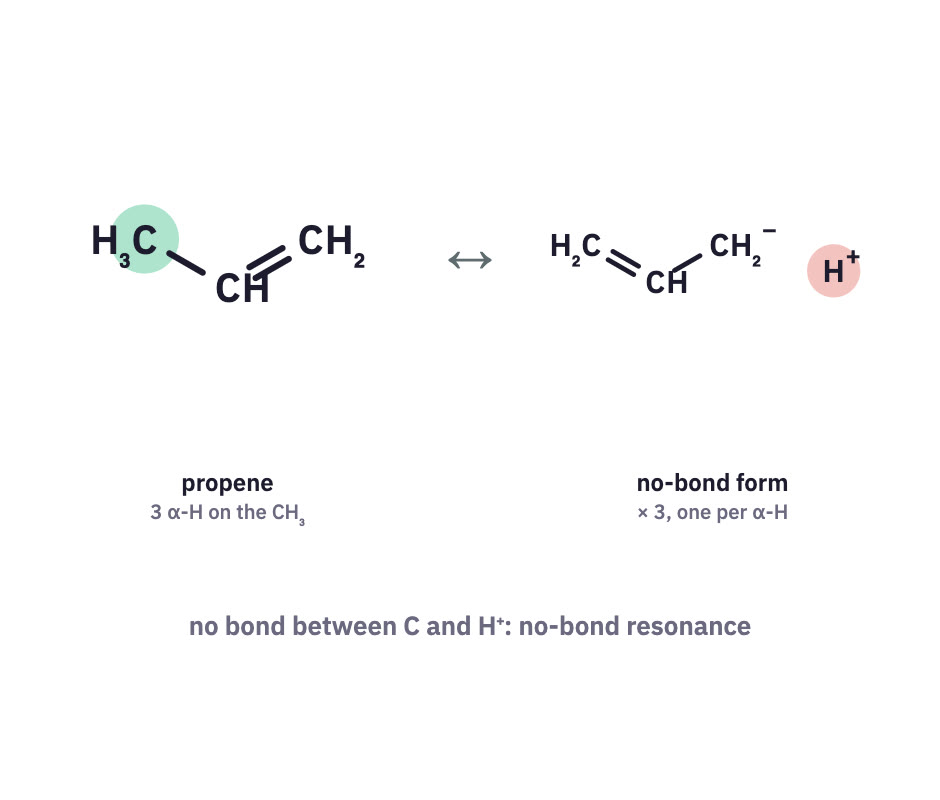
Propene's hyperconjugative forms
Each of propene's three α-H gives a form with no bond drawn between C and .
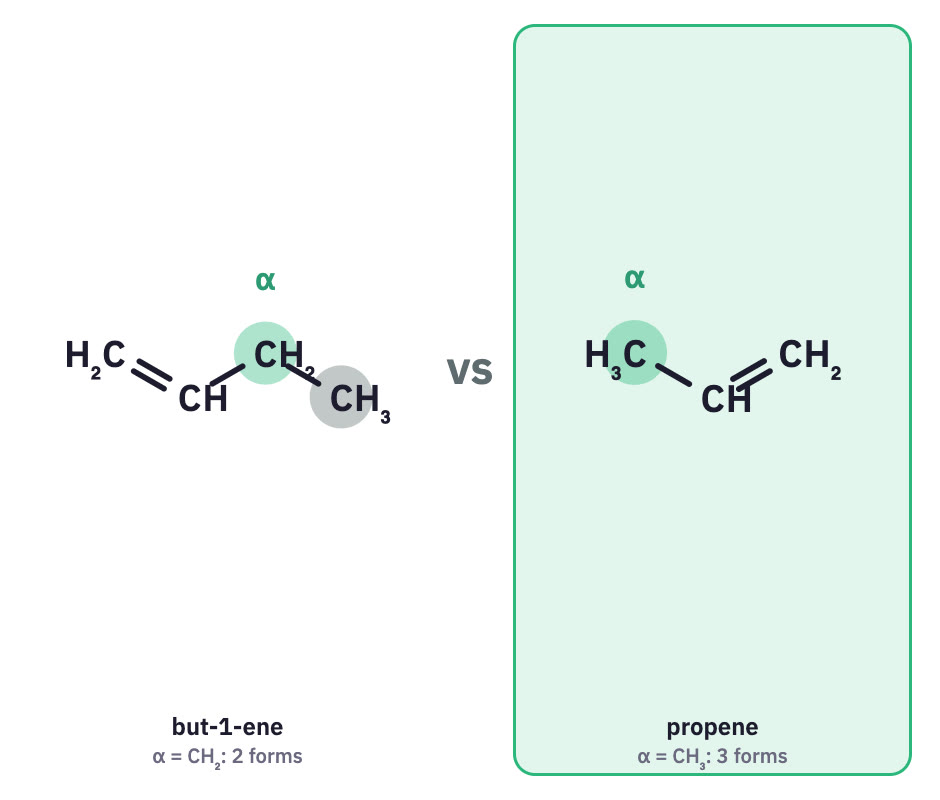
but-1-ene vs propene
In but-1-ene only the on the double bond is α (2 forms); propene's is α (3 forms).
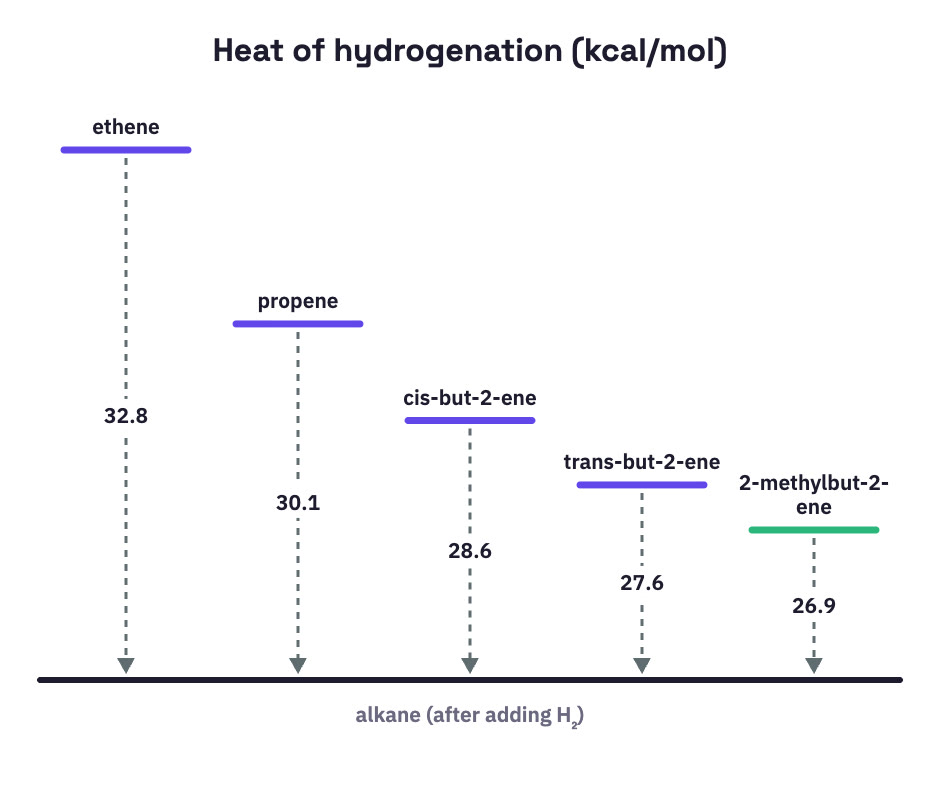
Heats of hydrogenation
kcal/mol: ethene 32.8, propene 30.1, cis-but-2-ene 28.6, trans-but-2-ene 27.6, 2-methylbut-2-ene 26.9. Less heat released means a more stable alkene; trans beats cis because the cis methyls crowd.
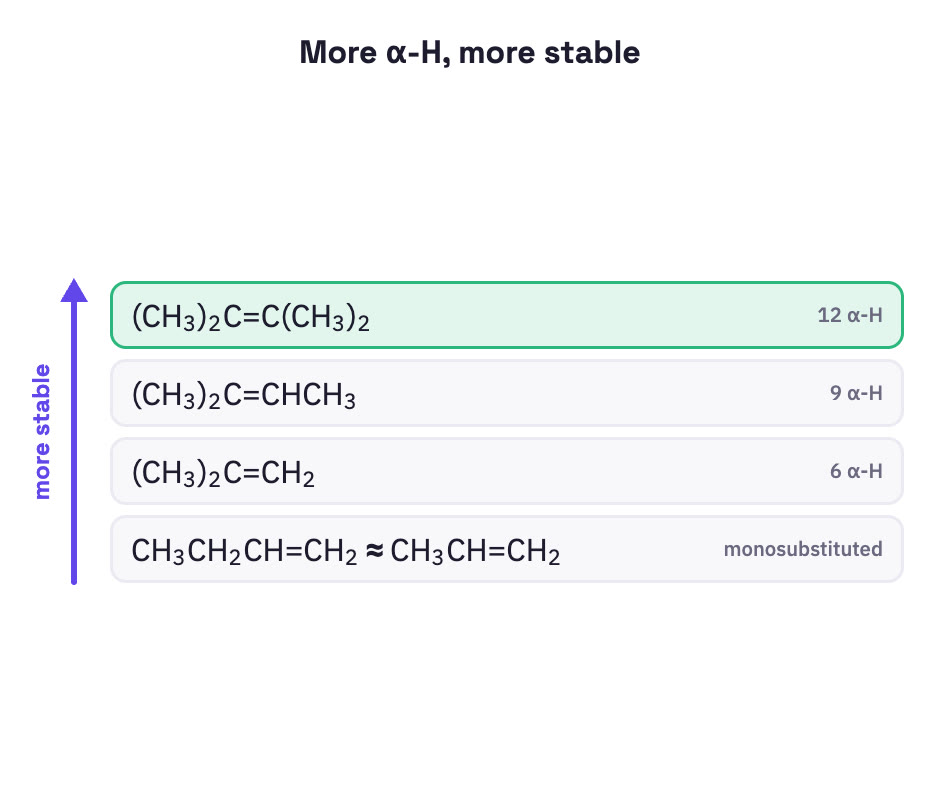
More α-H, more stable
(12 α-H) > (9) > (6) > monosubstituted alkenes. This is the basis of Saytzeff's rule. (The book lists but-1-ene above propene; the two are about equal.)
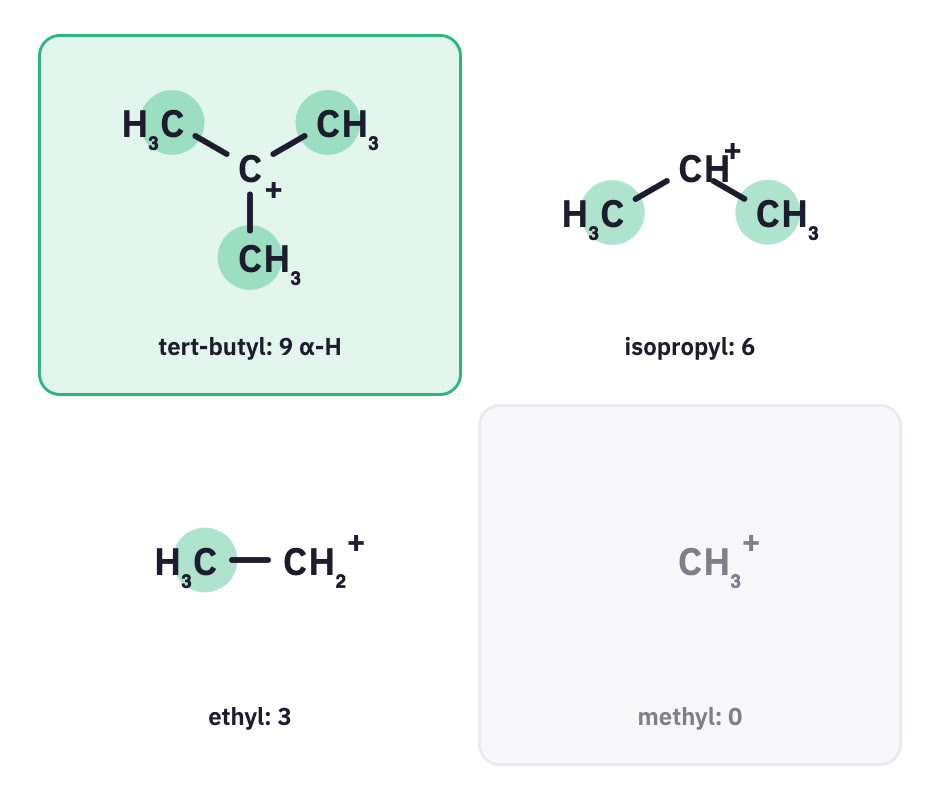
Carbocations: 9, 6, 3, 0
tert-Butyl (9 forms) > isopropyl (6) > ethyl (3) > methyl (0); radicals follow the same order. Cations (6 electrons) gain more than radicals (7).
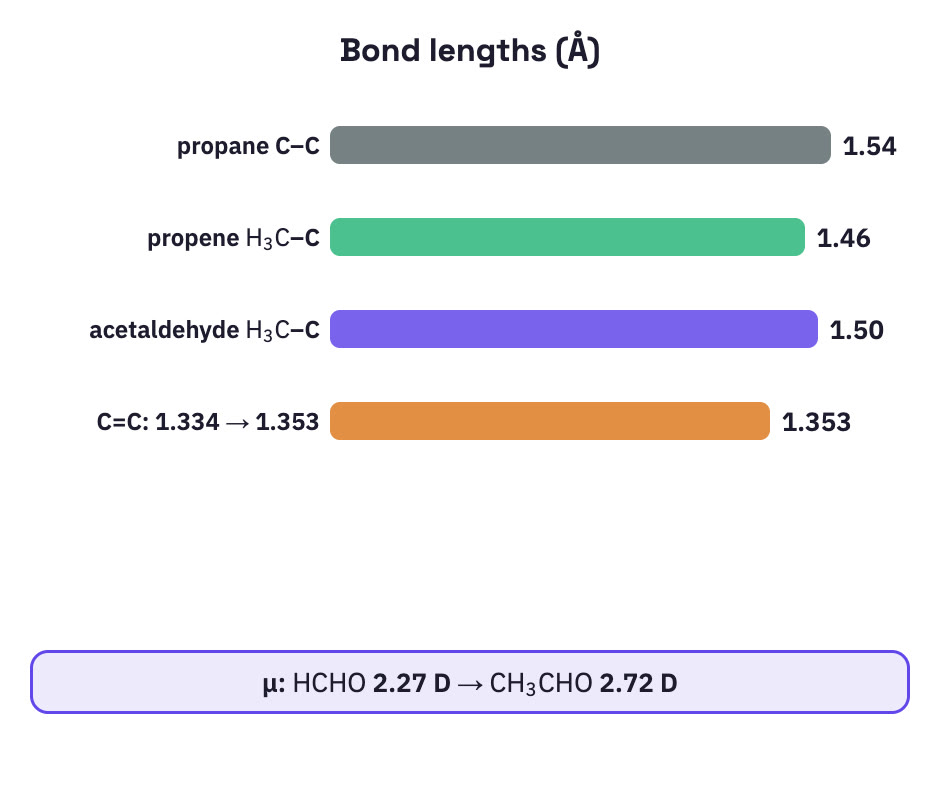
Bond lengths and dipoles
Propene's –C is 1.46 Å (propane 1.54 Å); its C=C lengthens to 1.353 Å (1.334 Å). Acetaldehyde: –C 1.50 Å, C=O 1.21 Å. μ rises from HCHO 2.27 D to 2.72 D.
Key formulas
One for every idea
1. How many hyperconjugative structures can be drawn for but-1-ene ()? Compare it with propene.
- Only the attached to the sp² carbon is α: 2 H, so 2 forms.
- Propene's is α with 3 H: 3 forms.
But-1-ene 2, propene 3: propene has more hyperconjugation.
2. Arrange in increasing stability: ethene, 2-methylpropene, propene, 2,3-dimethylbut-2-ene. Use α-H counts.
- α-H: ethene 0, propene 3, 2-methylpropene 6, 2,3-dimethylbut-2-ene 12.
Ethene < propene < 2-methylpropene < 2,3-dimethylbut-2-ene.
3. How many hyperconjugative structures does the isopropyl cation, , have? How does it compare with the tert-butyl cation?
- Two groups × 3 H = 6 α-H: 6 forms.
- tert-Butyl: 3 × 3 = 9.
6; tert-butyl (9) is more stable.
4. Why is the C–C single bond in propene shorter than the C–C bond in propane?
- Hyperconjugation gives forms in which the –CH bond is a double bond.
The real bond has partial double-bond character: 1.46 Å vs 1.54 Å.
Your turn
Which alkene has the largest number of hyperconjugative structures?
Show the answer and the traps
(CH₃)₂C=CHCH₃, option d: three α-carbons, 9 α-H.
Propene has only 3 α-H.
2-Methylpropene has 6.
And but-2-ene also has 6.
Common mistakes
Try these
1. Which alkene has the lowest heat of hydrogenation? (a) (b) (c) (d)
(d): 12 α-H, the most stable alkene.
2. How many α-hydrogens does 2-methylbut-2-ene have?
9 (three groups on the double-bond carbons).
3. Arrange the radicals in decreasing stability: , , , .
> > > (9, 6, 3, 0 forms).
4. Why is trans-but-2-ene more stable than cis-but-2-ene, although both have 6 α-H?
In the cis isomer the two methyl groups crowd and repel each other.
5. Why does acetaldehyde have a larger dipole moment (2.72 D) than formaldehyde (2.27 D)?
The methyl group releases electrons by hyperconjugation (and +I), increasing the polarity of C=O.