 layrd.liveLayer by Layer
- 1. Inductive Effect
- 2. Carboxylic Acid Strength
- 3. Alcohols, Hydrocarbons, Amines
- 4. Electromeric & Mesomeric
- 5. Hyperconjugation
- 6. Fission & Free Radicals
- 7. Carbocations
- 8. Carbanions
- 9. Carbenes
- 10. Nitrenes & Benzyne
- 11. Electrophiles & Nucleophiles
- 12. Reaction Types
- 13. Free Radical Substitution
- 14. SN2 Reaction
- 15. SN1 Reaction
- 16. SN1 vs SN2
- 17. Electrophilic Substitution
- 18. Markovnikov's Rule
- 19. Br₂ Addition & Dienes
- 20. Peroxide Effect
- 21. Nucleophilic Addition
- 22. E1, E1cB & Saytzeff
- 23. E2 Elimination
Bond Fission and Free Radicals
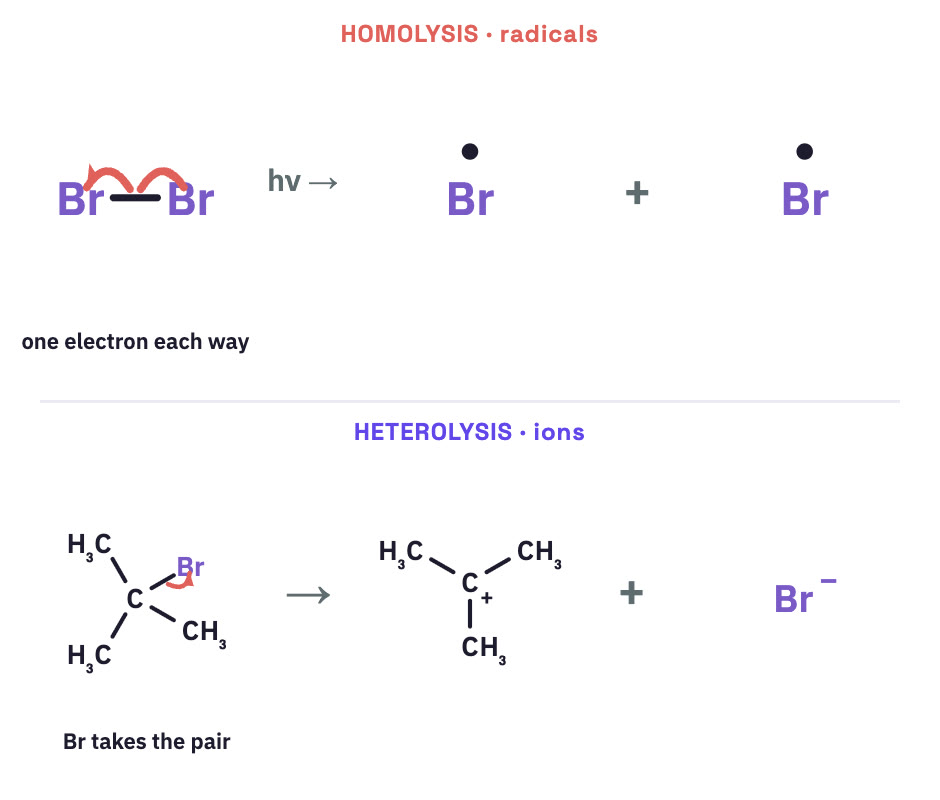
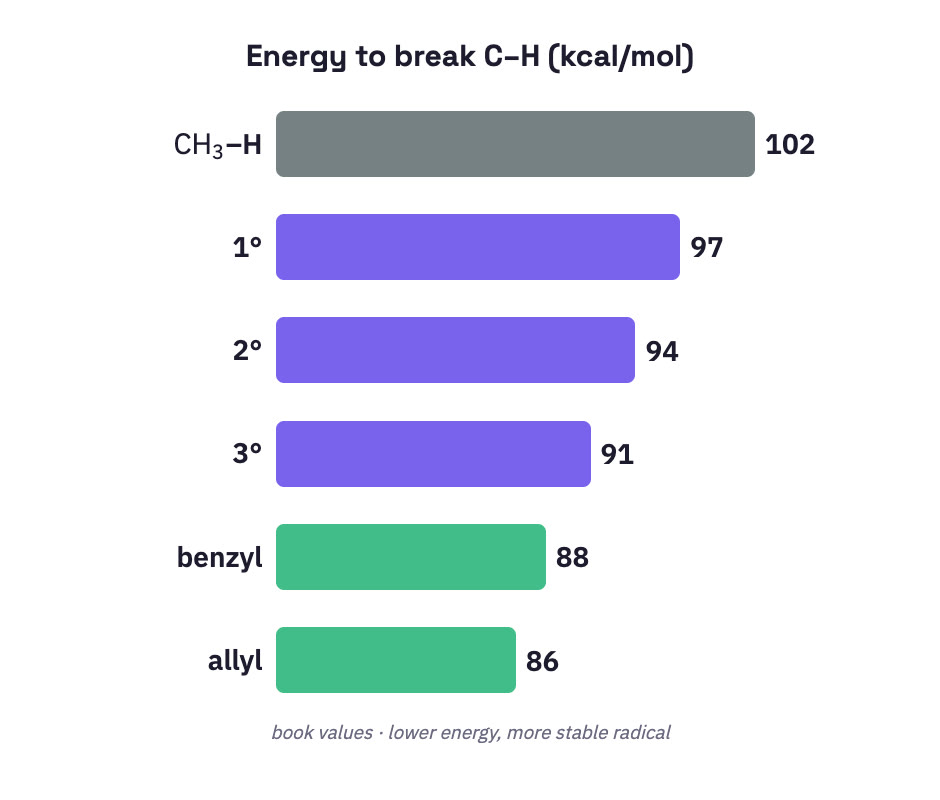
A covalent bond can break two ways. In homolysis each atom keeps one electron and free radicals form; in heterolysis one atom takes the pair and ions form. Bond dissociation energies rank the radicals: the less energy needed, the more stable the radical, which puts allyl and benzyl ahead of 3° alkyl radicals.
Builds on: Part 5 · Hyperconjugation and the Baker–Nathan Effect.
 Video coming soon
Homolysis and heterolysis
Homolysis () is drawn with fish-hook arrows and favoured by non-polar bonds, the vapour phase, heat, UV light and peroxides. Heterolysis () gives ions; the more electronegative atom takes the pair, helped by polar bonds and polar solvents.
Energy to break C–H
Book values (kcal/mol): –H 102, 1° 97, 2° 94, 3° 91, benzyl 88, allyl 86. Another common set: 105, 101, 98.5, 96.5.
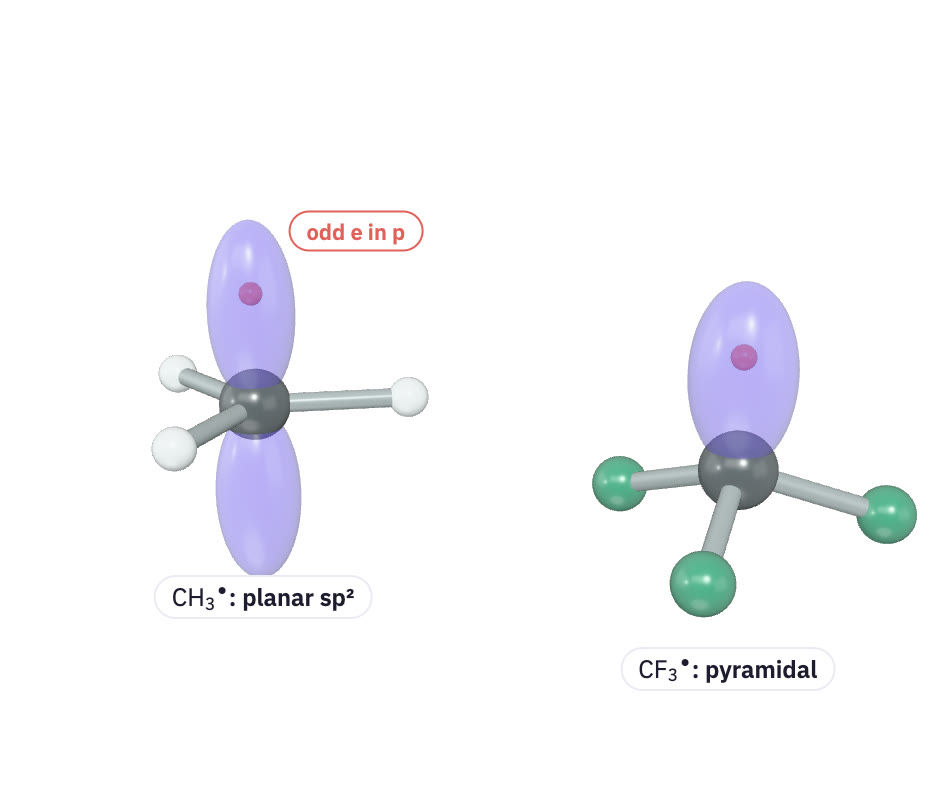
Planar , pyramidal
An alkyl radical is sp² and planar with its odd electron in a p orbital. Electronegative substituents raise the s-character: is pyramidal.
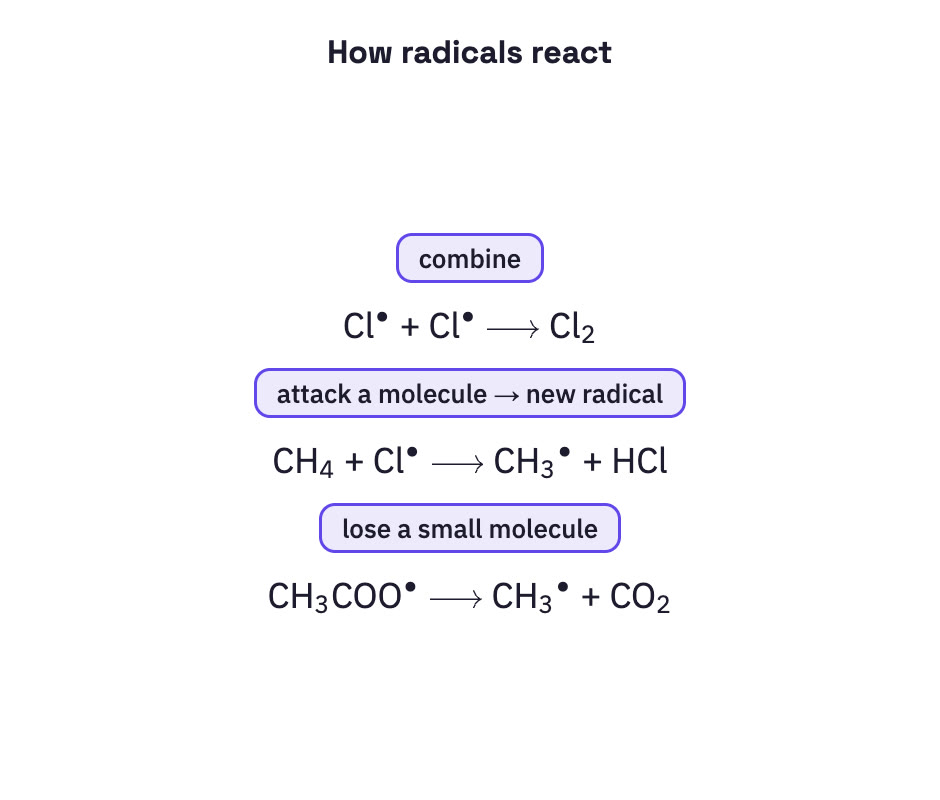
How radicals react
Combine (), attack a molecule to make a new radical (), or lose a small molecule ().
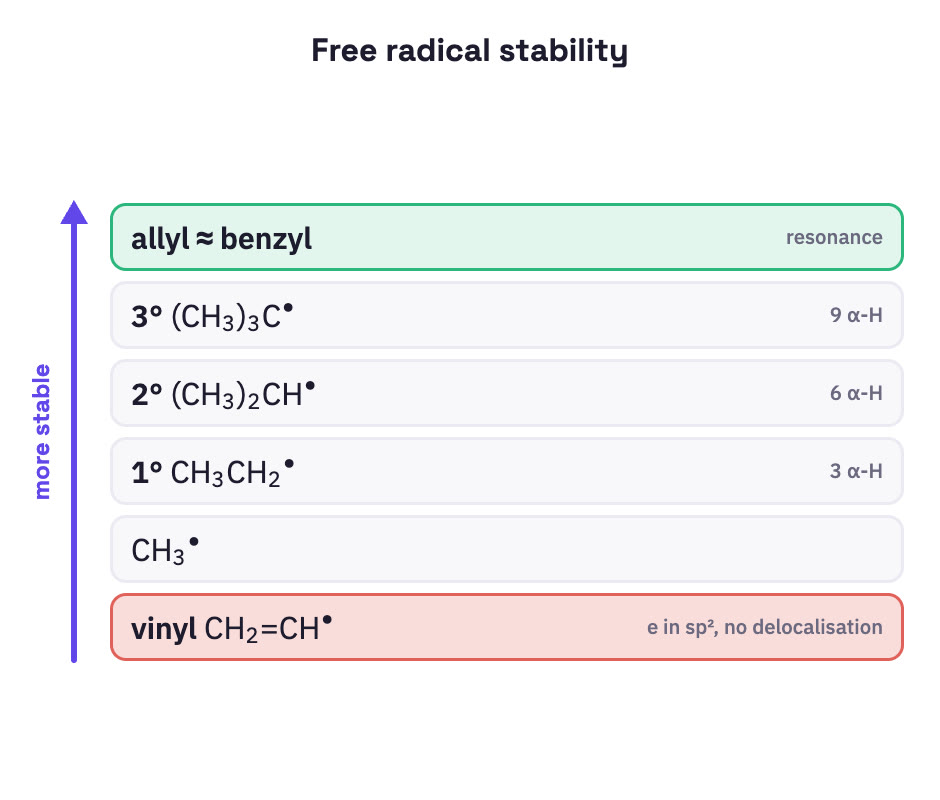
Free radical stability
Allyl ≈ benzyl > 3° > 2° > 1° > > vinyl. The book prints 3° above benzyl and allyl, but its own bond energies (3° 91, benzyl 88, allyl 86) put them first, as exam keys do.
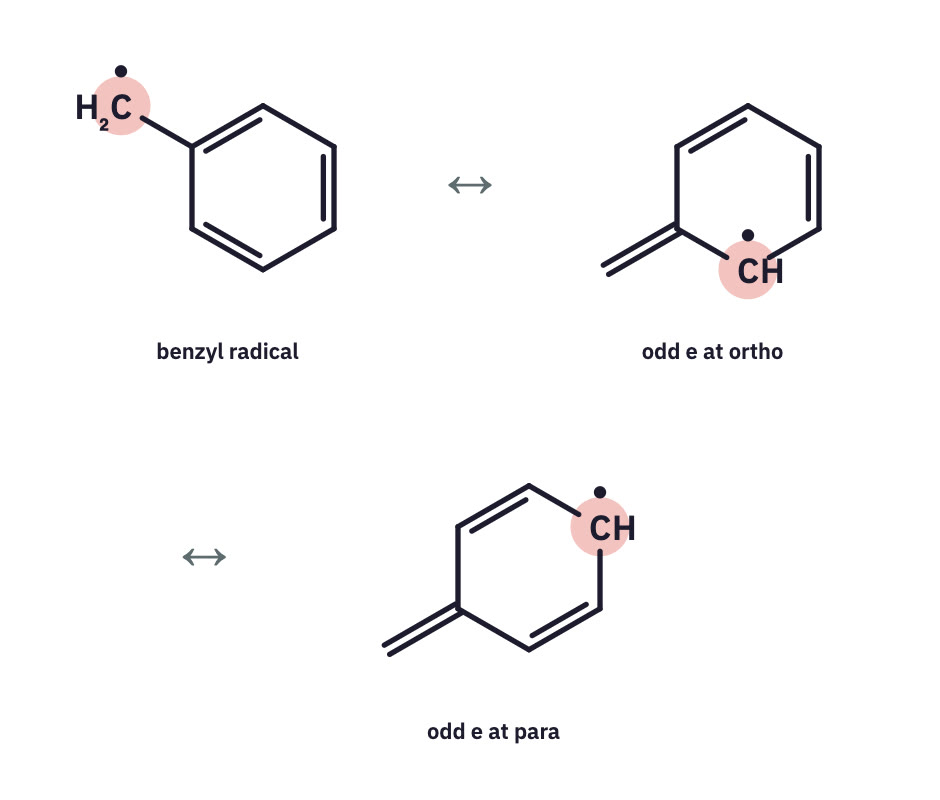
The benzyl radical
The odd electron of the benzyl radical spreads to the ortho and para carbons of the ring. Substituted benzyl radicals: p- > p- > H > p-.
One for every idea
1. Show the products when (i) the Br–Br bond breaks in UV light and (ii) the C–Br bond of tert-butyl bromide breaks in water.
- (i) Identical atoms, light: homolysis, .
- (ii) Polar bond, polar solvent: heterolysis; Br takes the pair.
(i) ; (ii) .
2. Breaking a 3° C–H bond needs 91 kcal/mol and breaking a bond needs 102 kcal/mol. Which radical is more stable, and by how much less energy does it form?
- 102 − 91 = 11 kcal/mol.
The 3° radical; it forms with 11 kcal/mol less energy.
3. Classify each step: (a) ; (b) ; (c) .
- (a) two radicals combine to a neutral molecule.
- (b) a radical attacks a neutral molecule and makes a new radical.
- (c) a radical loses a neutral molecule ().
Combination, attack (propagation), loss of a small molecule.
4. Arrange in decreasing stability: , allyl radical, , vinyl radical.
- Allyl: resonance. : 9 α-H. : none.
- Vinyl: odd electron in an sp² orbital on a double-bonded carbon, not delocalised.
Allyl > > > vinyl.
Your turn
Which C–H bond has the lowest bond dissociation energy?
Show the answer and the traps
The allylic C–H, option c: 86 kcal/mol, because the allyl radical is resonance-stabilised.
CH₃–H is the strongest, 102.
The 3° C–H, 91, is low, but allylic is lower.
And the 2° C–H is 94.
Common mistakes
Try these
1. Free radicals are: (a) diamagnetic and charged (b) paramagnetic and neutral (c) diamagnetic and neutral (d) paramagnetic and charged
(b): one unpaired electron, no charge.
2. Which conditions favour homolysis: (a) polar solvent, (b) UV light, (c) acid catalyst?
(b) UV light (also heat, the vapour phase and peroxides).
3. In heterolysis of , which fragment keeps the electron pair?
Carbon (more electronegative than Li): a carbanion and .
4. Why is the benzyl radical more stable than the ethyl radical?
Its odd electron is delocalised over the ring (resonance), which outweighs hyperconjugation.
5. Arrange the C–H bonds in increasing bond energy: allylic, 3°, 1°, methyl.
Allylic (86) < 3° (91) < 1° (97) < methyl (102).