 layrd.liveLayer by Layer
- 1. Inductive Effect
- 2. Carboxylic Acid Strength
- 3. Alcohols, Hydrocarbons, Amines
- 4. Electromeric & Mesomeric
- 5. Hyperconjugation
- 6. Fission & Free Radicals
- 7. Carbocations
- 8. Carbanions
- 9. Carbenes
- 10. Nitrenes & Benzyne
- 11. Electrophiles & Nucleophiles
- 12. Reaction Types
- 13. Free Radical Substitution
- 14. SN2 Reaction
- 15. SN1 Reaction
- 16. SN1 vs SN2
- 17. Electrophilic Substitution
- 18. Markovnikov's Rule
- 19. Br₂ Addition & Dienes
- 20. Peroxide Effect
- 21. Nucleophilic Addition
- 22. E1, E1cB & Saytzeff
- 23. E2 Elimination
Electrophiles, Nucleophiles and Ambident Reagents
Every polar reaction pairs an electron-poor reagent with an electron-rich site. Electrophiles (E⁺) are electron-loving Lewis acids, charged or neutral; nucleophiles (Nu:) are electron-rich Lewis bases. Nucleophilicity follows basicity across a period but reverses down a group in protic solvents, and ambident nucleophiles can attack through two different atoms.
Builds on: Part 7 · Carbocations: Structure and Stability, Part 8 · Carbanions: Structure and Stability.
 Video coming soon
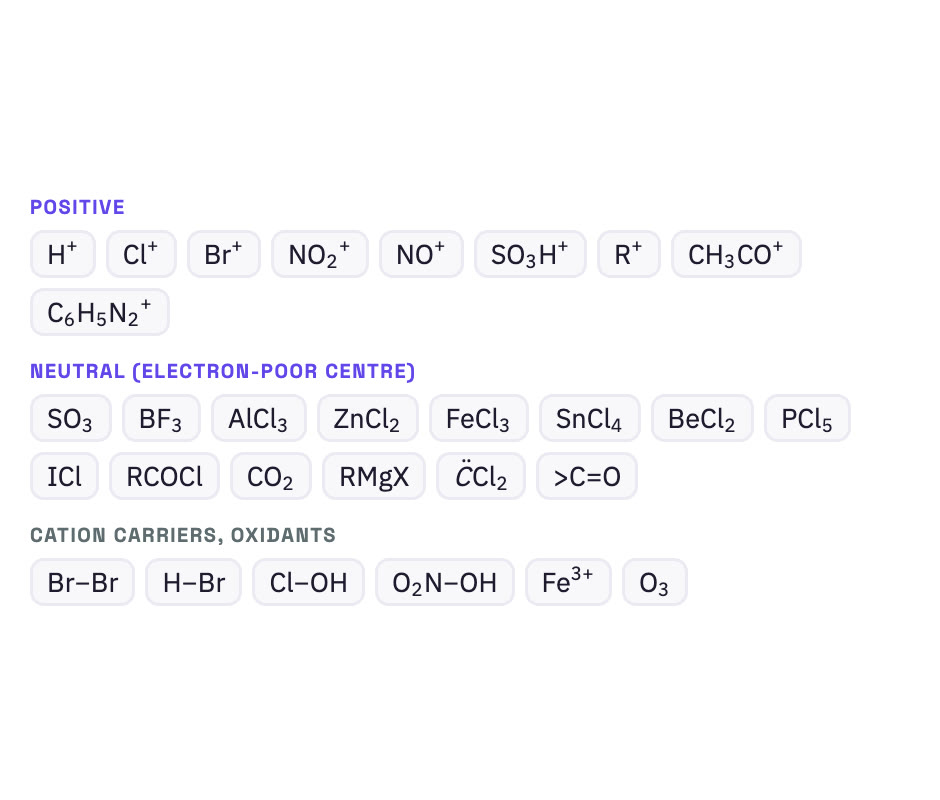
Positive and neutral electrophiles
Positive: , , , , , , , , . Neutral (electron-deficient centre): , , , , , , , , ICl, RCOCl, , RMgX, :CCl₂, nitrenes, C=O. Cation carriers (, HBr, HOCl, ) and oxidants (, ) also act as electrophiles.
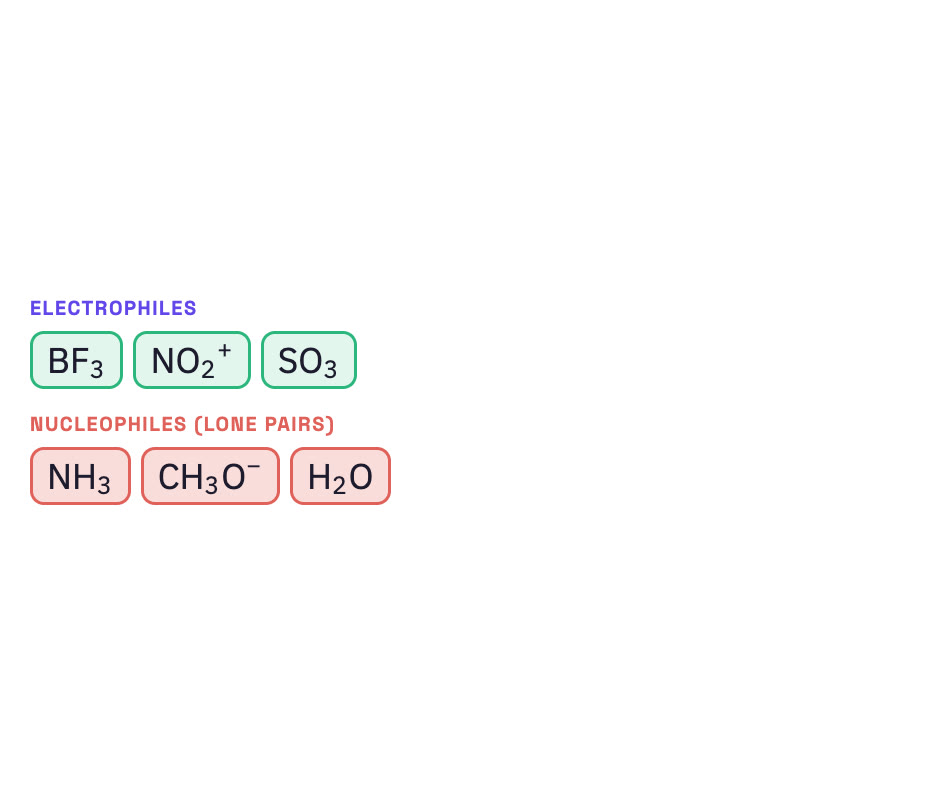
Sorting six reagents
Electrophiles: (empty p), , . Nucleophiles: , , (lone pairs).
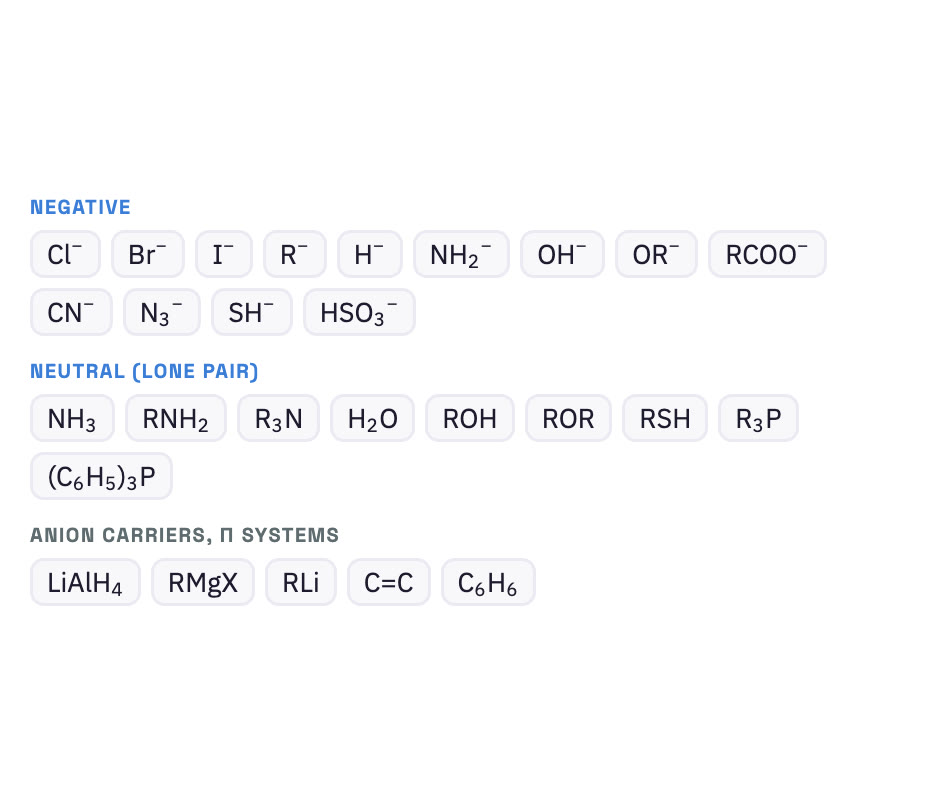
Negative and neutral nucleophiles
Negative: halides, , , , , , , , , , . Neutral: , amines, , ROH, ethers, RSH, phosphines. Anion carriers (, RMgX, RLi), C=C and benzene rings also act as nucleophiles.
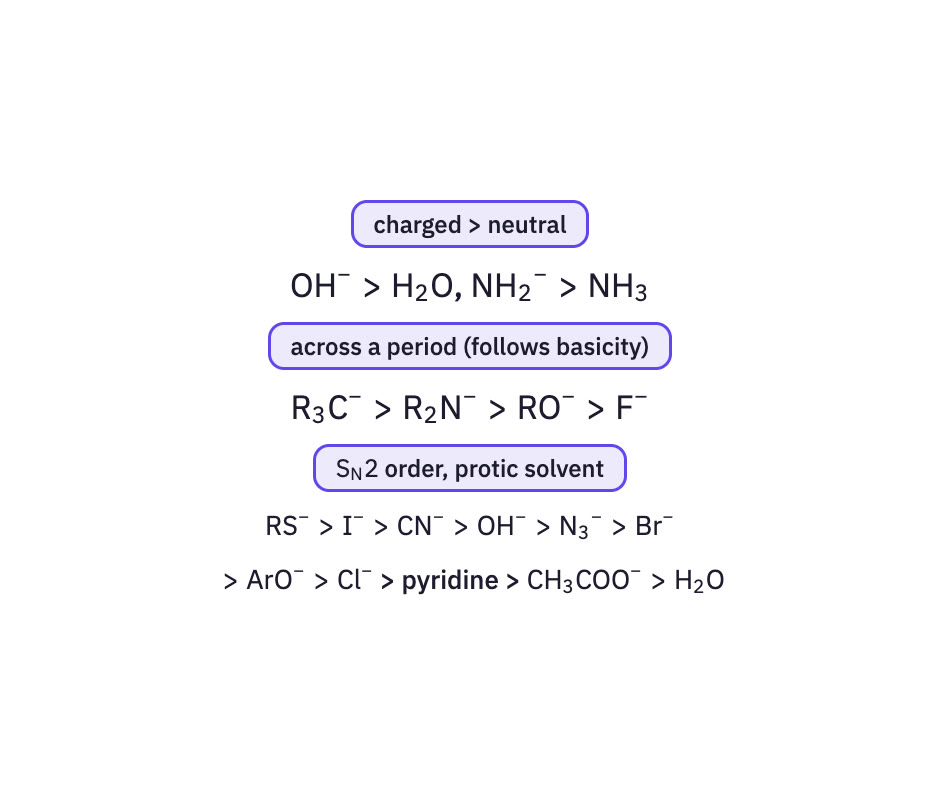
Orders to know
, ; across a period . order in a protic solvent: > pyridine > .
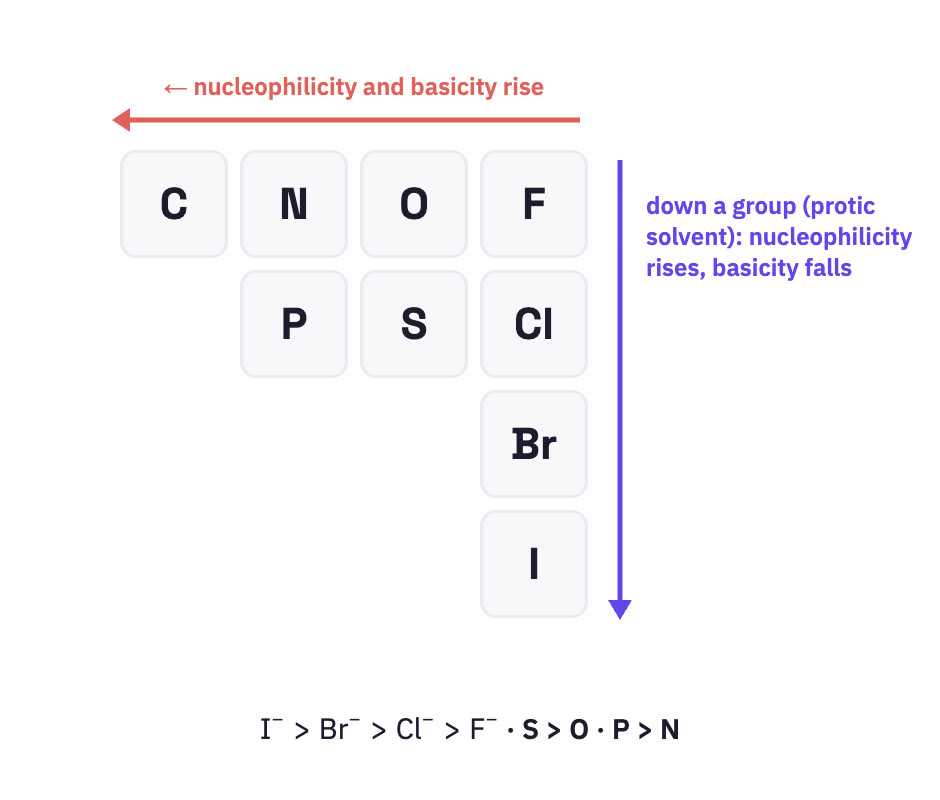
Across a period vs down a group
Across a period nucleophilicity follows basicity. Down a group in protic solvents it rises while basicity falls: ; S > O, P > N.
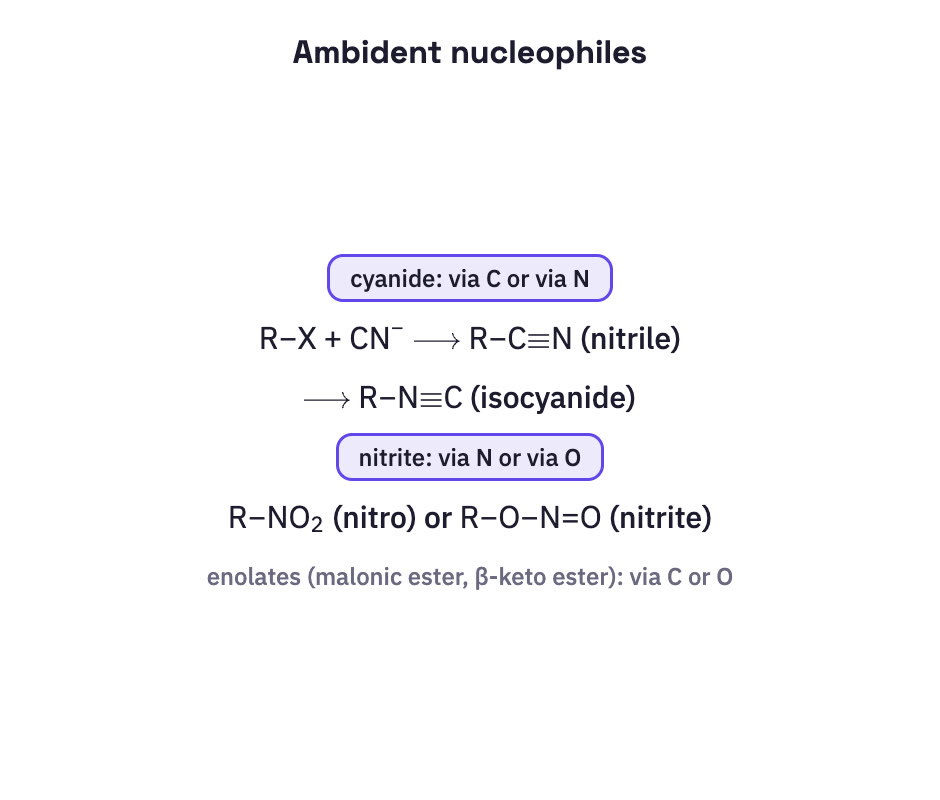
Two attacking atoms
via C gives RCN, via N gives RNC; via N gives , via O gives RONO; enolates attack via C or O. Ambiphiles (, ROH, , , RCHO, RCOCl…) have both electron-rich and electron-poor sites.
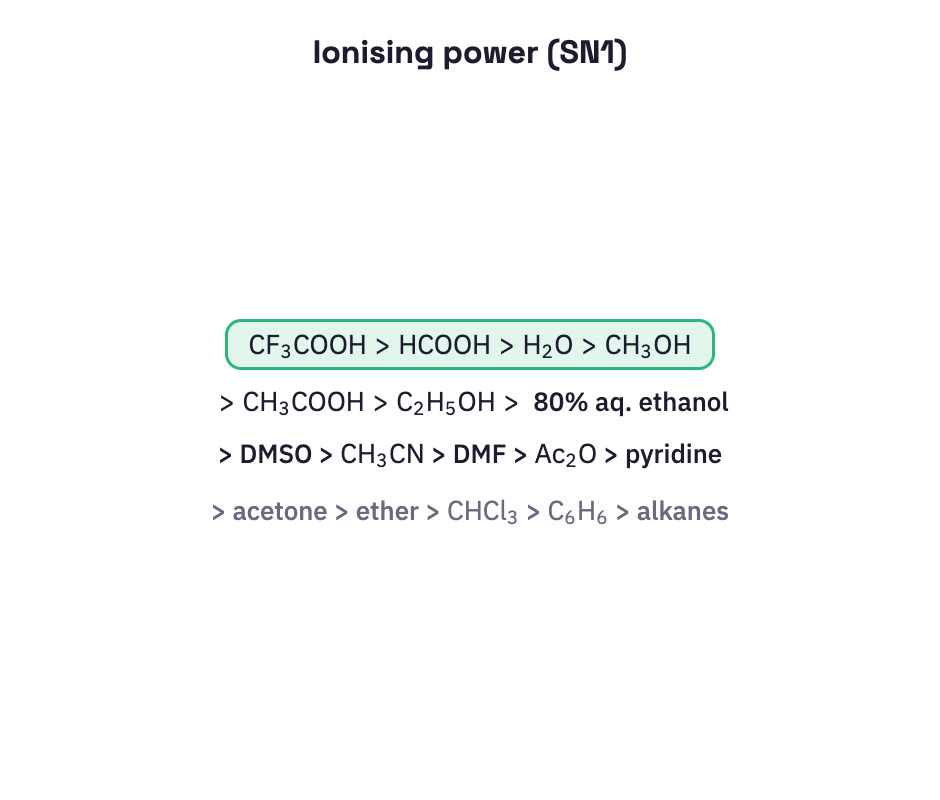
Ionising power of solvents
> 80 % aq. ethanol > DMSO > > DMF > > pyridine > acetone > ether > > > alkanes.
One for every idea
1. Pick the electrophiles: , , , , , .
- has an empty p orbital; a positive N; an electron-poor S.
- , and have lone pairs to give: nucleophiles.
, and .
2. Arrange in decreasing nucleophilicity in a protic solvent: , , , .
- S beats O (larger, more polarisable).
- (charge on one O) beats acetate (charge spread over two O); neutral water is weakest.
.
3. Silver nitrite with an alkyl halide gives a nitroalkane, but sodium nitrite can give an alkyl nitrite. What property of does this show?
- Bonding through N gives ; through O gives .
is an ambident nucleophile.
Your turn
In methanol, which halide ion is the strongest nucleophile?
Show the answer and the traps
I⁻, option d: large, polarisable, and least caged by hydrogen bonds.
F⁻ is the strongest base, but methanol solvates it heavily.
Cl⁻ is smaller and more solvated than I⁻.
And Br⁻ is less polarisable than I⁻.
Common mistakes
Try these
1. Which of these is NOT a nucleophile? (a) (b) (c) (d)
(c) : it accepts a pair (electrophile).
2. Which is the stronger nucleophile in water: or ? Why?
: a charged species beats its conjugate acid.
3. Arrange in decreasing nucleophilicity: , , , .
(across a period, follows basicity).
4. with an alkyl halide gives mainly a nitrile, mainly an isocyanide. What does this show about ?
is ambident: it can bond through C or through N.
5. Is an electrophile, a nucleophile or both?
Both (ambiphile): the carbonyl C is electron-poor, the O has lone pairs.