 layrd.liveLayer by Layer
- 1. Inductive Effect
- 2. Carboxylic Acid Strength
- 3. Alcohols, Hydrocarbons, Amines
- 4. Electromeric & Mesomeric
- 5. Hyperconjugation
- 6. Fission & Free Radicals
- 7. Carbocations
- 8. Carbanions
- 9. Carbenes
- 10. Nitrenes & Benzyne
- 11. Electrophiles & Nucleophiles
- 12. Reaction Types
- 13. Free Radical Substitution
- 14. SN2 Reaction
- 15. SN1 Reaction
- 16. SN1 vs SN2
- 17. Electrophilic Substitution
- 18. Markovnikov's Rule
- 19. Br₂ Addition & Dienes
- 20. Peroxide Effect
- 21. Nucleophilic Addition
- 22. E1, E1cB & Saytzeff
- 23. E2 Elimination
SN1 vs SN2: Substrate, Leaving Group and Solvent
SN1 is fast when the carbocation is stable, the leaving group good and the solvent polar and ionising; SN2 is fast when the carbon is unhindered, the nucleophile strong and concentrated, and the solvent aprotic. The twelve-point comparison turns those rules into a checklist for choosing the mechanism.
Builds on: Part 15 · SN1 Reaction: Carbocations, Racemisation and Rearrangement.
 Video coming soon
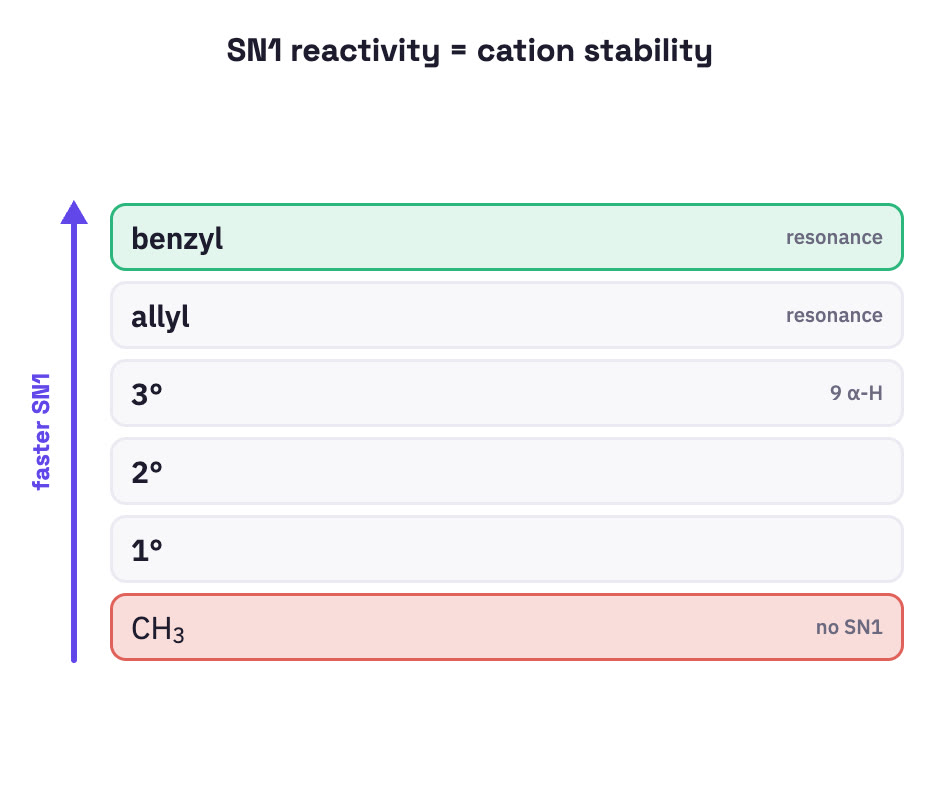
Substrate order
, following carbocation stability: benzyl > allyl > 3° > 2° > 1° > methyl. Leaving groups: ≈ , the same order as in SN2 but more important here (slow step).
Solvent polarity
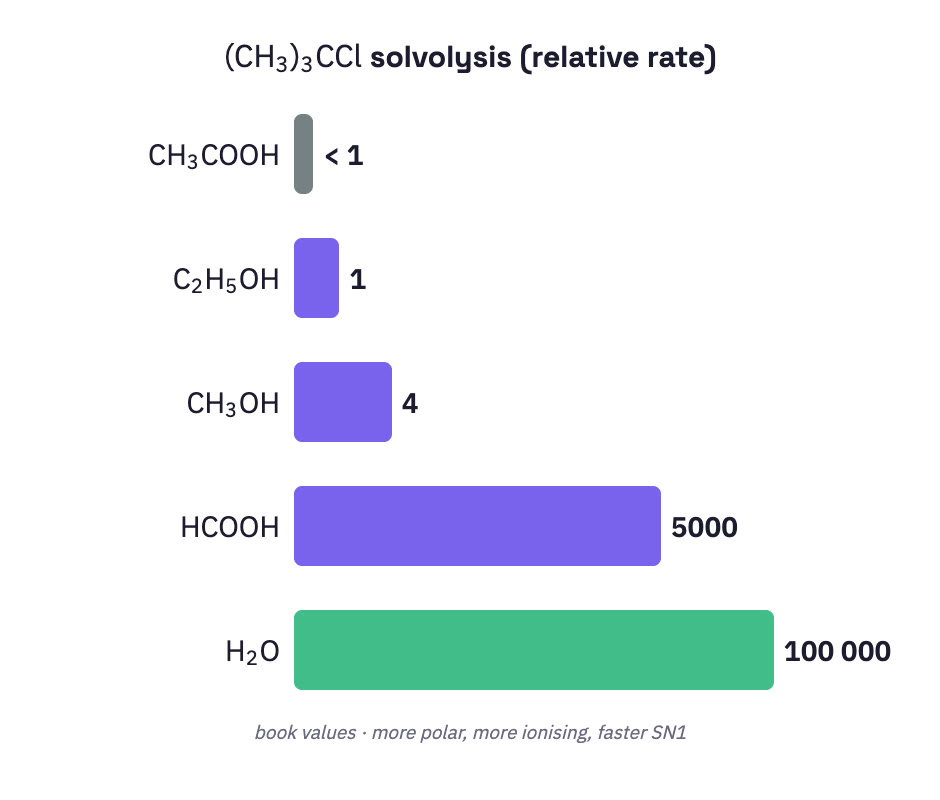
Solvolysis of : < 1, 1, 4, 5000, 100 000. Polar solvents with high dielectric constants stabilise the ions forming in the slow step.
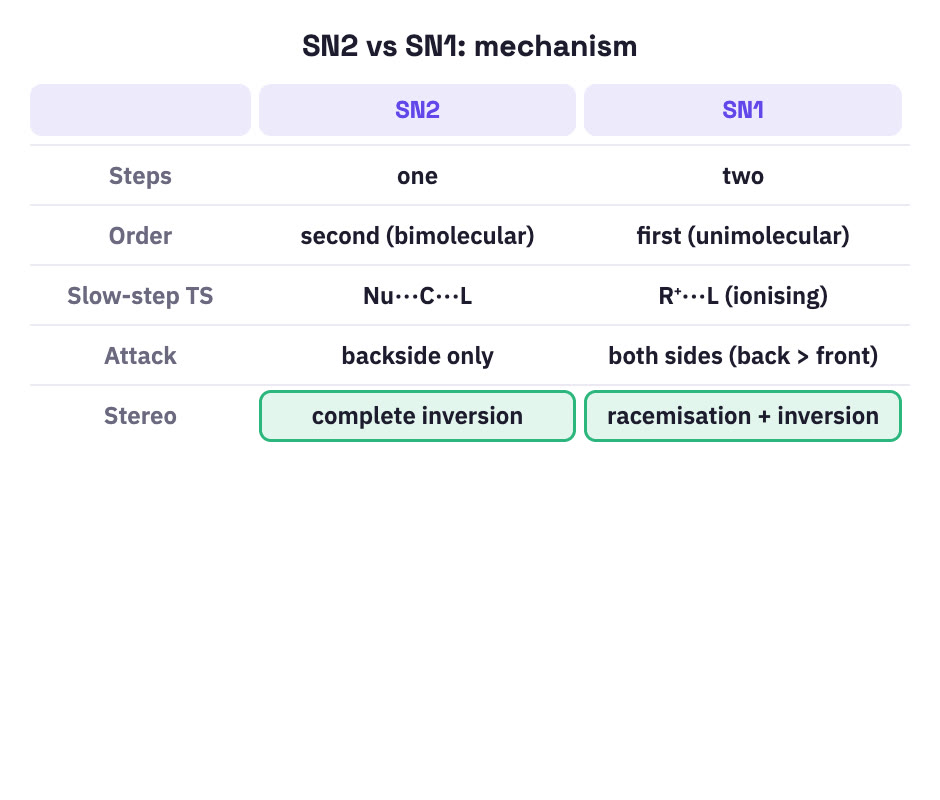
SN2 vs SN1: mechanism
Steps: one vs two. Order: second vs first. Slow-step TS: Nu···C···L vs R⁺···L. Attack: backside only vs both sides (back predominates). Stereochemistry: complete inversion vs racemisation with some inversion.
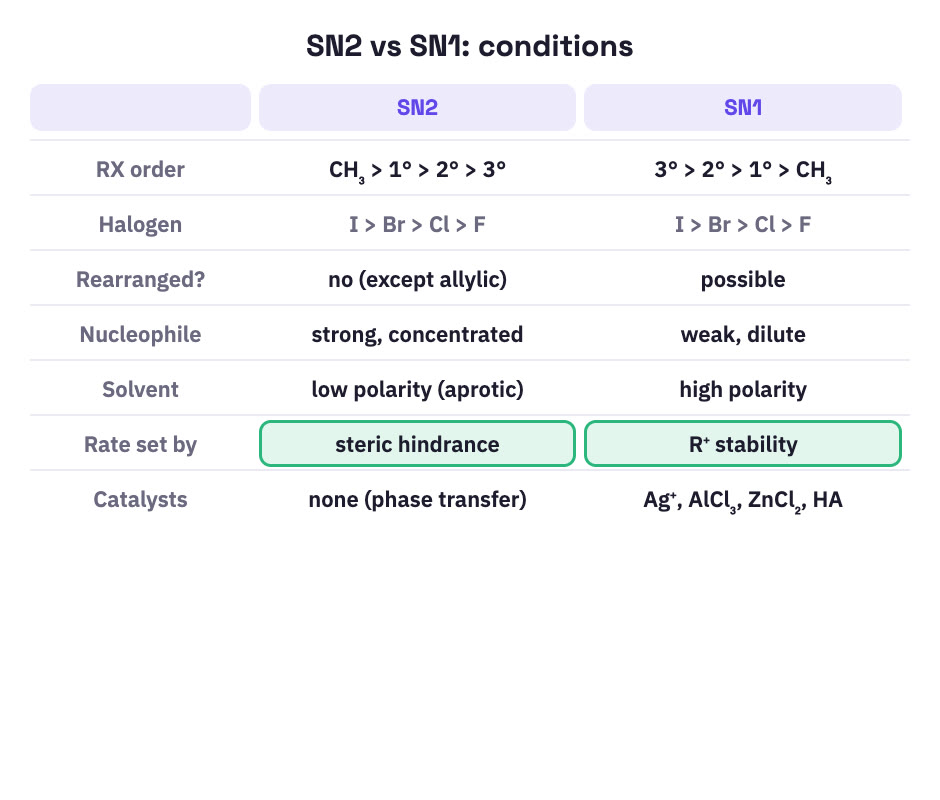
SN2 vs SN1: conditions
RX order: CH₃ > 1° > 2° > 3° vs the reverse; halogens I > Br > Cl > F in both. Rearrangement: none (except allylic) vs possible. Nucleophile: strong, concentrated vs weak, dilute. Solvent: low polarity (aprotic) vs high polarity. Rate set by steric hindrance vs cation stability. Catalysis: none (phase transfer) vs Ag⁺, AlCl₃, ZnCl₂, strong acids.
One for every idea
1. Arrange in decreasing reactivity: , , , .
- SN1 follows carbocation stability: benzyl (resonance) ≈ 3° (9 α-H) > 2° > 1°.
≈ (the book's order puts benzyl first).
2. Predict the mechanism: (a) + NaCN in DMF; (b) in aqueous formic acid; (c) + (high concentration).
- (a) 1° substrate, strong nucleophile, aprotic solvent.
- (b) 3° substrate, weak nucleophile, highly polar solvent.
- (c) 2° substrate, strong concentrated nucleophile.
(a) SN2; (b) SN1; (c) mostly SN2, with E2 competing.
Your turn
2-Chloro-2-methylpropane undergoes SN1 solvolysis fastest in:
Show the answer and the traps
Water, option d: relative rate 100 000, the most ionising of the four.
Ethanol is the slowest, rate 1.
Methanol: only 4.
Formic acid is strongly ionising, 5000, but still well behind water.
Common mistakes
Try these
1. Which gives the faster SN1 reaction: or ? Why?
: iodide is the better leaving group, and it leaves in the slow step.
2. Allyl chloride reacts by both SN1 and SN2 faster than propyl chloride. Explain.
The allyl cation (SN1) and the SN2 transition state are both stabilised by the adjacent π bond.
3. Why does speed up the SN1 reaction of an alkyl halide?
pulls off the halide (precipitating AgX), helping ionisation (Lewis acid catalysis).
4. Benzyl chloride in water vs benzyl chloride with NaCN in DMSO: which mechanism in each?
Water: SN1 (stable benzyl cation, weak Nu, polar solvent). NaCN/DMSO: SN2 (strong Nu, aprotic solvent, unhindered 1° carbon).