 layrd.liveLayer by Layer
- 1. Inductive Effect
- 2. Carboxylic Acid Strength
- 3. Alcohols, Hydrocarbons, Amines
- 4. Electromeric & Mesomeric
- 5. Hyperconjugation
- 6. Fission & Free Radicals
- 7. Carbocations
- 8. Carbanions
- 9. Carbenes
- 10. Nitrenes & Benzyne
- 11. Electrophiles & Nucleophiles
- 12. Reaction Types
- 13. Free Radical Substitution
- 14. SN2 Reaction
- 15. SN1 Reaction
- 16. SN1 vs SN2
- 17. Electrophilic Substitution
- 18. Markovnikov's Rule
- 19. Br₂ Addition & Dienes
- 20. Peroxide Effect
- 21. Nucleophilic Addition
- 22. E1, E1cB & Saytzeff
- 23. E2 Elimination
Electrophilic Substitution: SE1 and SE2 in Benzene
Electrophilic substitution (SE) replaces a group on carbon with an electrophile. In aliphatic compounds the first-order SE1 path is rare; in benzene, SE2 runs in three steps: generate a strong electrophile, let the π cloud attack it to form a resonance-stabilised arenium ion (the slow step), then lose H⁺ to restore aromaticity.
Builds on: Part 4 · Electromeric and Mesomeric (Resonance) Effects, Part 7 · Carbocations: Structure and Stability.
 Video coming soon
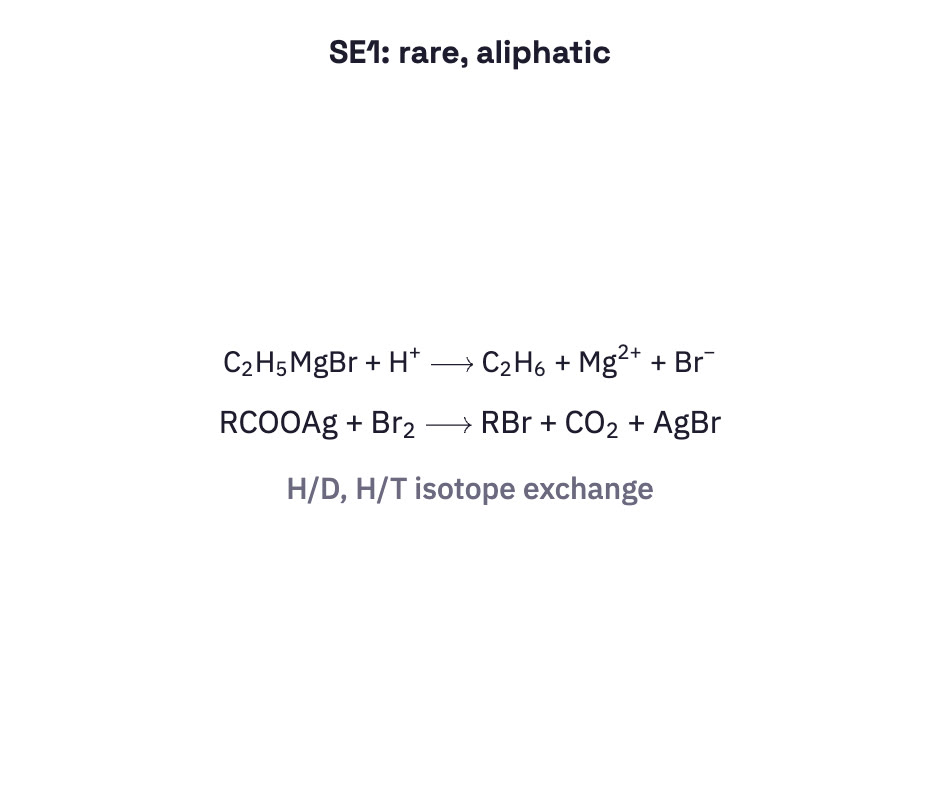
Rare, aliphatic
A metal replaced by H (), silver carboxylate + bromine (), and H/D or H/T isotope exchange.
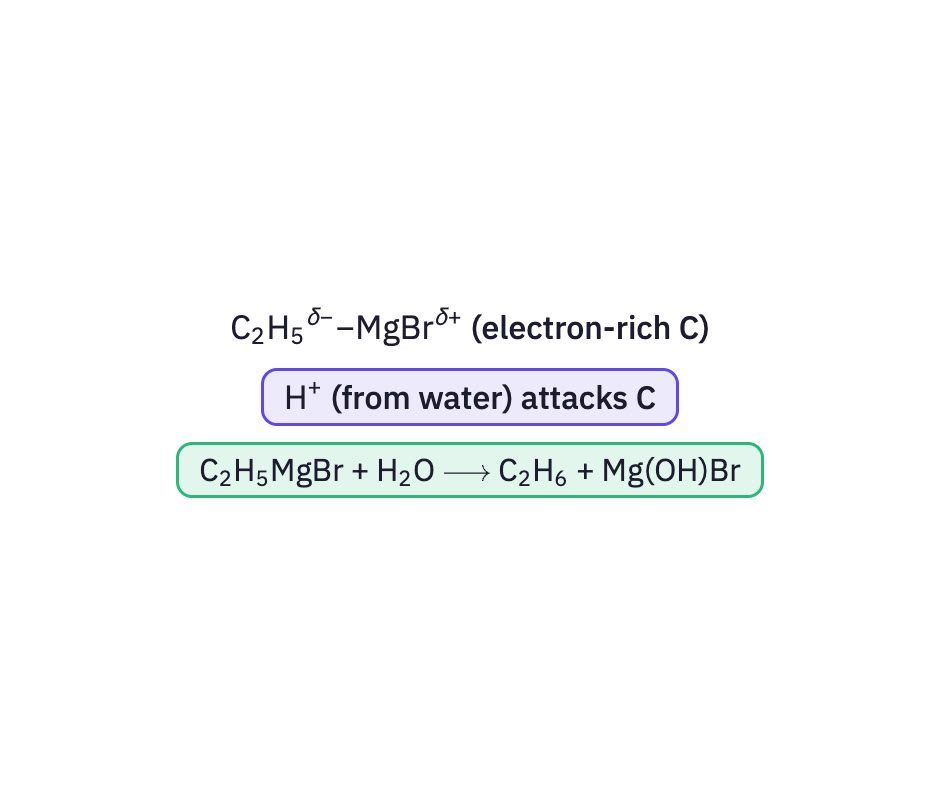
Grignard reagent + water
The carbon bonded to Mg is electron-rich; from water replaces MgBr: an aliphatic electrophilic substitution.
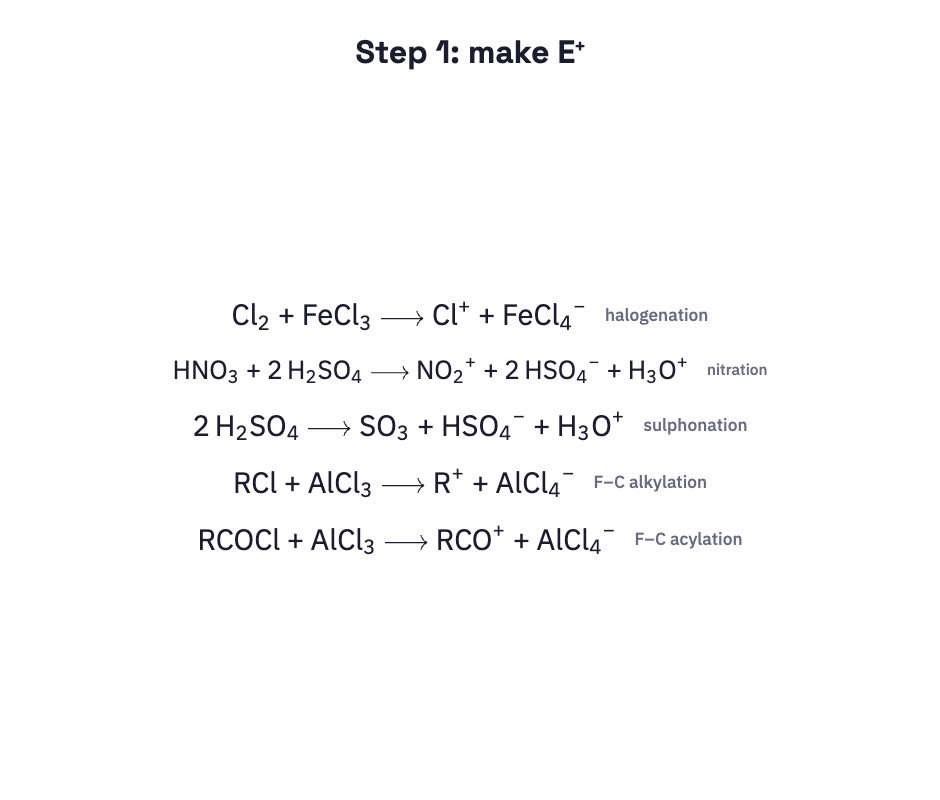
Making the electrophile
; ; ; ; .
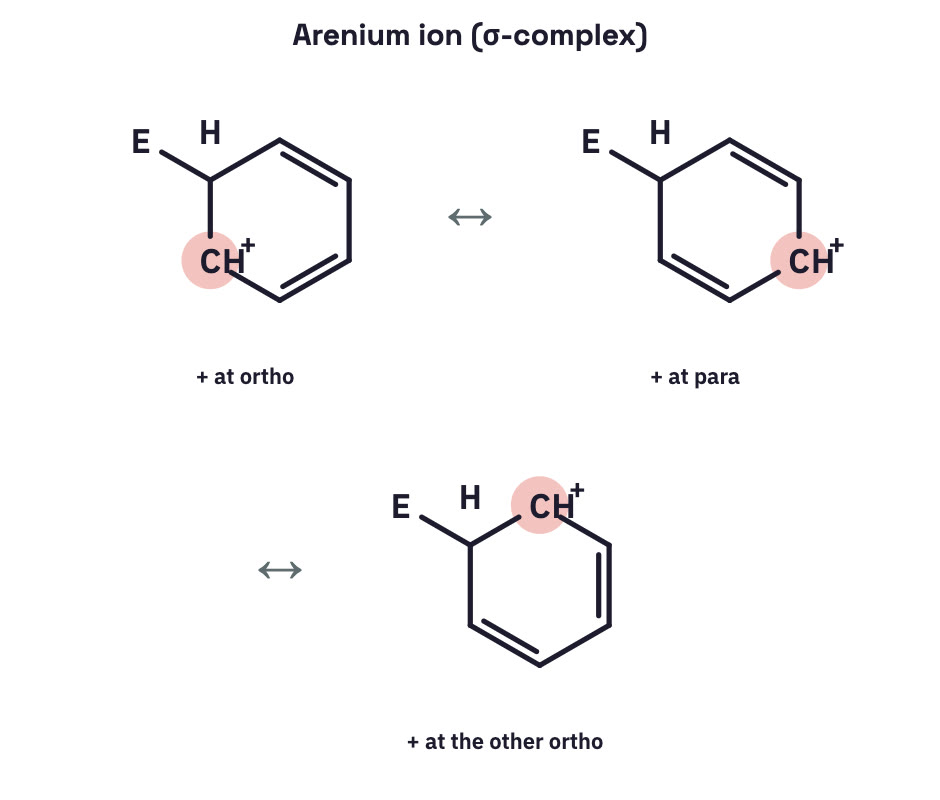
The arenium ion
The electrophile bonds to one ring carbon, which becomes sp³ (bearing H and E); the positive charge is shared by the two ortho carbons and the para carbon. This σ-complex is the Wheland intermediate.
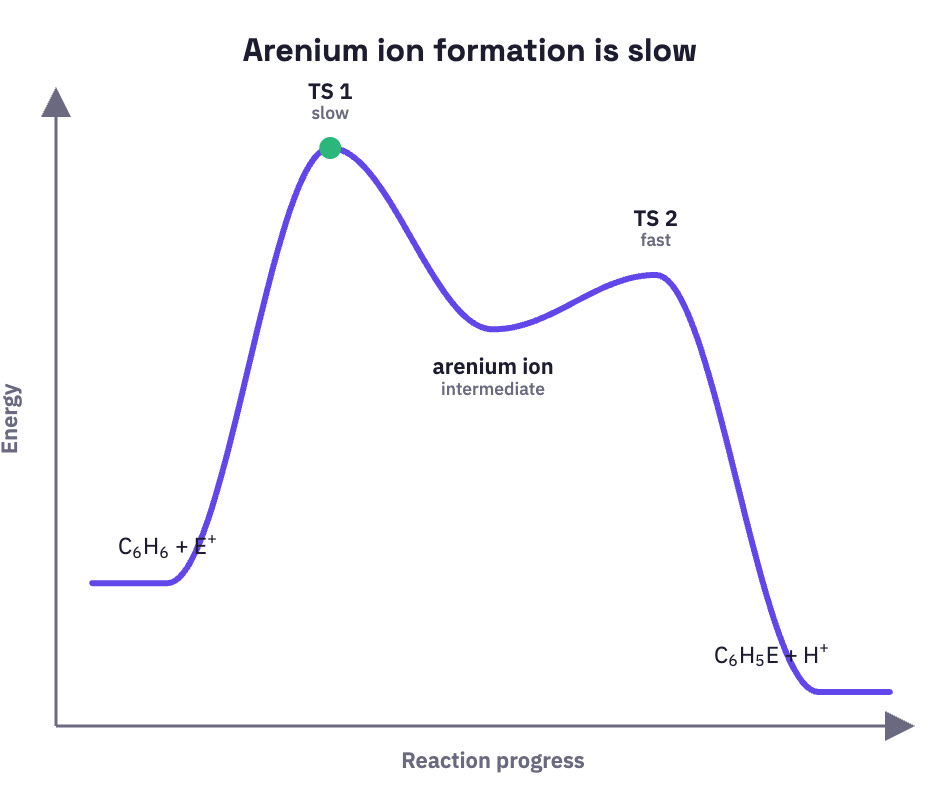
The slow step
Forming the arenium ion breaks aromaticity, so the first hump is the high, rate-determining one; loss of (with the catalyst regenerated, e.g. ) is fast.
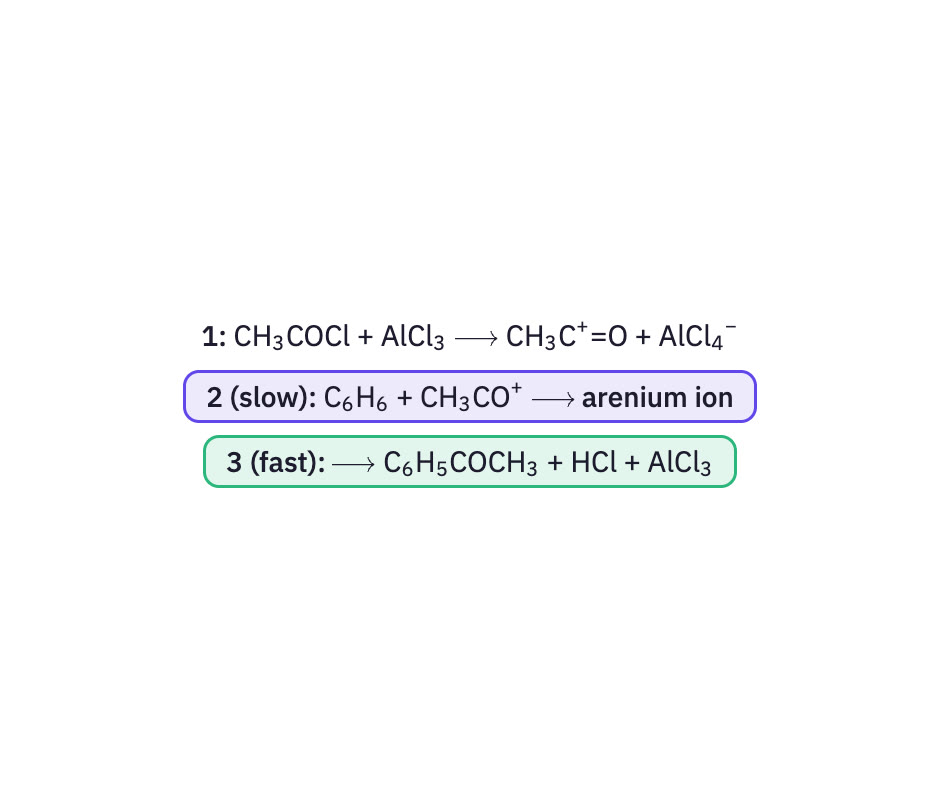
Friedel–Crafts acylation
(1) ; (2) slow attack giving the arenium ion; (3) removes : .
One for every idea
1. In , what replaces what on carbon, and what kind of reagent attacks?
- The C–Mg carbon is electron-rich.
- from water, an electrophile, replaces MgBr.
An aliphatic electrophilic substitution ().
2. Write the three steps for the Friedel–Crafts acylation of benzene with acetyl chloride and .
- .
- Slow: the π system attacks , giving a resonance-stabilised arenium ion.
- Fast: removes .
.
Your turn
The rate-determining step in the nitration of benzene is:
Show the answer and the traps
Attack of NO₂⁺ on the ring to form the arenium ion, option b: it breaks the aromatic sextet.
Forming NO₂⁺ is a fast acid–base step.
Losing H⁺ is fast: it restores aromaticity.
And protonating HNO₃ is a fast pre-equilibrium.
Common mistakes
Try these
1. In the nitration of benzene, the attacking electrophile is: (a) (b) (c) (d)
(c) the nitronium ion.
2. Why is needed for the bromination of benzene but not of ethene?
Benzene's aromatic π system is less reactive; polarises to give a strong electrophile ().
3. How many resonance forms does the arenium ion have, and where is the positive charge?
Three; on the two carbons ortho and the carbon para to the sp³ carbon.