 layrd.liveLayer by Layer
- 1. Inductive Effect
- 2. Carboxylic Acid Strength
- 3. Alcohols, Hydrocarbons, Amines
- 4. Electromeric & Mesomeric
- 5. Hyperconjugation
- 6. Fission & Free Radicals
- 7. Carbocations
- 8. Carbanions
- 9. Carbenes
- 10. Nitrenes & Benzyne
- 11. Electrophiles & Nucleophiles
- 12. Reaction Types
- 13. Free Radical Substitution
- 14. SN2 Reaction
- 15. SN1 Reaction
- 16. SN1 vs SN2
- 17. Electrophilic Substitution
- 18. Markovnikov's Rule
- 19. Br₂ Addition & Dienes
- 20. Peroxide Effect
- 21. Nucleophilic Addition
- 22. E1, E1cB & Saytzeff
- 23. E2 Elimination
E1 and E1cB Eliminations: Saytzeff vs Hofmann
Elimination removes two groups from neighbouring carbons and forms a C=C. Which bond breaks first decides the mechanism. In E1 the C–X bond ionises first to a carbocation, which then loses a β-H, so E1 competes with SN1. In E1cB the β-H goes first, leaving a carbanion that then expels a poor leaving group. Base-induced eliminations usually give the more substituted (Saytzeff) alkene, but a bulky base gives the Hofmann alkene. Alcohols dehydrate with acid by E1.
Builds on: Part 5 · Hyperconjugation and the Baker–Nathan Effect, Part 15 · SN1 Reaction: Carbocations, Racemisation and Rearrangement.
 Video coming soon
One cation, two exits
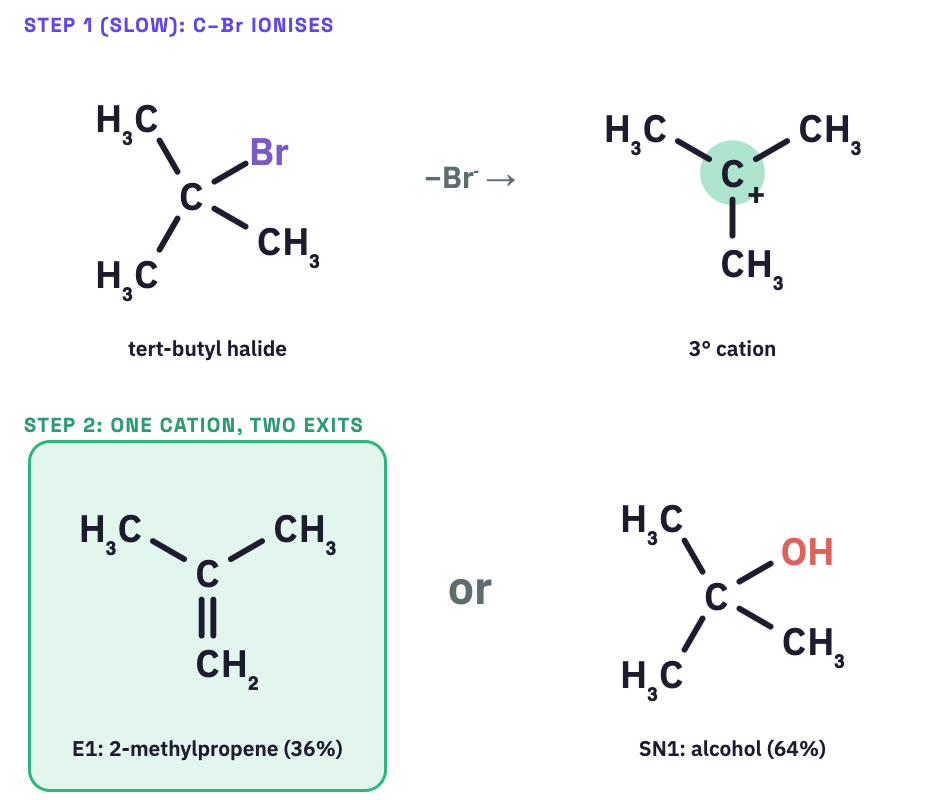
Step 1 (slow): the C–X bond ionises to a carbocation. Step 2 (fast): a base removes a β-H (E1), or a nucleophile captures the cation (). tert-Butyl chloride in aqueous ethanol at 65 °C: 64 % 2-methylpropan-2-ol, 36 % 2-methylpropene. The ratio is the same for Cl, Br and I. Reactivity: 3° > 2° > 1°.
Saytzeff vs Hofmann
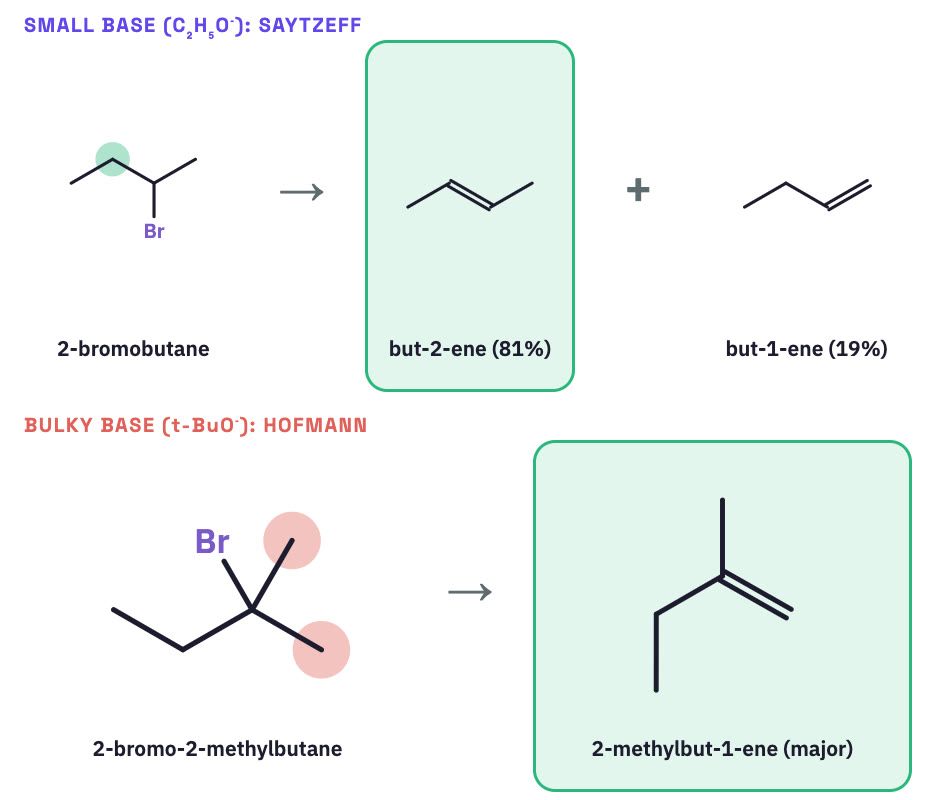
Saytzeff: the more substituted, more stable alkene is the main product. 2-Bromobutane + : but-2-ene 81 %, but-1-ene 19 %. 2-Bromo-2-methylbutane: 70 % 2-methylbut-2-ene, 30 % 2-methylbut-1-ene. A bulky base (KO-t-Bu) takes the less hindered terminal H and gives the Hofmann alkene. Leaving groups: I⁻ > Br⁻ > Cl⁻ > F⁻.
One substrate, two bases
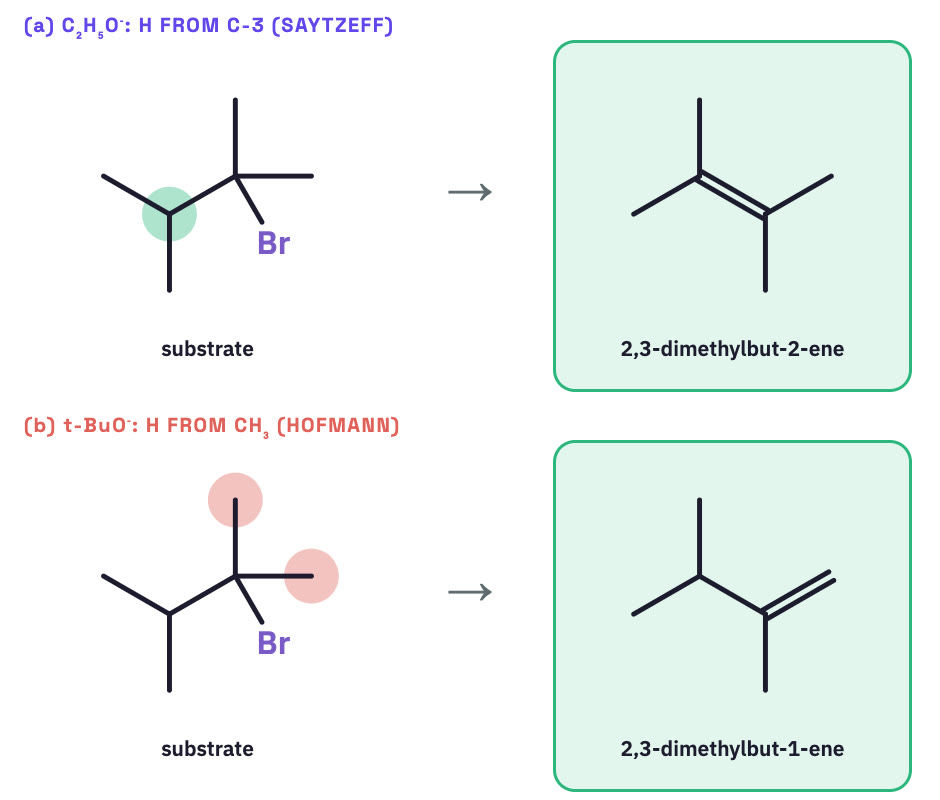
2-Bromo-2,3-dimethylbutane: sodium ethoxide removes H from C-3 to give 2,3-dimethylbut-2-ene (Saytzeff); potassium tert-butoxide removes a hydrogen to give 2,3-dimethylbut-1-ene (Hofmann).
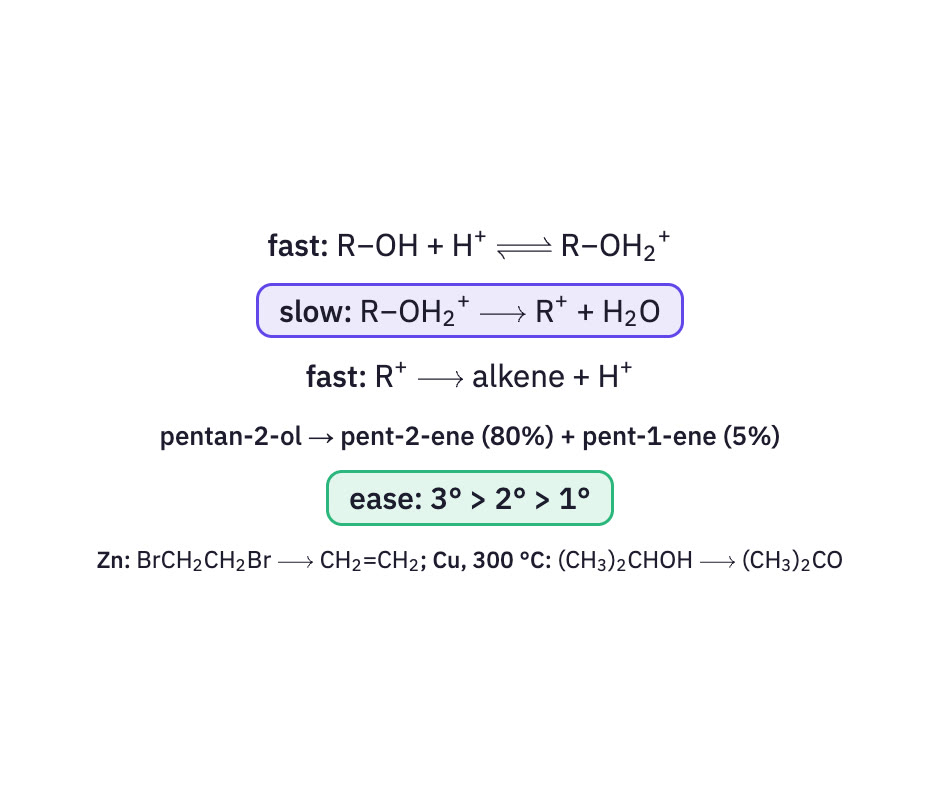
Alcohols lose water by E1
(fast); (slow); . Ethanol (170 °C) → ethene; pentan-2-ol → pent-2-ene (80 %) + pent-1-ene (5 %). Ease: 3° > 2° > 1° (1° by E2). Alcohols that give conjugated alkenes dehydrate faster. Dehalogenation ( + Zn → ethene) and dehydrogenation (isopropyl alcohol over Cu, 300 °C → acetone) are other eliminations.
Carbanion first
When the β-H is strongly acidic and the leaving group is poor, the base removes the H first (fast, reversible), giving the conjugate-base carbanion; losing the leaving group is the slow second step.
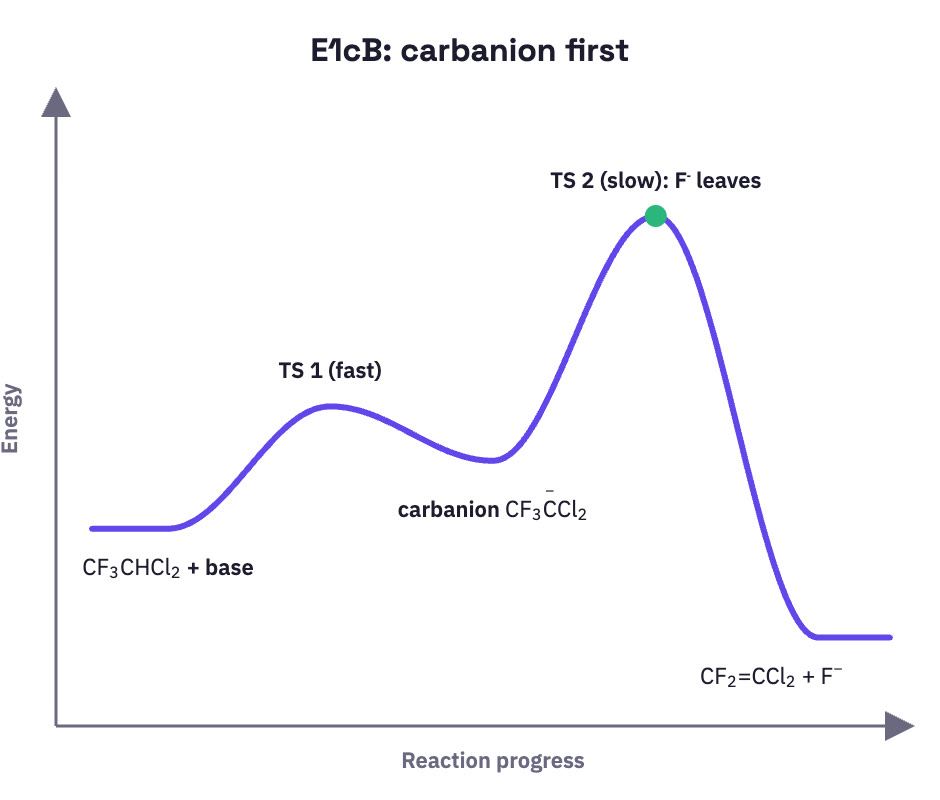
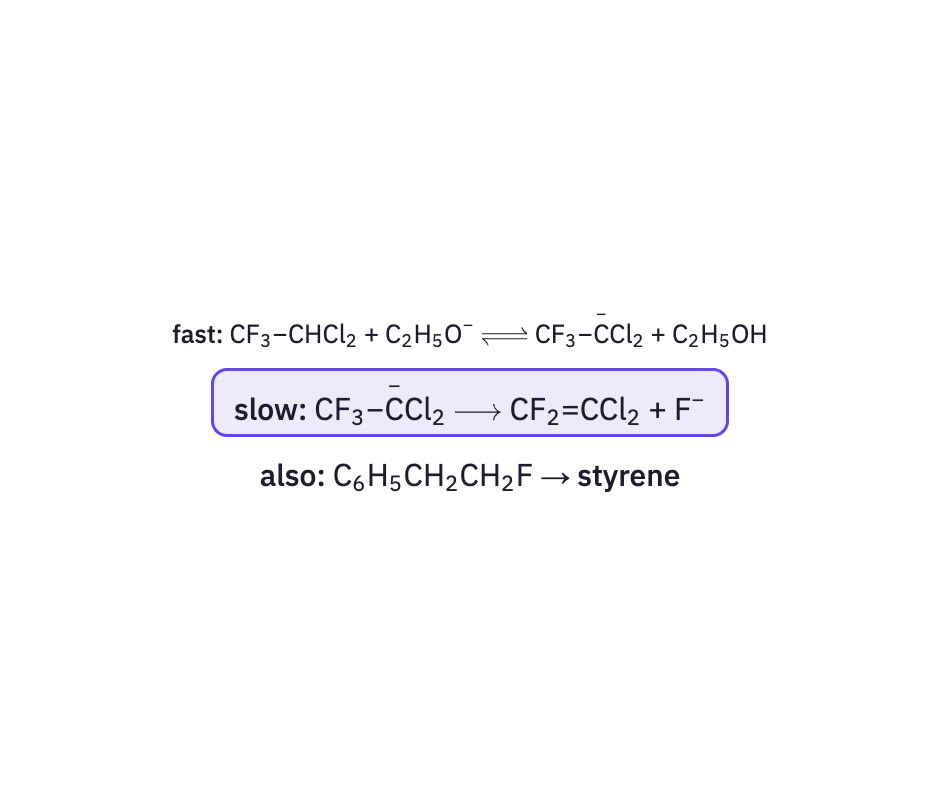
CF₃CHCl₂ + ethoxide
(fast); (slow). The −I of and the two Cl stabilise the carbanion. Also: → styrene; β-nitro esters with ethoxide.
One for every idea
1. 2-Bromo-2-methylbutane is warmed in ethanol. Name the two alkenes possible by E1, and the substitution product that competes.
- The 3° cation forms.
- Losing H from C-3 gives 2-methylbut-2-ene (more substituted, major); losing H from gives 2-methylbut-1-ene.
- Ethanol capturing the cation gives 2-ethoxy-2-methylbutane ().
2-Methylbut-2-ene (major) and 2-methylbut-1-ene; 2-ethoxy-2-methylbutane competes.
2. 2-Bromo-2,3-dimethylbutane is treated with (a) sodium ethoxide and (b) potassium tert-butoxide. Give the major alkene in each case.
- (a) The small base removes H from C-3: tetrasubstituted alkene (Saytzeff).
- (b) The bulky base removes a hydrogen (Hofmann).
(a) 2,3-Dimethylbut-2-ene; (b) 2,3-dimethylbut-1-ene.
3. Arrange in decreasing ease of acid dehydration: 2-methylpropan-2-ol, propan-1-ol, propan-2-ol. Give the major alkene from 2-methylbutan-2-ol.
- Ease follows carbocation stability: 3° > 2° > 1°.
- 2-Methylbutan-2-ol gives the 3° cation, which loses H from C-3.
2-Methylpropan-2-ol > propan-2-ol > propan-1-ol; 2-methylbut-2-ene (Saytzeff).
4. In CF₃CHCl₂ + EtO⁻, why does the reaction go by E1cB and not E2?
- The H on is very acidic (−I of and two Cl), so a stable carbanion forms first.
- The leaving group is F⁻, a poor one, so its loss is the slow second step.
Carbanion first, slow loss of a poor leaving group: the E1cB pattern.
Your turn
2-Bromo-2-methylbutane is heated with potassium tert-butoxide. The main product is:
Show the answer and the traps
2-Methylbut-1-ene, option b: the bulky base takes a terminal CH₃ hydrogen, the Hofmann product.
2-Methylbut-2-ene is the Saytzeff product, from a small base like ethoxide.
The alcohol needs water, and tert-butoxide is too bulky to substitute at a 3° carbon.
Common mistakes
Try these
1. Dehydration of pentan-2-ol with conc. H₂SO₄ gives mainly: (a) pent-1-ene (b) pent-2-ene (c) 2-methylbut-2-ene (d) pentane
(b) Pent-2-ene (80 %): the more substituted alkene (Saytzeff).
2. Why is the ratio of SN1 to E1 products from tert-butyl chloride, bromide and iodide the same?
All three give the same tert-butyl cation; the leaving group is gone before substitution or elimination is decided.
3. Which dehydrates faster with acid: butan-2-ol or but-3-en-2-ol? Why?
But-3-en-2-ol: it gives a conjugated diene (and an allylic cation).
4. Neopentyl alcohol is heated with conc. H₂SO₄. Give the main alkene.
2-Methylbut-2-ene: the 1° cation rearranges by a methyl shift to the 3° tert-amyl cation, which loses H⁺ (Saytzeff).